A claim you hear on longevity podcasts

Do SGLT2 inhibitors help heart failure?

Strong consensus for. Of 10 studies that test it, 9 agree and 1 partly agrees.

Best for:
Anyone with heart failure, or caring for someone who has it
Price:
Free to read, with every receipt. Pro is $9 a month or $79 a year and adds AI Ask.

The claim checked: SGLT2 inhibitors are among the best new drugs for heart failure Hear it at 1:37:28

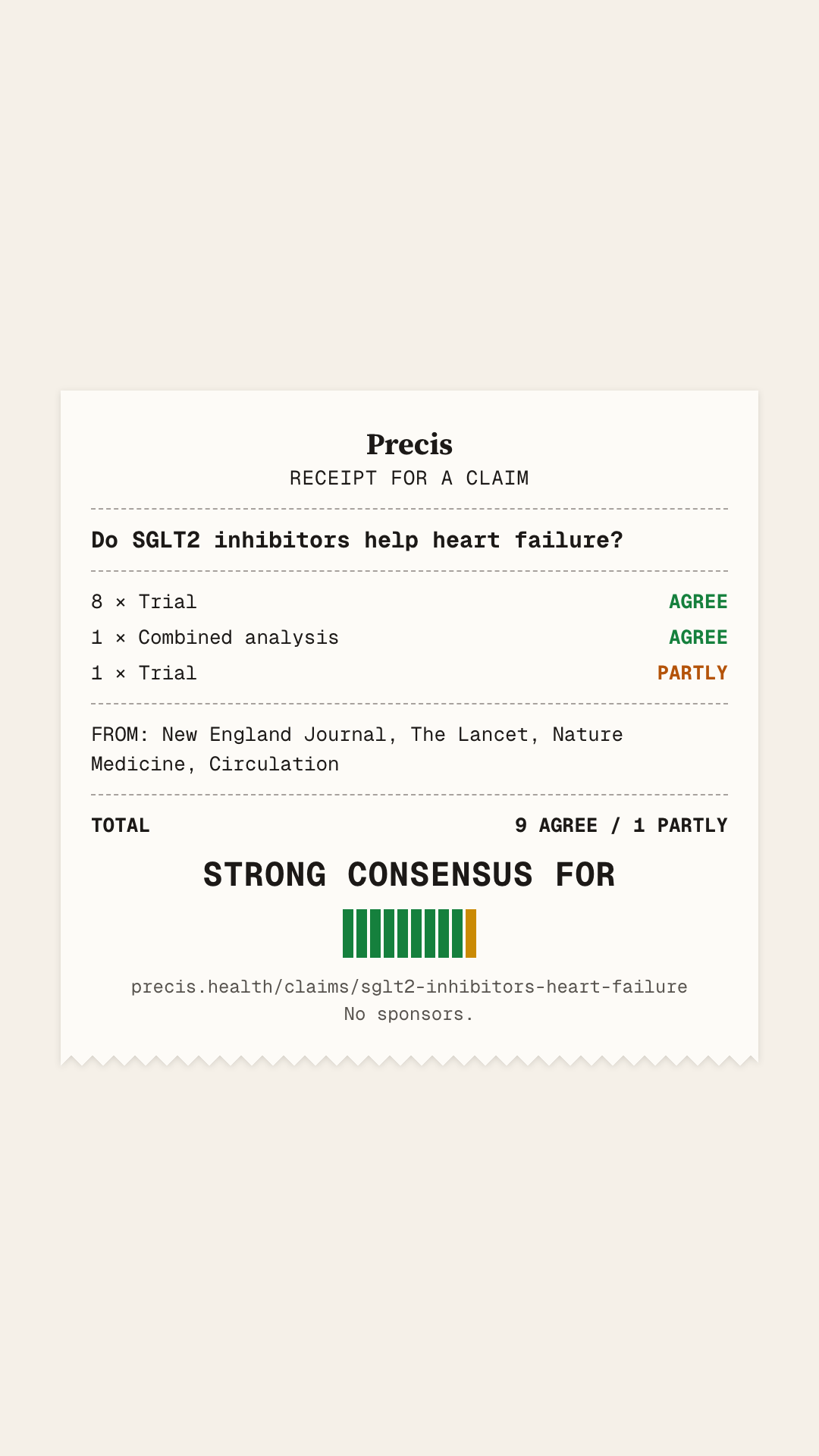
PrecisRECEIPT FOR A CLAIM


Do SGLT2 inhibitors help heart failure?


  • 8 × TrialAGREE
  • 1 × Combined analysisAGREE
  • 1 × TrialPARTLY

FROM: New England Journal, The Lancet, Nature Medicine, Circulation


TOTAL9 AGREE / 1 PARTLY

Strong consensus for

What do the studies say?

Strong consensus for

9 of 10 studies agree, and none disagree. In large trials, dapagliflozin and empagliflozin lowered the risk of heart failure getting worse or of death from heart causes, whether the heart's pumping was weak or close to normal. A pooled analysis of 21,947 patients across that range confirmed it. In a small trial of people in hospital with sudden heart failure, the drug did not ease breathlessness or shorten the stay, though it was safe. SGLT2 inhibitors are diabetes drugs that make the kidneys pass sugar into the urine.

Computed from 10 studies that test this point, each judged by two readers, in full. 1 more study is waiting for a full read and does not count yet.

What was said on the podcast?

“So you pee out, you know, they call it sweet pee, right? The urine, you just pee out the glucose uh into the urine and that somehow is communicating to the heart and telling it, you know, a failed heart that you're you're good to go.”
Nav Chandel, a guest on The Drive · 416 ‒ The science of mitochondria: their role in health, aging, disease, and much more · 1:37:28 on YouTube
Episode check NAD boosters won't slow aging, the episode says. Of 10 studies, 2 agree, 1 disagrees and 7 partly agree. 6 claims checked against 59 studies · 22 chapters not checked yet See the whole episode →
The point checked Strong consensus for

SGLT2 inhibitors help people with heart failure

Agree 9

controlled trial · 2019 · landmark

“Among patients with heart failure and a reduced ejection fraction, the risk of worsening heart failure or death from cardiovascular causes was lower among those who received dapagliflozin than among those who received placebo, regardless of the presence or absence of diabetes.”

Dapagliflozin in Patients with Heart Failure and Reduced Ejection Fraction. N Engl J Med
Who: Adults with NYHA class II-IV heart failure and ejection fraction 40% or less, elevated NT-proBNP, on recommended therapy, with or without type 2 diabetes; mean age about 66
PMID 31535829

controlled trial · 2020 · landmark

“Among patients receiving recommended therapy for heart failure, those in the empagliflozin group had a lower risk of cardiovascular death or hospitalization for heart failure than those in the placebo group, regardless of the presence or absence of diabetes.”

Cardiovascular and Renal Outcomes with Empagliflozin in Heart Failure. N Engl J Med
Who: Adults with chronic NYHA class II-IV heart failure and ejection fraction 40% or less (enriched for markedly reduced EF and high NT-proBNP), on recommended therapy, with or without diabetes; mean age about 67
PMID 32865377

controlled trial · 2021 · landmark

“Empagliflozin reduced the combined risk of cardiovascular death or hospitalization for heart failure in patients with heart failure and a preserved ejection fraction, regardless of the presence or absence of diabetes.”

Empagliflozin in Heart Failure with a Preserved Ejection Fraction. N Engl J Med
Who: Adults with NYHA class II-IV chronic heart failure, ejection fraction above 40% and elevated NT-proBNP, with or without diabetes; median ejection fraction 54%
PMID 34449189

controlled trial · 2022 · landmark

“Dapagliflozin reduced the combined risk of worsening heart failure or cardiovascular death among patients with heart failure and a mildly reduced or preserved ejection fraction.”

Dapagliflozin in Heart Failure with Mildly Reduced or Preserved Ejection Fraction. N Engl J Med
Who: Adults aged 40 or older with stabilized heart failure and ejection fraction above 40%, structural heart disease and elevated natriuretic peptides, with or without type 2 diabetes, enrolled as outpatients or during or after hospitalization
PMID 36027570

Show 5 more Show fewer

controlled trial · 2021 · landmark

“In patients with diabetes and recent worsening heart failure, sotagliflozin therapy, initiated before or shortly after discharge, resulted in a significantly lower total number of deaths from cardiovascular causes and hospitalizations and urgent visits for heart failure than placebo.”

Sotagliflozin in Patients with Diabetes and Recent Worsening Heart Failure. N Engl J Med
Who: Adults aged 18-85 with type 2 diabetes recently hospitalized for worsening heart failure treated with intravenous diuretics, clinically stable, with elevated natriuretic peptides, reduced or preserved ejection fraction
PMID 33200892

controlled trial · 2022 · landmark

“Initiation of the SGLT2 inhibitor empagliflozin in patients hospitalized for acute heart failure resulted in a statistically significant and clinically meaningful benefit in the 90 days after randomization.”

The SGLT2 inhibitor empagliflozin in patients hospitalized for acute heart failure: a multinational randomized trial. Nat Med
Who: Adults hospitalized for acute de novo or decompensated chronic heart failure, stabilized and randomized 1-5 days after admission, any ejection fraction, with or without diabetes; median age 71
PMID 35228754

pooled analysis · 2022 · landmark

“This meta-analysis of 21,947 patients with HF across the full spectrum of ejection fraction, including both outpatients and hospitalized patients, confirms that SGLT2i significantly reduce the risk of mortality and worsening HF and improve patient symptoms and overall health status when added to standard therapy for HF.”

SGLT-2 inhibitors in patients with heart failure: a comprehensive meta-analysis of five randomised controlled trials. Lancet
Who: Patients with heart failure across the full ejection-fraction range, outpatients and those hospitalized for worsening heart failure, from DELIVER, EMPEROR-Preserved, DAPA-HF, EMPEROR-Reduced and SOLOIST-WHF
PMID 36041474

controlled trial · 2021 · landmark

“In conclusion, in patients with heart failure and a reduced ejection fraction, empagliflozin reduced the risk of inpatient and outpatient worsening heart failure events, benefits that were seen within 12 to 28 days of initiation of treatment and were sustained for the duration of double-blind therapy.”

Effect of Empagliflozin on the Clinical Stability of Patients With Heart Failure and a Reduced Ejection Fraction: The EMPEROR-Reduced Trial. Circulation
Who: EMPEROR-Reduced participants: adults with chronic NYHA class II-IV heart failure and ejection fraction 40% or less (enriched for 30% or less), on appropriate heart-failure therapy, with or without diabetes
PMID 33081531

controlled trial · 2020 · landmark

“In the DAPA-HF trial, treatment with dapagliflozin reduced death and HF hospitalizations across the range of baseline KCCQ values, and improved symptom burden, functional status, and quality of life in patients with HFrEF.”

Effects of Dapagliflozin on Symptoms, Function, and Quality of Life in Patients With Heart Failure and Reduced Ejection Fraction: Results From the DAPA-HF Trial. Circulation
Who: DAPA-HF participants: adults with NYHA class II or higher heart failure, ejection fraction 40% or less, elevated NT-proBNP, optimally treated; 4443 with baseline KCCQ data
PMID 31736335
Partly agree 1

controlled trial · 2020 · landmark

“In patients with acute HF, treatment with empagliflozin had no effect on change in VAS dyspnoea, diuretic response, NT-proBNP, and length of hospital stay, but was safe, increased urinary output and reduced a combined endpoint of worsening HF, rehospitalization for HF or death at 60 days.”

Randomized, double-blind, placebo-controlled, multicentre pilot study on the effects of empagliflozin on clinical outcomes in patients with acute decompensated heart failure (EMPA-RESPONSE-AHF). Eur J Heart Fail
Who: Adults hospitalized for acute decompensated heart failure at five Dutch centres, with or without type 2 diabetes, randomized within 24 hours of presentation; mean age 76, 47% de novo heart failure
PMID 31912605

Disagree 0· none of the studies we read

More on supplements and drugs

The Precis Weekly

Get each new check by email.

One email a week with the claims and episodes we checked, what the studies found and the minute each claim was said.

Free. Unsubscribe anytime.