A claim you hear on longevity podcasts

Are antioxidant supplements useless, and sometimes harmful?

Strong consensus for. Of 10 studies that test it, 8 agree and 2 partly agree.

Best for:
Anyone taking antioxidant supplements on top of a healthy diet
Price:
Free to read, with every receipt. Pro is $9 a month or $79 a year and adds AI Ask.

The claim checked: If you eat a healthy diet, extra antioxidants do nothing, and some trials found they made cancer worse Hear it at 17:23

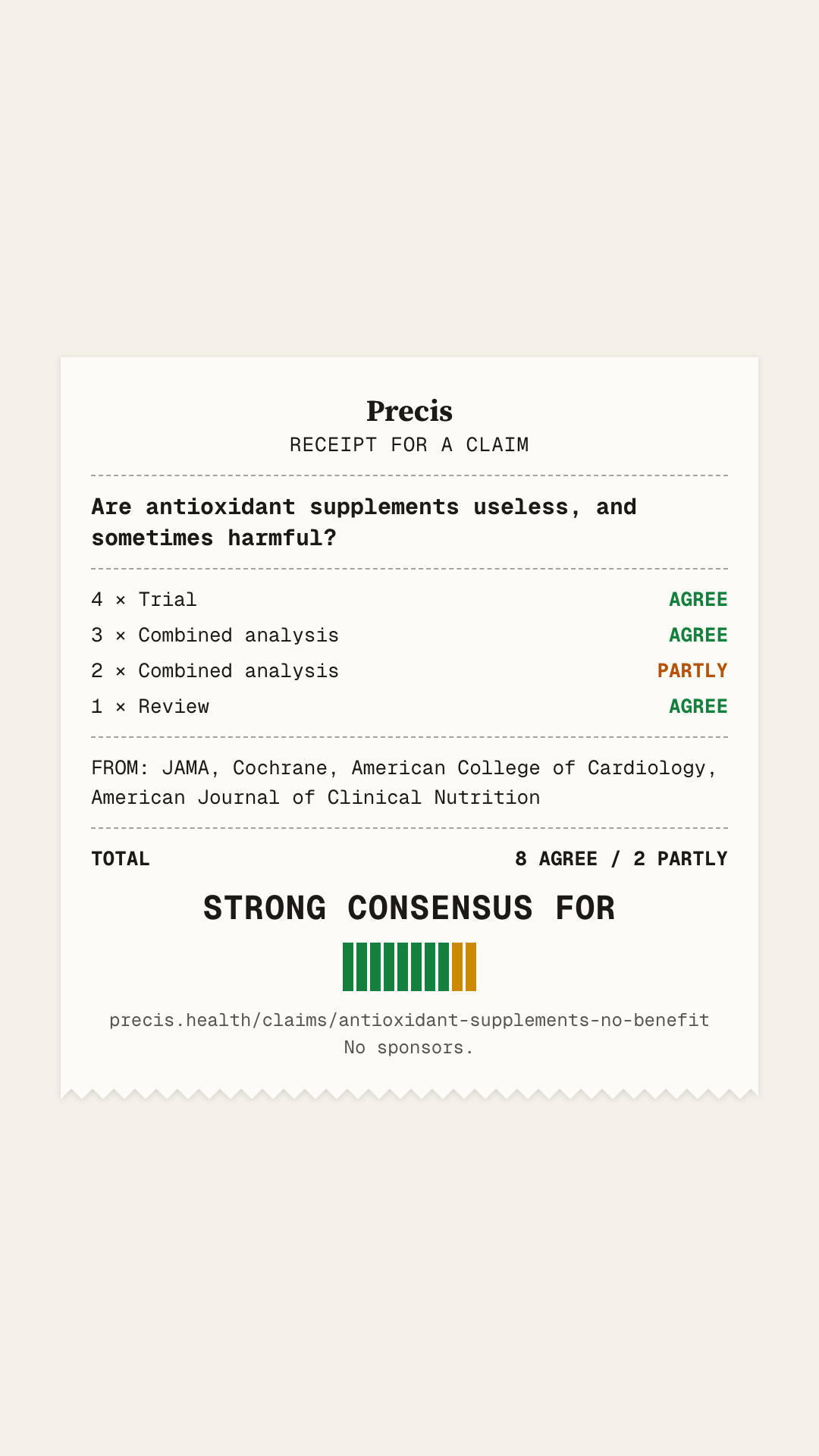
PrecisRECEIPT FOR A CLAIM


Are antioxidant supplements useless, and sometimes harmful?


  • 4 × TrialAGREE
  • 3 × Combined analysisAGREE
  • 2 × Combined analysisPARTLY
  • 1 × ReviewAGREE

FROM: JAMA, Cochrane, American College of Cardiology, American Journal of Clinical Nutrition


TOTAL8 AGREE / 2 PARTLY

Strong consensus for

What do the studies say?

Strong consensus for

8 of 10 studies agree, and none disagree. In 14,641 male doctors aged 50 or older, neither vitamin E nor vitamin C lowered the risk of heart attacks and strokes, or of cancer. A review of 84 studies found most vitamin and mineral pills do not protect healthy adults from heart disease, cancer or early death. Of 2 pooled analyses that partly agree, the first tied vitamin E to a 12% drop in heart deaths, and the second found mixtures with selenium seemed to help healthy people. Several large early trials could not be read in full and are listed as waiting.

Computed from 10 studies that test this point, each judged by two readers, in full. 10 more studies are waiting for a full read and do not count yet.

What was said on the podcast?

“generally if you're eating a healthy diet I think it's it's the A the other part is that people who are taking gobs of it might be interfering with the normal function.”
Nav Chandel, a guest on The Drive · 416 ‒ The science of mitochondria: their role in health, aging, disease, and much more · 17:23 on YouTube
Episode check NAD boosters won't slow aging, the episode says. Of 10 studies, 2 agree, 1 disagrees and 7 partly agree. 6 claims checked against 59 studies · 22 chapters not checked yet See the whole episode →
Point 1 of 2 Strong consensus for

For people eating a normal diet, antioxidant supplements give no health benefit

Agree 8

controlled trial · 2008 · landmark

“In this large, long-term trial of male physicians, neither vitamin E nor C supplementation reduced the risk of major cardiovascular events.”

Vitamins E and C in the prevention of cardiovascular disease in men: the Physicians' Health Study II randomized controlled trial. JAMA
Who: 14,641 US male physicians aged 50 years or older (mean age 64.3), 754 (5.1%) with prevalent CVD at randomization
PMID 18997197

pooled analysis · 2018 · landmark

“Antioxidant mixtures did not appear to benefit CVD but might increase all-cause mortality.”

Supplemental Vitamins and Minerals for CVD Prevention and Treatment. J Am Coll Cardiol
Who: RCTs of vitamin and mineral supplements in adults, from meta-analyses and searches January 2012 to October 2017 plus the studies in the 2013 USPSTF review; outcomes CVD and all-cause mortality
PMID 29852980

systematic review · 2022 · landmark

“The findings from 84 RCTs and 6 cohort studies suggest that most vitamin and mineral supplements provide no clinically important protective effects for CVD, cancer, or all-cause mortality in healthy adults without known nutritional deficiencies.”

Vitamin and Mineral Supplements for the Primary Prevention of Cardiovascular Disease and Cancer: Updated Evidence Report and Systematic Review for the US Preventive Services Task Force. JAMA
Who: community-dwelling adults aged 18 or older without CVD, cancer, chronic disease or known vitamin/mineral deficiencies (mean age 61.0, 65.1% women), in countries rated very high on the Human Development Index
PMID 35727272

pooled analysis · 2013

“In conclusion, the findings of our study indicated that antioxidant vitamin supplementation had no significant effects on major cardiovascular events, myocardial infarction, stroke, total death, cardiac death, and any possible cardiac-related events.”

Effect of antioxidant vitamin supplementation on cardiovascular outcomes: a meta-analysis of randomized controlled trials. PLoS One
Who: placebo-controlled RCTs of antioxidant vitamins (vitamin E, beta-carotene, vitamin C, alone or combined) in adults; 8 trials in people without high cardiovascular risk and 7 in people with high CV risk or prior CVD
PMID 23437244

Show 4 more Show fewer

pooled analysis · 2013

“The limited trial evidence to date synthesised in this review does not support the use of selenium supplements in the primary prevention of cardiovascular disease.”

Selenium supplementation for the primary prevention of cardiovascular disease. Cochrane Database Syst Rev
Who: adults from the general population and at high risk of CVD; mostly men from the selenium-replete US (SELECT and NPC), with over 96% of participants from US-based studies
PMID 23440843

controlled trial · 2009 · landmark

“In this trial, neither 200 µg of selenomethionine or 400 IU of synthetic DL of alpha-tocopherol, given orally alone or combined for a median of 5.5 years had significant effects on the primary or secondary endpoints.”

Effect of selenium and vitamin E on risk of prostate cancer and other cancers: the Selenium and Vitamin E Cancer Prevention Trial (SELECT). JAMA
Who: 35,533 relatively healthy men aged 50+ (African American) or 55+ (others) with PSA <=4 ng/mL and a non-suspicious DRE, in the US, Canada and Puerto Rico; described as well-nourished at baseline
PMID 19066370

controlled trial · 2011 · landmark

“The lack of benefit from dietary supplementation with vitamin E or other agents with respect to preventing common health conditions and cancers or improving overall survival, and their potential harm, underscore the need for consumers to be skeptical of health claims for unregulated over-the-counter products in the absence of strong evidence of benefit from clinical trials.”

Vitamin E and the risk of prostate cancer: the Selenium and Vitamin E Cancer Prevention Trial (SELECT). JAMA
Who: Relatively healthy men aged 50+ (African American) or 55+ (all others) with PSA <=4.0 ng/mL and a non-suspicious digital rectal exam, at 427 sites in the US, Canada and Puerto Rico; supplements given on top of a normal diet
PMID 21990298

controlled trial · 2009 · landmark

“In this large-scale, randomized controlled trial among middle-aged and older men, neither long-term vitamin E nor vitamin C supplementation reduced the risk of prostate or total cancer.”

Vitamins E and C in the prevention of prostate and total cancer in men: the Physicians' Health Study II randomized controlled trial. JAMA
Who: US male physicians aged >=50 years (mean age 64.3), a well-nourished population, including 1,307 men with a prior cancer at randomization
PMID 19066368
Partly agree 2

pooled analysis · 2017

“Our meta-analysis showed a 12% reduction in cardiovascular mortality with vitamin E supplementation compared with placebo and control in primary prevention trials.”

Dietary Supplements and Risk of Cause-Specific Death, Cardiovascular Disease, and Cancer: A Systematic Review and Meta-Analysis of Primary Prevention Trials. Adv Nutr
Who: primary prevention RCTs (minimum 12 months) of dietary supplements in generally healthy adults; trial mean ages 36.8 to 69.2 (overall 58.9 years); trials with mean age 70+ or more than 75% secondary prevention excluded
PMID 28096125

pooled analysis · 2020

“Our analyses indicate a potential benefit of antioxidants with selenium in healthy trial participants, no effect in trial participants with a range of conditions or risk factors, and an increased risk of antioxidants without selenium with total mortality in smokers, as perhaps the highest risk group.”

Selenium, antioxidants, cardiovascular disease, and all-cause mortality: a systematic review and meta-analysis of randomized controlled trials. Am J Clin Nutr
Who: RCTs in human adults (excluding children, pregnant or breastfeeding women, chronic infections) of oral selenium alone or antioxidant mixtures (2 or more of vitamin A, retinol, beta-carotene, vitamins C and E, selenium, zinc, copper) vs placebo; subgroups of healthy, higher-risk and smoker populations
PMID 33053149

Disagree 0· none of the studies we read

Point 2 of 2 Leaning for

In some trials, antioxidant supplements made cancer outcomes worse

5 of 10 studies agree, 1 disagrees and 4 partly agree. In a large trial of healthy men, vitamin E raised the risk of prostate cancer. A review of selenium trials found doses around 200 µg a day raised the risk of some skin and prostate cancers. A review of trials in healthy adults found a higher risk of lung cancer. A trial of male doctors aged 50 or older found no clear sign of harm from vitamin E or C. Several large early trials of beta-carotene could not be read in full and are listed as waiting.

Computed from 10 studies that test this point, each judged by two readers, in full. 10 more studies are waiting for a full read and do not count yet.

Agree 5

controlled trial · 2011 · landmark

“Dietary supplementation with Vitamin E significantly increases the risk of prostate cancer among healthy men.”

Vitamin E and the risk of prostate cancer: the Selenium and Vitamin E Cancer Prevention Trial (SELECT). JAMA
Who: Healthy men at average prostate cancer risk aged 50+ (African American) or 55+ (all others) with PSA <=4.0 ng/mL and a non-suspicious digital rectal exam, from 427 sites in the US, Canada and Puerto Rico
PMID 21990298

pooled analysis · 2018 · landmark

“These intervention studies have suggested that selenium administration on the order of 200 µg/d increased risk of non‐melanoma skin cancer, advanced prostate cancer (in individuals with highest baseline exposure), dermatological abnormalities, and type 2 diabetes.”

Selenium for preventing cancer. Cochrane Database Syst Rev
Who: Adults in randomized trials of selenium supplements vs placebo (88% male; general-population men plus high-risk groups such as people with prior skin cancer, resected lung cancer, hepatitis B carriers and BRCA1 carriers), plus adults in longitudinal observational cohorts
PMID 29376219

systematic review · 2022 · landmark

“The most pronounced risk increase was for lung cancer, with the pooled estimate showing a statistically significantly increased risk over 3.7 to 12 years of followup (OR 1.20 [95% CI, 1.01–1.42]; 4 RCTs [n=94,830]; I2=38.8%).”

Vitamin and Mineral Supplements for the Primary Prevention of Cardiovascular Disease and Cancer: Updated Evidence Report and Systematic Review for the US Preventive Services Task Force. JAMA
Who: Community-dwelling adults without CVD, cancer or known vitamin or mineral deficiencies (mean age 61; about 65% women); beta-carotene trials included smokers and asbestos-exposed workers
PMID 35727272

other primary study · 2014

“In SELECT, supplementation with Se increased the risk of high-grade PCa among men with high Se stores at baseline, whereas supplementation with vitamin E increased the risk (primarily of high-grade cancer) among men with low Se stores at baseline.”

Baseline selenium status and effects of selenium and vitamin e supplementation on prostate cancer risk. J Natl Cancer Inst
Who: Men in the SELECT trial (aged 50+ African American or 55+ others, PSA <=4 ng/mL, non-suspicious rectal exam) with baseline toenail selenium measured; case-cohort design
PMID 24563519

Show 1 more Show fewer

pooled analysis · 2017

“Vitamin A was associated with a significant 16% increased risk of cancer incidence (RR: 1.16; 95% CI: 1.00, 1.35; I 2 = 0%).”

Dietary Supplements and Risk of Cause-Specific Death, Cardiovascular Disease, and Cancer: A Systematic Review and Meta-Analysis of Primary Prevention Trials. Adv Nutr
Who: Adults (mean age 18 or older, overall mean 58.9 years) in primary prevention RCTs of dietary supplements; secondary prevention trials, pregnant women and trials with mean age 70+ excluded
PMID 28096125

Partly agree 4

controlled trial · 2009 · landmark

“There was a statistically non-significant increase (p = 0.06; HR=1.13; 99% CI, 0.95–1.35; 95% CI, 0.99–1.29) in prostate cancer incidence in the vitamin E-alone arm (versus placebo), but not in the combination arm (p=0.52; HR=1.05; 99% CI, 0.88–1.25; 95% CI, 0.91 – 1.20).”

Effect of selenium and vitamin E on risk of prostate cancer and other cancers: the Selenium and Vitamin E Cancer Prevention Trial (SELECT). JAMA
Who: Relatively healthy men aged 50+ (African American) or 55+ (all others) in the US, Canada and Puerto Rico with PSA <=4 ng/mL and a digital rectal exam not suspicious for prostate cancer
PMID 19066370

controlled trial · 2009

“Indeed, the effect of factor D on esophageal cancer was reversed by age, showing a protective effect for younger but a harmful effect for older individuals.”

Total and cancer mortality after supplementation with vitamins and minerals: follow-up of the Linxian General Population Nutrition Intervention Trial. J Natl Cancer Inst
Who: Adults aged 40-69 without cancer or debilitating disease in four communes of Linxian, Henan Province, China (a nutritionally deficient population with very high esophageal and gastric cancer rates)
PMID 19318634

controlled trial · 2013

“At the final analysis, the incidence rates of lung SPTs were not significantly different (1.62 v 1.30 per 100 person-years in selenium and placebo arms, respectively; P = .294).”

Randomized, double-blind, placebo-controlled, phase III chemoprevention trial of selenium supplementation in patients with resected stage I non-small-cell lung cancer: ECOG 5597. J Clin Oncol
Who: Adults aged 18+ with completely resected stage I non-small-cell lung cancer, 6 to 36 months after surgery, enrolled through US and Canadian cancer cooperative groups
PMID 24002495

pooled analysis · 2020

“There was no effect on cancer incidence and mortality.”

Selenium, antioxidants, cardiovascular disease, and all-cause mortality: a systematic review and meta-analysis of randomized controlled trials. Am J Clin Nutr
Who: Randomized controlled trials in human adults given oral selenium alone or antioxidant mixtures (with or without selenium) versus placebo; children, pregnant or breastfeeding women and people with chronic infections excluded
PMID 33053149

Disagree 1

controlled trial · 2009 · landmark

“It is reassuring that there was not a clear signal of harm for either agent.”

Vitamins E and C in the prevention of prostate and total cancer in men: the Physicians' Health Study II randomized controlled trial. JAMA
Who: US male physicians aged 50 years or older, including 1,307 men with a history of cancer at randomization
PMID 19066368

More on supplements and drugs

The Precis Weekly

Get each new check by email.

One email a week with the claims and episodes we checked, what the studies found and the minute each claim was said.

Free. Unsubscribe anytime.