A claim you hear on longevity podcasts

Is fortified food enough folic acid without a prenatal vitamin?

Strong consensus for. Of 10 studies that test it, 8 agree and 2 partly agree.

Best for:
anyone planning a pregnancy and asking whether fortified food gives enough folic acid.
Price:
Free to read, with every receipt. Pro is $9 a month or $79 a year and adds AI Ask.

The claim checked: Where food is fortified with folic acid, a balanced diet gives many women enough Hear it at 18:05

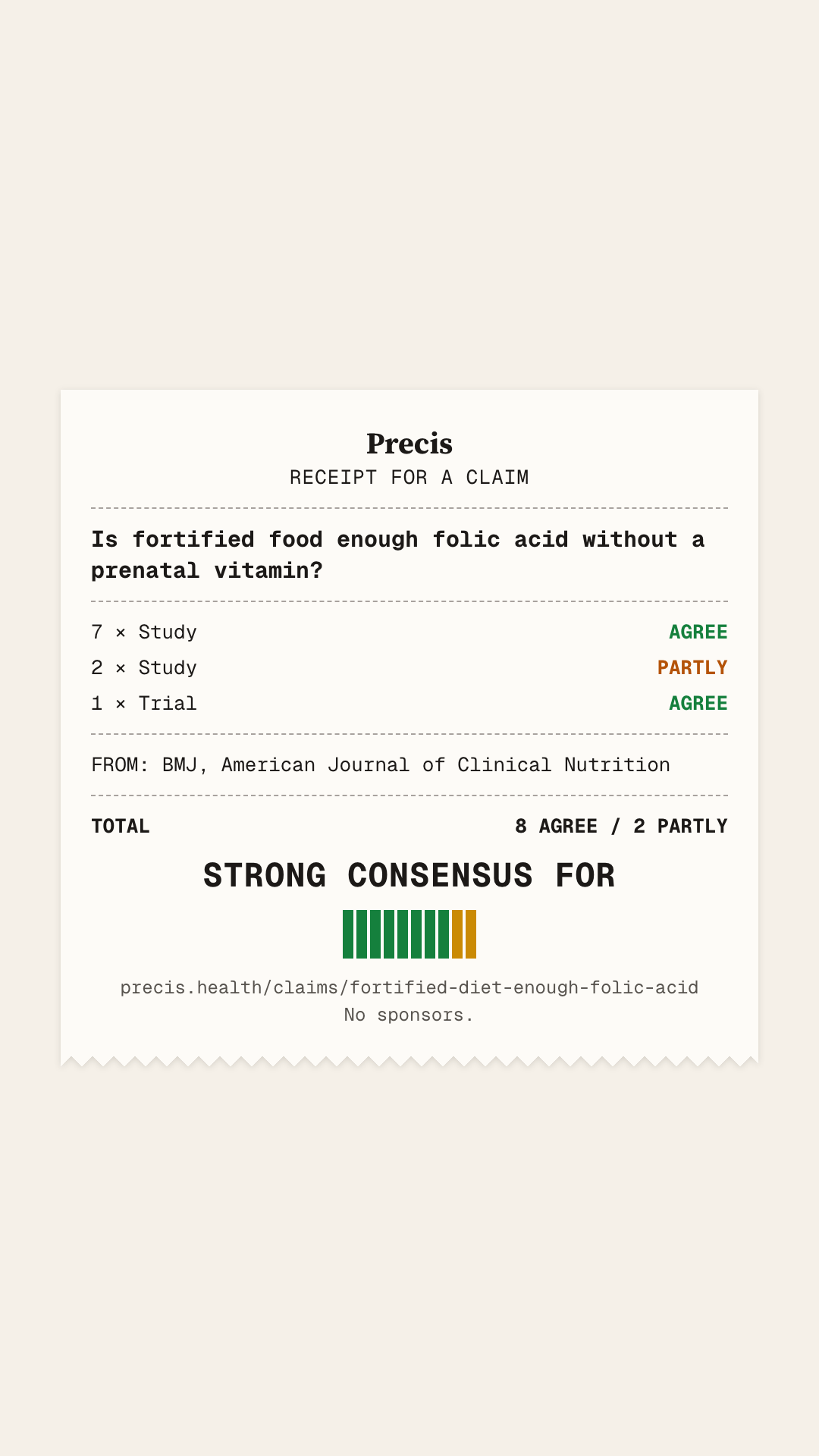
PrecisRECEIPT FOR A CLAIM


Is fortified food enough folic acid without a prenatal vitamin?


  • 7 × StudyAGREE
  • 2 × StudyPARTLY
  • 1 × TrialAGREE

FROM: BMJ, American Journal of Clinical Nutrition


TOTAL8 AGREE / 2 PARTLY

Strong consensus for

What do the studies say?

Strong consensus for

8 of 10 studies agree. Neural tube defects are birth defects of the spine and brain, such as spina bifida. In the US, grain is fortified with folic acid. There, most women of childbearing age had blood folate at the level tied to the lowest risk of these defects, even without a supplement. A study in Chile found much the same. Still, one US study found nearly a quarter of Mexican American women who took no supplement at risk of falling short. 2 partly agree: in Guatemala, 47.2% of women had too little folate.

Computed from 10 studies that test this point, each judged by two readers, in full. 10 more studies are waiting for a full read and do not count yet.

What was said on the podcast?

“if you have a well-balanced diet and a lot of the food um is now supplemented with, you know, B vitamins and folic acid and things that you want to be replete in with pregnancy. So I think um uh a lot of folks will have adequate levels”
Kathryn Gray, a guest on The Drive · 410 ‒ The biology of pregnancy: physiologic adaptation, childbirth, and long-term maternal health · 18:05 on YouTube
Episode check Missing the microbes of a vaginal birth is probably not the thing to stress about, the episode says. Of 10 studies, 6 disagree. 10 claims checked against 114 studies See every claim we checked →
Point 1 of 2 Strong consensus for

Where food is fortified with folic acid, many women of childbearing age who eat a balanced diet have adequate folate levels without a supplement

Agree 8

other primary study · 2015

“The majority of U.S. women of childbearing age, including those who do not take supplements containing folic acid, have RBC folate concentrations associated with the lowest (optimal) NTD risk.”

U.S. women of childbearing age who are at possible increased risk of a neural tube defect-affected pregnancy due to suboptimal red blood cell folate concentrations, National Health and Nutrition Examination Survey 2007 to 2012. Birth Defects Res A Clin Mol Teratol
Who: Nonpregnant U.S. women aged 12-49 years in NHANES 2007-2012, under mandatory folic acid fortification of enriched cereal grain products
PMID 25884850

other primary study · 2018

“Currently in the United States, RBC folate concentrations are largely consistent with optimal NTD prevention.”

Modeling the impact of folic acid fortification and supplementation on red blood cell folate concentrations and predicted neural tube defect risk in the United States: have we reached optimal prevention? Am J Clin Nutr
Who: Nonpregnant U.S. women aged 12-49 years, NHANES 2007-2012, with RBC folate, supplement data and reliable dietary recalls
PMID 29767673

other primary study · 2021

“The current study shows that serum folate levels are mostly within the normal range in young women living in urban areas of the MR of Chile and suggests that the current folic acid fortification policy is adequate to keep NTD within folate-preventable ranges.”

Folate status in women of childbearing age in the Urban Metropolitan Region of Chile: results from the National Health Survey 2016-2017. Public Health Nutr
Who: Women aged 15-49 living in urban areas of the Metropolitan Region of Chile, National Health Survey (ENS) 2016-2017; 98.8% took no folic acid supplement
PMID 32907649

other primary study · 2014

“Encouragingly for US prevention efforts in the post-folic acid fortification era, a large percentage of pregnant US women have red blood cell folate concentrations at or above those associated with low risk of neural tube defects, even in the absence of folic acid supplement use.”

Population red blood cell folate concentrations for prevention of neural tube defects: Bayesian model. BMJ
Who: Chinese Community Intervention Project births (1993-95) and women in the Folic Acid Dosing Trial (Hebei, 2003-05); model then applied to published US NHANES RBC folate distributions, including pregnant non-supplement users
PMID 25073783

Show 4 more Show fewer

controlled trial · 2011

“Using the endpoint of blood folate, our results suggest that the level of folic acid provided by the fortification program would increase RBC folate concentrations to a level associated with a low risk of NTDs.”

Folate status of reproductive age women and neural tube defect risk: the effect of long-term folic acid supplementation at doses of 140 µg and 400 µg per day. Nutrients
Who: Healthy non-pregnant women aged 18-40 in Dunedin, New Zealand, with no regular folic acid supplement use in the prior 6 months; New Zealand had no mandatory fortification at the time
PMID 22254076

trial or observed group · 2016

“Nearly a quarter of MA women overall (24.5%), and approximately 30% of MA women with lower acculturation factors (i.e. those who reported primarily speaking Spanish, being born in Mexico, or living in the United States <15 years) who did not report consuming a supplement, are at risk of having a RBC folate concentration below a value associated with the lowest risk for having a neural tube defect-affected pregnancy.”

Blood folate concentrations among women of childbearing age by race/ethnicity and acculturation, NHANES 2001-2010. Matern Child Nutr
Who: Non-pregnant non-Hispanic white and Mexican American women aged 15-44, NHANES 2001-2010 (RBC folate 2007-2010)
PMID 24934272

other primary study · 2021

“When limiting to WRA who relied solely on ECGP as a folic acid source, the estimated NTD rate was 7.1 NTDs/10,000 (95% UI: 5.3–9.2) among non-Hispanic white women of reproductive age compared to 7.5 NTDs/10,000 (95% UI: 5.6–9.6; p = 0.37) among Hispanic women of reproductive age in the post-fortification time period ( Table 6 ).”

Impact of Voluntary Folic Acid Fortification of Corn Masa Flour on RBC Folate Concentrations in the U.S. (NHANES 2011-2018). Nutrients
Who: Nonpregnant U.S. Hispanic women aged 12-49 (non-Hispanic white women as comparison), NHANES 2011-2018
PMID 33923768

other primary study · 2023

“When additional folic acid was added through fortification, median total folate intakes in the ECGP/CMF-only group were above the EAR for all the demographic groups.”

Folate and vitamin B12 usual intake and biomarker status by intake source in United States adults aged ≥19 y: NHANES 2007-2018. Am J Clin Nutr
Who: Nonpregnant US adults aged 19 y and older (men and women) in NHANES 2007-2018, grouped by folic acid source (fortified grain/corn masa only, plus ready-to-eat cereal, plus supplements)
PMID 37172826
Partly agree 2

other primary study · 2004

“Serum folate and RBC folate increased significantly from Phase I to Phase II in both women aged 19–44 years and seniors (p < 0.001).”

A comprehensive evaluation of food fortification with folic acid for the primary prevention of neural tube defects. BMC Pregnancy Childbirth
Who: Non-pregnant women aged 19-44 not taking folic acid supplements, St. John's and rural Newfoundland, Canada (plus seniors 65+); provincial NTD registry
PMID 15450123

trial or observed group · 2016

“The national prevalence of RBC folate insufficiency was 47.2% (95% CI, 43.3–51.1) (Table 1).”

Red Blood Cell Folate Insufficiency among nonpregnant Women of Childbearing age in Guatemala 2009 to 2010: Prevalence and predicted Neural Tube Defects risk. Birth Defects Res A Clin Mol Teratol
Who: Nonpregnant Guatemalan women aged 15-49, national multistage cluster survey (ENMICRON) 2009-2010
PMID 27010602

Disagree 0· none of the studies we read

Point 2 of 2 Leaning for

Where food is fortified with folic acid, a balanced diet without a folic acid supplement protects against neural tube defects about as well as taking one

2 of 7 studies agree and 4 partly agree. Where food is fortified, women who took a folic acid supplement had little or no lower risk of spina bifida than women who did not. 1 disagrees. In US survey data, only women who took at least 400 μg of folic acid a day from supplements had a lower estimated rate of these defects. The 4 that partly agree found that most women without a supplement had enough folate, but some still fell short.

Computed from 7 studies that test this point, each judged by two readers, in full. 10 more studies are waiting for a full read and do not count yet.

Agree 2

other primary study · 2011

“In the setting of folic acid fortification, we found that folic acid supplementation does not appear to offer further benefit for reducing spina bifida risk.”

Folic acid intake and spina bifida in the era of dietary folic acid fortification. Epidemiology
Who: Mothers of infants with spina bifida and nonmalformed controls, Slone Birth Defects Study (Boston, Philadelphia, San Diego, Toronto, Massachusetts and New York registries), pregnancies conceived after June 1997
PMID 21659881

other primary study · 2010

“This study of California births, conceived after folic acid fortification of the food supply, found that periconceptional intake of folic acid-containing supplements was only modestly if at all protective against NTDs.”

Periconceptional nutrient intakes and risks of neural tube defects in California. Birth Defects Res A Clin Mol Teratol
Who: Deliveries in Los Angeles, San Francisco and Santa Clara counties, California, 1999-2003 (post-fortification); majority Hispanic
PMID 20740594

Partly agree 4

other primary study · 2014

“Given the high rate of unplanned pregnancies in the United States (~50%), 41 the fact that the neural tube closes by day 28 of gestation (often before a woman confirms that she is pregnant), and the low levels of supplement use among women of childbearing age (~32%), 42 a subset of non-supplement using women might still be at increased risk of folate preventable neural tube defects (supplementary table G).”

Population red blood cell folate concentrations for prevention of neural tube defects: Bayesian model. BMJ
Who: Chinese Community Intervention Project births (1993-95) and Folic Acid Dosing Trial women; model applied to published US NHANES RBC folate distributions
PMID 25073783

other primary study · 2015

“There is still a group of women with less-than-optimal RBC folate concentrations, but it is relatively small and the majority of these women are in the elevated (not high) risk group, such that studies would need extremely large sample sizes to detect the residual impact of supplements in the presence of consumption of fortified ECGP for these women.”

U.S. women of childbearing age who are at possible increased risk of a neural tube defect-affected pregnancy due to suboptimal red blood cell folate concentrations, National Health and Nutrition Examination Survey 2007 to 2012. Birth Defects Res A Clin Mol Teratol
Who: Nonpregnant US women aged 12-49 y, NHANES 2007-2012 (mandatory folic acid fortification of enriched cereal grain products)
PMID 25884850

controlled trial · 2011

“From baseline to 40 weeks, the prevalence of RBC folate <906 nmol/L decreased nearly 3-fold in the 400 μg group, from 67% to 18%, and approximately 2-fold in the 140 μg group (67% to 35%).”

Folate status of reproductive age women and neural tube defect risk: the effect of long-term folic acid supplementation at doses of 140 µg and 400 µg per day. Nutrients
Who: Healthy nonpregnant women aged 18-40 y in Dunedin, New Zealand, not using folic acid supplements, before mandatory bread fortification (140 ug arm designed to mimic proposed fortification)
PMID 22254076

other primary study · 2024

“Folic acid-exposed spina bifida cases would need to have been at least 1.2× more likely to participate than folic acid-exposed controls to explain the null OR observed in NBDPS if the true OR is actually ≤0.70.”

Bias analyses to investigate the impact of differential participation: Application to a birth defects case-control study. Paediatr Perinat Epidemiol
Who: National Birth Defects Prevention Study (US case-control), post-mandatory-fortification deliveries 1998-2003: spina bifida cases and live-born controls
PMID 38102868

Disagree 1

other primary study · 2018

“However, only women with reported intakes ≥400 μg folic acid/d from supplements had statistically significantly lower estimated NTD prevalence than women who did not use supplements, regardless of RTE intake (median difference 2.8/10,000 live births; 95% UI: 0.6, 5.2/10,000 live births).”

Modeling the impact of folic acid fortification and supplementation on red blood cell folate concentrations and predicted neural tube defect risk in the United States: have we reached optimal prevention? Am J Clin Nutr
Who: Nonpregnant U.S. women aged 12-49 years, NHANES 2007-2012
PMID 29767673

More on supplements and drugs

The Precis Weekly

Get each new check by email.

One email a week with the claims and episodes we checked, what the studies found and the minute each claim was said.

Free. Unsubscribe anytime.