A claim you hear on longevity podcasts

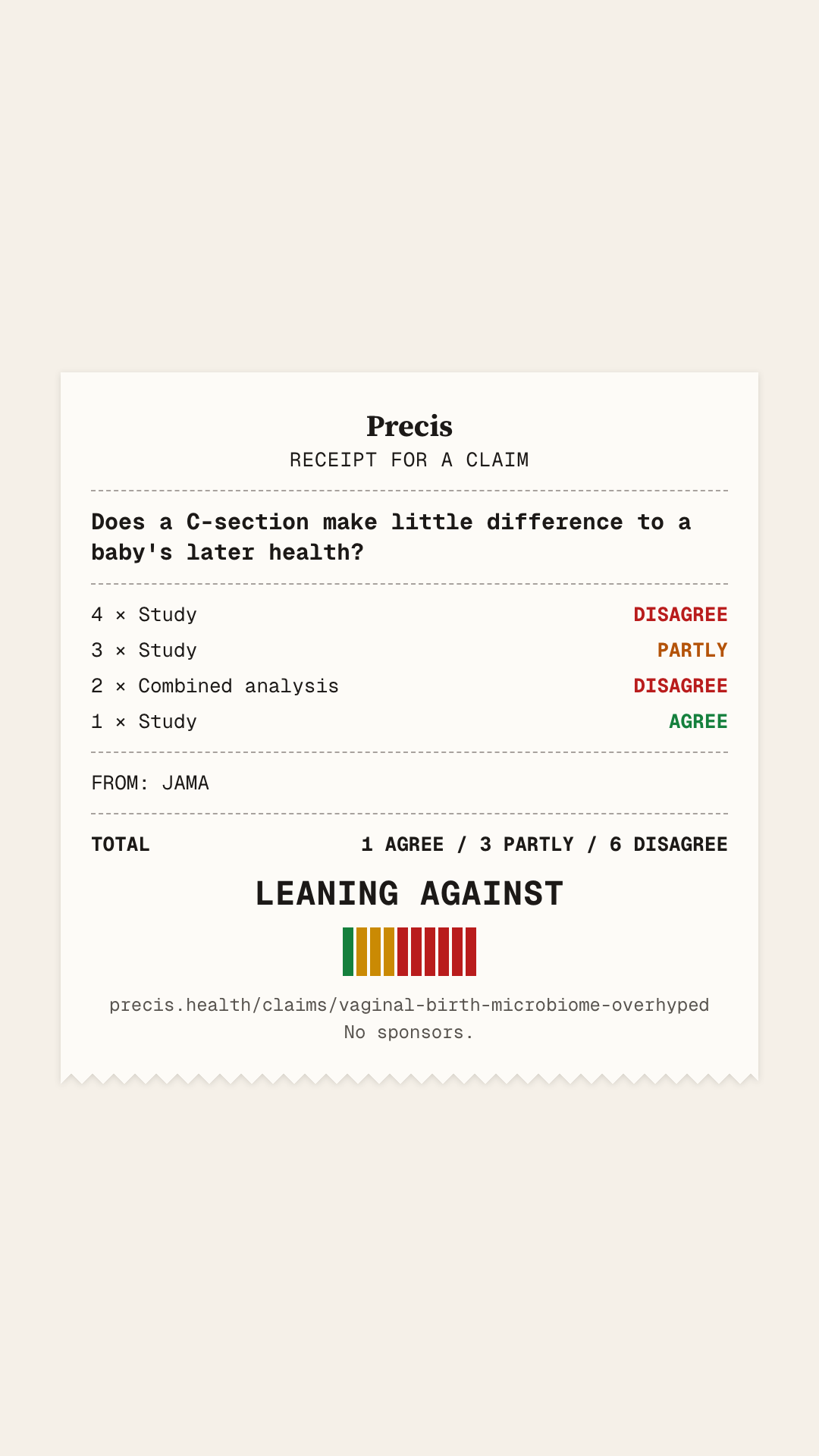
Does a C-section make little difference to a baby's later health?

Leaning against. Of 10 studies that test it, 6 disagree, 3 partly agree and 1 agrees.

Best for:
parents weighing a C-section or a vaginal birth and the baby's microbiome.
Price:
Free to read, with every receipt. Pro is $9 a month or $79 a year and adds AI Ask.

The claim checked: Missing the microbe transfer of a vaginal birth is probably not the thing to stress about Hear it at 1:26:28

PrecisRECEIPT FOR A CLAIM


Does a C-section make little difference to a baby's later health?


  • 4 × StudyDISAGREE
  • 3 × StudyPARTLY
  • 2 × Combined analysisDISAGREE
  • 1 × StudyAGREE

FROM: JAMA


TOTAL1 AGREE / 3 PARTLY / 6 DISAGREE

Leaning against

What do the studies say?

Leaning against

6 of 10 studies disagree. Children born by C-section had more asthma, allergies, infections or obesity than children born vaginally. All 6 compared groups of children, which can show a link but cannot prove the C-section caused it. 1 agrees: in Scotland, a planned repeat C-section had a weak link to asthma that the authors call clinically insignificant. 3 partly agree: in Denmark and Scotland the extra risk was real but small for any one child.

Computed from 10 studies that test this point, each judged by two readers, in full. 9 more studies are waiting for a full read and do not count yet.

What was said on the podcast?

“Well, I I'm not saying that there's no helpful component of that, but I would say of all the things that help determine your health and your baby's health, that's probably not the thing to stress about.”
Kathryn Gray, a guest on The Drive · 410 ‒ The biology of pregnancy: physiologic adaptation, childbirth, and long-term maternal health · 1:26:28 on YouTube
Episode check Missing the microbes of a vaginal birth is probably not the thing to stress about, the episode says. Of 10 studies, 6 disagree. 10 claims checked against 114 studies See every claim we checked →
Point 1 of 2 Leaning against

Being born by C-section, and so missing the microbe transfer of a vaginal birth, makes little difference to a child's later health

Agree 1

other primary study · 2016

“Our study demonstrated a weak, clinically insignificant association between planned repeat CS birth and offspring hospitalisation with asthma, consistent with existing literature.”

Planned Repeat Cesarean Section at Term and Adverse Childhood Health Outcomes: A Record-Linkage Study. PLoS Med
Who: 40,145 term singleton second-born infants in Scotland (1993-2007) to mothers with one previous cesarean (17,919 planned repeat CS, 8,847 unscheduled repeat CS, 13,379 VBAC)
PMID 26978456

Partly agree 3

other primary study · 2015

“Despite the study limitations, the findings suggest that avoidance of vaginal birth may be an important early-life factor in the growing global burden of asthma, although absolute increase in risk to individuals is low.”

Planned Cesarean Delivery at Term and Adverse Outcomes in Childhood Health. JAMA
Who: 321,287 term singleton first-born offspring born in Scotland 1993-2007 (12,355 planned cesarean, 56,015 unscheduled cesarean, 252,917 vaginal)
PMID 26624826

other primary study · 2020

“Even though the association is statistically highly significant, the absolute increased disease risk by being born by caesarean section is low.”

Caesarean Delivery and Risk of Chronic Inflammatory Diseases (Inflammatory Bowel Disease, Rheumatoid Arthritis, Coeliac Disease, and Diabetes Mellitus): A Population Based Registry Study of 2,699,479 Births in Denmark During 1973-2016. Clin Epidemiol
Who: All children born in Denmark from 1973 to March 2016 in the national birth and patient registries (15.0% born by cesarean)
PMID 32210632

other primary study · 2010

“In conclusion, this is the first study to investigate whether there is an association between mode of delivery in childbirth and the prevalence of allergic diseases in Korea, and we did not find a significant correlation.”

Relationship between mode of delivery in childbirth and prevalence of allergic diseases in Korean children. Allergy Asthma Immunol Res
Who: 279 children aged 16 years or younger who visited Severance Children's Hospital, Yonsei University College of Medicine, Korea, in 2008 (100 cesarean, 179 vaginal; mean age 4.6 years)
PMID 20224675

Disagree 6

pooled analysis · 2018 · landmark

“Although we cannot conclude that cesarean delivery causes certain outcomes, patients and clinicians should be aware that cesarean delivery is associated with long-term risks for the baby and for subsequent pregnancies and a reduced risk of urinary incontinence and pelvic organ prolapse for the mother.”

Long-term risks and benefits associated with cesarean delivery for mother, baby, and subsequent pregnancies: Systematic review and meta-analysis. PLoS Med
Who: Term (>37 weeks) deliveries in high-income countries; 1 RCT and 79 large (>1,000 participant) prospective cohort studies comparing cesarean with vaginal delivery; childhood outcomes drawn from 35 manuscripts
PMID 29360829

pooled analysis · 2020

“The results of the studies included indicated that children delivered by cesarean section more commonly developed respiratory tract infections, obesity and the manifestations of asthma than children delivered vaginally.”

Pediatrics Consequences of Caesarean Section-A Systematic Review and Meta-Analysis. Int J Environ Res Public Health
Who: Newborns and children delivered by cesarean vs vaginal delivery in studies published 2008-2020 (mostly European cohorts)
PMID 33142727

other primary study · 2018

“Children born by cesarean delivery were particularly at increased risk for adverse health outcomes in the longer term, that is, respiratory infection, other infection, and metabolic disorder.”

The effect of medical and operative birth interventions on child health outcomes in the first 28 days and up to 5 years of age: A linked data population-based cohort study. Birth
Who: 491,590 low-risk healthy pregnant women aged 20-35 in New South Wales, Australia (term singleton births 2000-2008) and their children
PMID 29577380

other primary study · 2012

“Birth by C/S is associated with asthma and atopic sensitization in Cypriot children aged 8–9 years.”

Asthma and atopy in children born by caesarean section: effect modification by family history of allergies - a population based cross-sectional study. BMC Pediatr
Who: 2,216 children aged 7-8 years attending public primary schools in Nicosia and Limassol, Cyprus (31.7% born by C/S); skin prick testing in a Nicosia subgroup of 746
PMID 23153011

Show 2 more Show fewer

trial or observed group · 2017

“In our racially and ethnically diverse cohort, Cesarean delivery and pre-pregnancy overweight and obesity were associated with childhood overweight or obesity.”

Does vaginal delivery mitigate or strengthen the intergenerational association of overweight and obesity? Findings from the Boston Birth Cohort. Int J Obes (Lond)
Who: 1,441 racially and ethnically diverse term mother-child dyads in the Boston Birth Cohort (961 vaginal, 480 Cesarean)
PMID 27899809

other primary study · 2017

“In conclusion, CS without medical indication is associated with an increased risk of both asthma and allergic rhinitis in children.”

Cesarean section without medical indication and risks of childhood allergic disorder, attenuated by breastfeeding. Sci Rep
Who: 12,639 primary school pupils (grades 1-5) in Shanghai, China, from the 2014 SCHEDULE survey; 47% born by CS, 19% by CS without medical indication
PMID 28852079

Point 2 of 2 Conflicting

Children born by C-section are no more likely to have gut problems than children born vaginally

The studies split. 3 of 10 found no link between birth by C-section and later gut disease, such as inflammatory bowel disease (IBD) or celiac disease. 3 found one. In all children born in Denmark, C-section birth came with a risk of celiac disease 1.10 times as high. In a US registry, it came with a 77% higher risk of eosinophilic esophagitis, an allergic swelling of the food pipe. 4 partly agree: a Swedish study linked C-section to Crohn's disease but to no other gut problem.

Computed from 10 studies that test this point, each judged by two readers, in full. Sources land on both sides. 10 more studies are waiting for a full read and do not count yet.

Agree 3

other primary study · 2021 · landmark

“Based on our systematic review and MA, no consistent evidence was found to link mode of delivery, maternal age, passive smoking, perinatal factors, vaccination, socioeconomic factors and most hygiene-related factors to subsequent risk of developing IBD, although the heterogeneity and quality of studies may have limited analysis ( Fig. 5 ).”

Early life exposures and the risk of inflammatory bowel disease: Systematic review and meta-analyses. EClinicalMedicine
Who: Case-control and cohort studies of exposures from pregnancy to age 5 years and later IBD, Crohn's disease or ulcerative colitis
PMID 34308303

other primary study · 2015

“No significant difference in risk of obesity at age 5 years, inflammatory bowel disease, or cancer was demonstrated following planned cesarean delivery compared with either unscheduled cesarean delivery or vaginal birth.”

Planned Cesarean Delivery at Term and Adverse Outcomes in Childhood Health. JAMA
Who: 321,287 term singleton first-born offspring born in Scotland 1993-2007 (12,355 planned cesarean, 56,015 unscheduled cesarean, 252,917 vaginal)
PMID 26624826

other primary study · 2015

“This study found no association of mode of delivery, intrauterine growth or factors pertaining to intrauterine fetal growth on future development of CD.”

Perinatal risk factors for development of celiac disease in children, based on the prospective Norwegian Mother and Child Cohort Study. Clin Gastroenterol Hepatol
Who: Children in the prospective Norwegian Mother and Child (MoBa) cohort born 1999-2008, linked to the Medical Birth Registry and National Patient Register
PMID 25459557

Partly agree 4

other primary study · 2022

“The present paper reported that vaginal delivery was a significant IBD risk factor.”

Environmental Risk Factors for Childhood Inflammatory Bowel Diseases: A Multicenter Case-Control Study. Children (Basel)
Who: Children aged 0-16 years at three tertiary hospitals in Jeddah and Riyadh, Saudi Arabia (2009-2021): 167 with IBD (93 Crohn's, 74 UC) and 168 convenience-sampled outpatient controls
PMID 35327810

other primary study · 2022

“Cesarean section is associated with Crohn's disease later in life, but no other association between delivery mode and gastrointestinal disorders later in life could be found.”

Delivery mode and risk of gastrointestinal disease in the offspring. Acta Obstet Gynecol Scand
Who: All full-term (37-42 weeks) singletons born in Sweden 1990-2000 in the Medical Birth Register (11.6% cesarean)
PMID 35924371

trial or observed group · 2024

“This suggests that mode of delivery could have a potential role on the risk of developing CD and on its age of onset, but it is more likely that it works in concert with other perinatal factors.”

Prevalence of delivery mode in an Italian nationwide cohort with celiac disease: a SIGENP multicenter retrospective study (the CD-deliver-IT). Ital J Pediatr
Who: Patients with confirmed coeliac disease followed at 12 Italian referral centres (median age 14 years, median age at diagnosis 6 years)
PMID 39061072

other primary study · 2012

“We found a modest but statistically significant excess risk for celiac disease after elective, but not emergency, cesarean delivery.”

Pregnancy outcome and risk of celiac disease in offspring: a nationwide case-control study. Gastroenterology
Who: Swedish-born individuals (born after 1973) with biopsy-verified celiac disease from 28 pathology departments, and age- and sex-matched general-population controls
PMID 21995948

Disagree 3

other primary study · 2020

“Compared to being born vaginally, being born by CS was associated with development of DM (HR=1.08 (95% confidence interval (CI): 1.04, 1.12)), RA (HR=1.07 (95% CI: 1.02, 1.14)), CD (HR=1.10 (95% CI: 1.03, 1.18)), and IBD (HR=1.07 (95% CI: 1.02, 1.12)).”

Caesarean Delivery and Risk of Chronic Inflammatory Diseases (Inflammatory Bowel Disease, Rheumatoid Arthritis, Coeliac Disease, and Diabetes Mellitus): A Population Based Registry Study of 2,699,479 Births in Denmark During 1973-2016. Clin Epidemiol
Who: All children born in Denmark from 1973 to March 2016 in the national birth and patient registries (15.0% born by cesarean)
PMID 32210632

other primary study · 2026

“Our results confirm that C-section delivery is associated with an increased risk of multiple GI disturbances, primarily mediated by early-life disruption of the gut microbiota and modulated by environmental, nutritional, and perinatal factors.”

Gastrointestinal consequences of cesarean section birth: A systematic review of short- and long-term effects in infancy and beyond. World J Clin Pediatr
Who: Infants and children born by C-section (elective or emergency) vs vaginal delivery in observational studies, RCTs and reviews, mostly from high-income countries
PMID 41884021

other primary study · 2018

“Cesarean delivery, compared with vaginal delivery, conferred a 77% increase in risk of EoE (aOR, 1.77; 95% CI, 1.01–3.09).”

Prenatal, intrapartum, and postnatal factors are associated with pediatric eosinophilic esophagitis. J Allergy Clin Immunol
Who: Non-Hispanic white children with eosinophilic esophagitis from a Cincinnati Children's Hospital registry and population-based community controls; data from mothers via web questionnaire
PMID 28601683

More on lifestyle and genes

The Precis Weekly

Get each new check by email.

One email a week with the claims and episodes we checked, what the studies found and the minute each claim was said.

Free. Unsubscribe anytime.