A claim you hear on longevity podcasts

Does a C-section raise the risk of placenta accreta next time?

Strong consensus for. Of 10 studies that test it, 9 agree and 1 partly agrees.

Best for:
anyone planning another pregnancy after a C-section and asking about placenta accreta.
Price:
Free to read, with every receipt. Pro is $9 a month or $79 a year and adds AI Ask.

The claim checked: A past C-section, and more so several, raises the risk of placenta accreta in the next pregnancy Hear it at 1:06:26

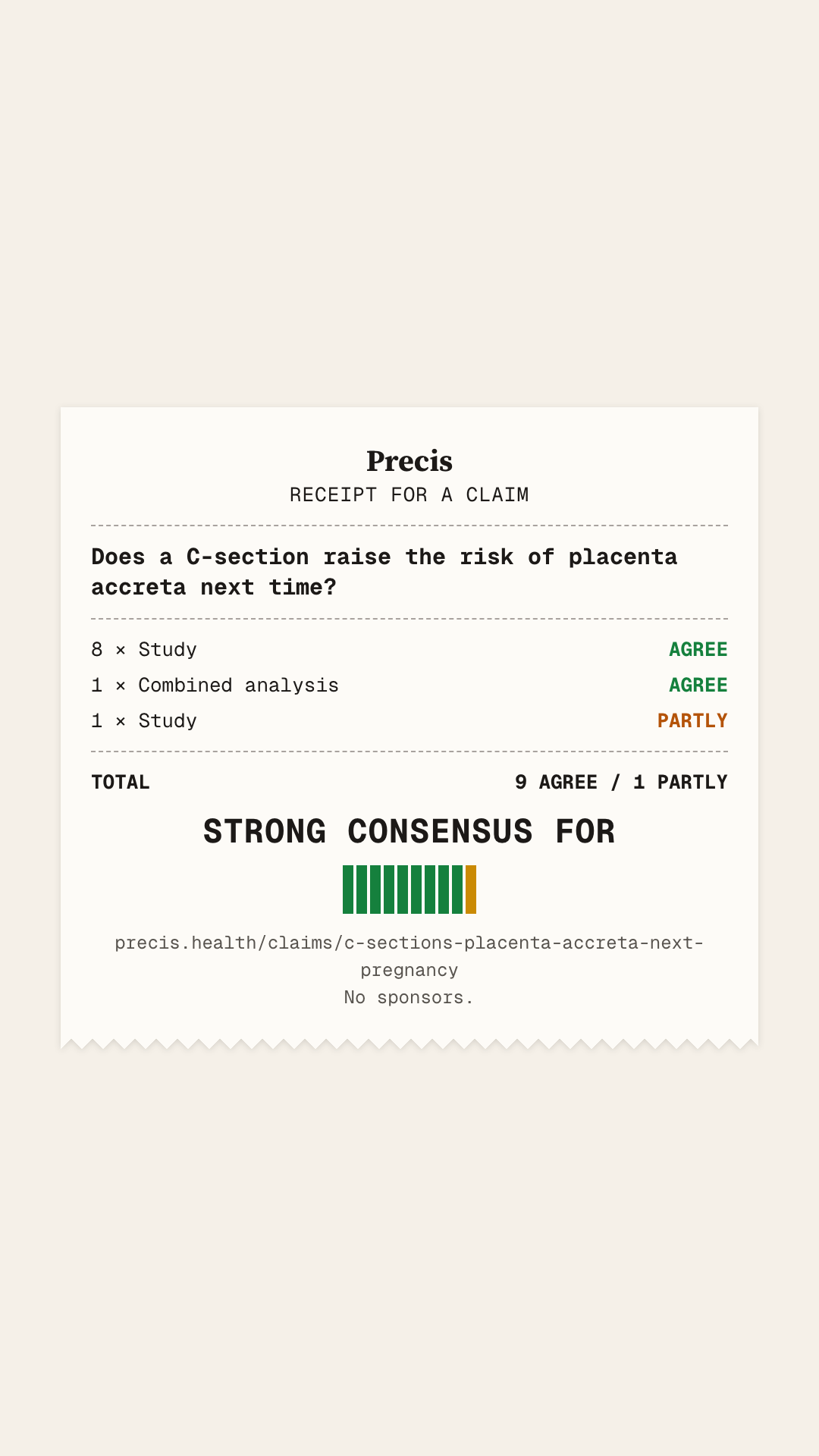
PrecisRECEIPT FOR A CLAIM


Does a C-section raise the risk of placenta accreta next time?


  • 8 × StudyAGREE
  • 1 × Combined analysisAGREE
  • 1 × StudyPARTLY

TOTAL9 AGREE / 1 PARTLY

Strong consensus for

What do the studies say?

Strong consensus for

9 of 10 studies agree. Placenta accreta spectrum means the placenta grows too deep into the wall of the womb. Then it does not come away after birth. Women who had a C-section before had it more often. In a UK study, the odds were 14.41 times higher after a past C-section. 1 study partly agrees: once other risks were counted, a past C-section no longer stood out on its own.

Computed from 10 studies that test this point, each judged by two readers, in full. 10 more studies are waiting for a full read and do not count yet.

What was said on the podcast?

“for folks who have prior C-sections, multiple prior C-sections, they're at higher risk for abnormal placentation in the next pregnancy, meaning that um the um specifically placenta accreta spectrum.”
Kathryn Gray, a guest on The Drive · 410 ‒ The biology of pregnancy: physiologic adaptation, childbirth, and long-term maternal health · 1:06:26 on YouTube
Episode check Missing the microbes of a vaginal birth is probably not the thing to stress about, the episode says. Of 10 studies, 6 disagree. 10 claims checked against 114 studies See every claim we checked →
Point 1 of 2 Strong consensus for

A prior C-section raises the risk of placenta accreta spectrum in a later pregnancy

Agree 9

other primary study · 2012

“The odds of having placenta accreta/increta/percreta were also raised in women who had a previous caesarean delivery (aOR 14.41, 95% CI 5.63 to 36.85).”

Incidence and risk factors for placenta accreta/increta/percreta in the UK: a national case-control study. PLoS One
Who: 134 women with placenta accreta/increta/percreta and 256 control women (the two women delivering immediately before each case in the same hospital) from all 221 obstetrician-led maternity units in the UK
PMID 23300807

pooled analysis · 2020

“The findings from this systematic review showed that advanced maternal age, obesity, parity, prior CS, placenta previa and IVF are associated with a significant high risk of AIP.”

Risk factors for abnormally invasive placenta: a systematic review and meta-analysis. J Matern Fetal Neonatal Med
Who: 46 studies (published 2000 onward) comparing women with and without abnormally invasive placenta; 33 studies (656,168 pregnancies) reported prior caesarean section
PMID 29938551

other primary study · 2017

“In multiparous women, previous caesarean birth and current placenta praevia were associated with an increased risk of placenta accreta.”

Incidence, risk factors and perinatal outcomes for placenta accreta in Australia and New Zealand: a case-control study. BMJ Open
Who: 295 women with placenta accreta and 570 controls (the two women giving birth immediately before each case in the same hospital) in Australian and New Zealand maternity units (AMOSS)
PMID 28982832

other primary study · 2019

“After controlling for potential risk factors, placenta previa (aOR: 12.86, 95% CI 7.70–21.45; P < 0.001), ART (aOR: 6.78, 95% CI 4.54–10.14; P < 0.001), smoking during pregnancy (aOR: 1.95, 95% CI 1.15–3.31; P = 0.013), ≥2 previous CSs (aOR: 2.51, 95% CI 1.35–4.67; P = 0.004), and uterine anomalies (aOR: 3.97, 95% CI 1.24–12.68; P = 0.020) were all related to PAS.”

Risk factors for placenta accreta spectrum: findings from the Japan environment and Children's study. BMC Pregnancy Childbirth
Who: 90,554 women with singleton pregnancies in the Japan Environment and Children's Study (15 regional centres), 202 with placenta accreta spectrum
PMID 31775687

Show 5 more Show fewer

other primary study · 2019

“In conclusion, our study revealed that 2 or more instances of previous cesarean deliveries and/or abortions, placenta previa, and placenta-myometrial interface interruption were independent risk factors for PA.”

Combining Clinical Characteristics and Specific Magnetic Resonance Imaging Features to Predict Placenta Accreta. J Comput Assist Tomogr
Who: 97 pregnant women with ultrasound-suspected placenta accreta who underwent prenatal MRI at Xinhua Hospital, China (excluding prior uterine surgery and fetal abnormalities); 42 confirmed PA
PMID 31356517

other primary study · 2025

“This represented an OR of 9.35 (95% CI, 4.30–24.51) for the second cesarean delivery, 25.56 (95% CI, 12.10–65.88) for the third cesarean delivery, 54.67 (95% CI, 25.12–143.33) for the fourth cesarean delivery, and 89.99 (95% CI, 35.39–257.13) for the fifth or more cesarean delivery.”

Contemporary Placenta Accreta Spectrum Disorder Incidence and Risk Factors. Obstet Gynecol
Who: all patients who delivered by cesarean and had prenatal imaging at a single US institution (about 70% Hispanic, majority Medicaid); primary cesarean (no prior cesarean) as reference
PMID 40245410

other primary study · 2022

“There was a statistically significant association between previous caesarean section and placenta accreta spectrum P <0.001 (95% CI: 0.000,0.000).”

Placenta Accreta Spectrum: Prevalence, Trend and Association with Sociodemographic / Obstetric Factors in a Tertiary Health Facility in Niger Delta, Nigeria. Niger Med J
Who: 137 women with placenta praevia (39 with PAS) managed at Rivers State University Teaching Hospital, Port Harcourt, Nigeria, out of 14,195 deliveries
PMID 38884036

other primary study · 2025

“Previous caesarean sections were noted in 88.2% of cases, with PAS risk increasing substantially as the number of caesareans rose.”

Paving the Path to Prevent Peripartum Hysterectomies: Risk Stratification in Placenta Accreta Spectrum. J Mother Child
Who: deliveries at SMS Medical College, Jaipur, India, comparing 85 histopathologically confirmed PAS cases with 9,003 non-PAS deliveries
PMID 40818149

other primary study · 2024

“The important result of the present study was that odds ratio in one previous cesarean section to patients without this history was 29, and patients with more than 2 previous history had 106 times higher chance for this pathology; this is a very terrible event in the obstetric field.”

Accuracy of Prenatal Ultrasonography for Diagnosis of Placenta Accreta Spectrum and Risk Factors in A Tertiary Center in Southern Iran. Galen Med J
Who: 217 pregnant women with suspected PAS referred to Hafez High Risk Prenatal Clinic, Shiraz, Iran, who had imaging and surgery at the centre (64 pathology-confirmed PAS, 153 non-PAS)
PMID 42038131
Partly agree 1

other primary study · 2025

“However, multivariate analysis did not show that prior CS was an independent indicator for PAS.”

Risk factors and maternal-neonatal outcomes of placenta accreta spectrum: A case control study. Medicine (Baltimore)
Who: 138 histologically confirmed PAS cases and 276 controls without PAS matched on age (plus or minus 1 year) and admission time (plus or minus 6 months) at a tertiary women's hospital in China
PMID 41088690

Disagree 0· none of the studies we read

Point 2 of 2 Strong consensus for

The risk of placenta accreta spectrum rises with the number of prior C-sections

9 of 10 studies agree that the risk climbs with each C-section. One study looked at women whose placenta lay low in the womb. Accreta was found in 19% after one C-section, 36% after two and 57% after three or more. 1 UK study partly agrees: women with two or more past C-sections had about the same odds as women with one.

Computed from 10 studies that test this point, each judged by two readers, in full. 10 more studies are waiting for a full read and do not count yet.

Agree 9

pooled analysis · 2020

“More importantly, the risk of AIP increased with the number of prior CS (OR of 2.6, 95% CI 1.6-4.4 and 5.4, 95% CI 1.7-17.4 for 2 and 3 prior CS respectively) (Table 3).”

Risk factors for abnormally invasive placenta: a systematic review and meta-analysis. J Matern Fetal Neonatal Med
Who: 46 studies (published 2000 onward) comparing women with and without abnormally invasive placenta; analysis stratified by number of prior caesarean sections
PMID 29938551

other primary study · 2017

“In multiparous women, the independent risk factors were prior caesarean section (AOR ≥2 prior sections vs 0: 13.8, 95% CI 7.4 to 26.1) and current placenta praevia (AOR: 36.3, 95% CI 14.0 to 93.7).”

Incidence, risk factors and perinatal outcomes for placenta accreta in Australia and New Zealand: a case-control study. BMJ Open
Who: 295 women with placenta accreta and 570 controls (the two women giving birth immediately before each case in the same hospital) in Australian and New Zealand maternity units (AMOSS)
PMID 28982832

other primary study · 2024

“The PAS rates in women with one, two, and three or more prior cesareans were respectively, 19% (95% CI 14–24), 36% (95% CI 25–48), and 57% (95% CI 43–71).”

Risk factors for placenta accreta spectrum disorders in women with any prior cesarean and a placenta previa or low lying: a prospective population-based study. Sci Rep
Who: 396 women with at least one prior cesarean and a placenta previa or low-lying placenta in 176 French maternity units (source population 520,114 deliveries)
PMID 38503816

other primary study · 2025

“Multivariable analysis confirmed an increased risk of PAS with increasing cesarean delivery as indicated by ORs of 16.12 (95% CI, 7.10–43.56), 44.85 (95% CI, 20.04–120.43), 78.66 (95% CI, 33.01–220.19), and 74.76 (95% CI, 23.99–252.00) for risk of second through fifth or greater cesarean delivery, respectively (Table 5).”

Contemporary Placenta Accreta Spectrum Disorder Incidence and Risk Factors. Obstet Gynecol
Who: all patients who delivered by cesarean and had prenatal imaging at a single US institution (about 70% Hispanic, majority Medicaid)
PMID 40245410

Show 5 more Show fewer

other primary study · 2019

“The number of previous CS, number of vaginal bleeding, medications during pregnancy, and placenta previa were all found to be independent risk factors for PA ( P = 0.044, P = 0.003, P = 0.003, and P < 0.001, respectively).”

Development of a Novel Nomogram for Predicting Placenta Accreta in Patients With Scarred Uterus: A Retrospective Cohort Study. Front Med (Lausanne)
Who: women with a scarred uterus (prior cesarean or myomectomy) and singleton pregnancies delivered at Shengjing Hospital, China Medical University
PMID 31921868

other primary study · 2024

“In our major PP patients undergoing repeat CDs, antenatal MRI identified PAS in 38.8% of patients experiencing CD2-CD3, in 57.9% of those with CD4-CD5, and in 84.6% of patients with CD6-CD7.”

Impact of high-order repeat cesarean deliveries on early maternal complications among major placenta previa patients in Southern Saudi Arabia. Saudi Med J
Who: 184 women with major placenta previa undergoing their second to seventh cesarean delivery at Abha Maternity and Children's Hospital, Saudi Arabia
PMID 39379124

other primary study · 2026

“A history of 2 or more previous cesarean deliveries was strongly correlated with placenta accreta (OR = 5.31, 95% CI: 1.85–15.23, P = .002).”

Risk factors and clinical characteristics of pernicious placenta accreta in pregnancies complicated by placenta previa. Medicine (Baltimore)
Who: 177 women with pernicious placenta previa (placenta previa over a prior cesarean scar, singleton, 28 weeks or more, cesarean delivery) at Tangshan Maternal and Child Health Hospital, China
PMID 41650084

pooled analysis · 2017 · landmark

“When referred to the total number of women screened in those studies (n=1233), the incidence of placenta previa accreta was 4.1% in women with one previous caesarean delivery and 13.3% in women with >2 previous caesarean deliveries.”

Prenatal ultrasound diagnosis and outcome of placenta previa accreta after cesarean delivery: a systematic review and meta-analysis. Am J Obstet Gynecol
Who: 14 cohort studies (5 retrospective, 9 prospective) of pregnancies with placenta previa or low-lying placenta and one or more prior caesarean deliveries screened for placenta accreta; count analysis from 8 studies
PMID 28268196

other primary study · 2019

“In patients with placenta previa, the incidence of PAS was significantly increased at 1.3% (6/460), 12.2% (6/49), and 27.3% (6/22) for 0, 1, and ≥ 2 previous CSs ( P < 0.001).”

Risk factors for placenta accreta spectrum: findings from the Japan environment and Children's study. BMC Pregnancy Childbirth
Who: 90,554 women with singleton pregnancies in the Japan Environment and Children's Study (15 regional centres), 202 with placenta accreta spectrum
PMID 31775687

Partly agree 1

other primary study · 2012

“There did not appear to be a linear association between placenta accreta/increta/percreta and number of previous caesarean deliveries, with women who had two or more previous caesareans having similar odds of placenta accreta/increta/percreta to women with one previous caesarean (p = 0.810).”

Incidence and risk factors for placenta accreta/increta/percreta in the UK: a national case-control study. PLoS One
Who: 134 women with placenta accreta/increta/percreta and 256 control women (the two women delivering immediately before each case in the same hospital) from all 221 obstetrician-led maternity units in the UK
PMID 23300807

Disagree 0· none of the studies we read

More on lifestyle and genes

The Precis Weekly

Get each new check by email.

One email a week with the claims and episodes we checked, what the studies found and the minute each claim was said.

Free. Unsubscribe anytime.