A claim you hear on longevity podcasts

Does treating a blocked nose help sleep apnea and CPAP?

Strong consensus for. Of 10 studies that test it, 6 agree and 4 partly agree.

Best for:
Anyone with nasal congestion and sleep apnea
Price:
Free to read, with every receipt. Pro is $9 a month or $79 a year and adds AI Ask.

The claim checked: Treating a blocked nose can ease sleep apnea and make CPAP easier to stick with Hear it at 17:13

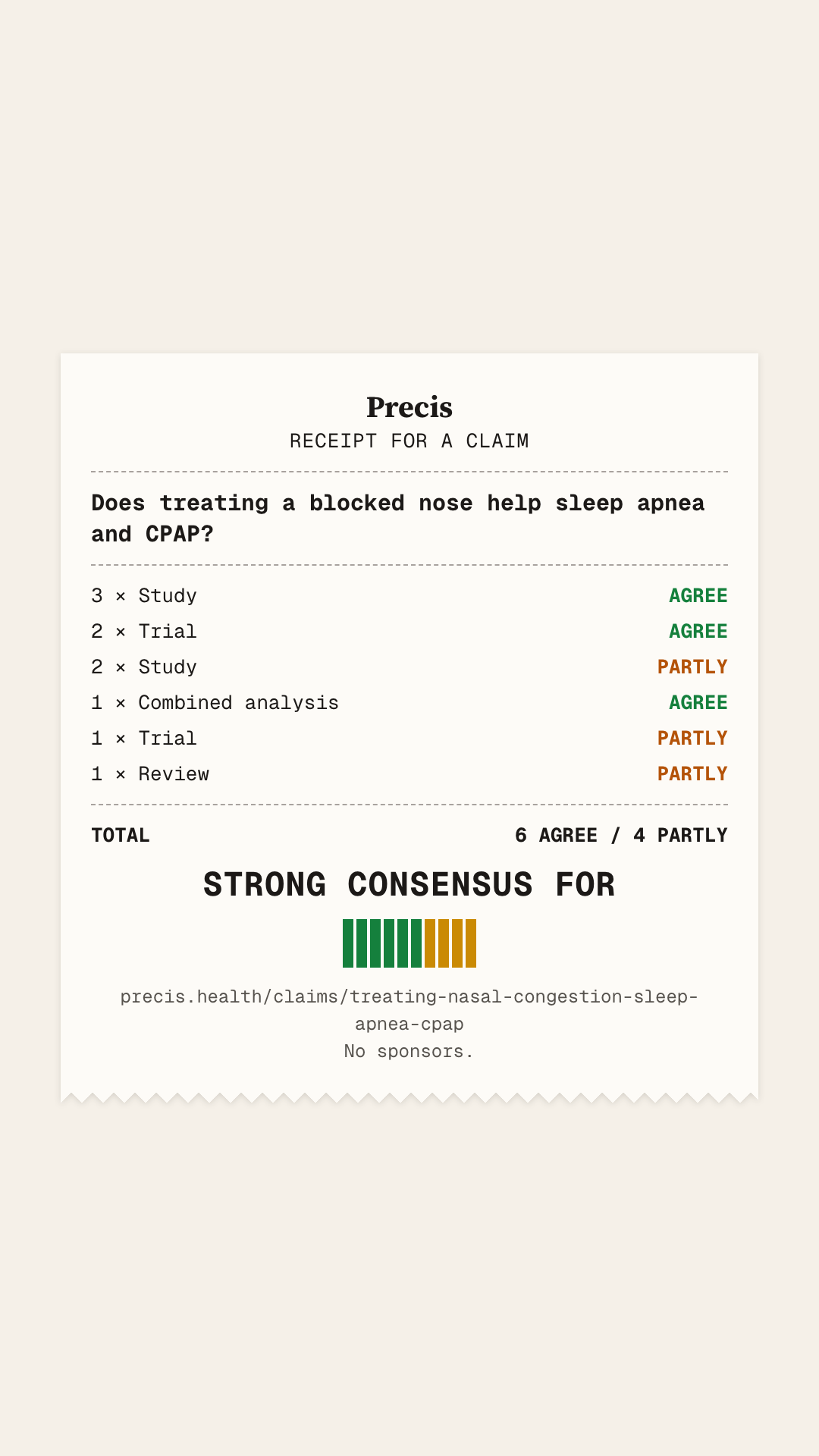
PrecisRECEIPT FOR A CLAIM


Does treating a blocked nose help sleep apnea and CPAP?


  • 3 × StudyAGREE
  • 2 × TrialAGREE
  • 2 × StudyPARTLY
  • 1 × Combined analysisAGREE
  • 1 × TrialPARTLY
  • 1 × ReviewPARTLY

TOTAL6 AGREE / 4 PARTLY

Strong consensus for

What do the studies say?

Strong consensus for

Six of ten studies agree, and none disagree. In a trial of people with apnea and rhinitis, a runny or blocked nose, a steroid nose spray made the apnea less severe. A pooled analysis of nose surgery found that the apnea-hypopnea index (AHI), the count of breathing pauses per hour of sleep, and daytime sleepiness both improved, though the drop in AHI was small. Four studies partly agree: nose surgery eased snoring or sleepiness more than the pauses themselves. In a trial against sham surgery, only 15% of patients had a clear drop in AHI.

Computed from 10 studies that test this point, each judged by two readers, in full. 10 more studies are waiting for a full read and do not count yet.

What was said on the podcast?

“Because if you have sleep apnea and chronic nasal congestion, addressing the congestion may make the nighttime breathing easier and it can also make CPAP much more comfortable and easier to stick with.”
Mark Hyman, The Doctor's Farmacy · Sleep Apnea: Why CPAP Isn't Fixing the Real Problem (This Does!) · 17:13 on YouTube
Episode check Blood pressure that stays high on treatment should make you think of sleep apnea, the episode says. Three of seven studies agree, and four partly agree. 10 claims checked against 86 studies See every claim we checked →
Point 1 of 2 Strong consensus for

In people with sleep apnea and chronic nasal congestion, treating the congestion can ease breathing at night

Agree 6

controlled trial · 2004

“The findings of this study indicate a significant improvement in the severity of OSAS but not in snoring noise levels in patients with OSAS and associated rhinitis following intranasal corticosteroid treatment, and indicate that this treatment may benefit selected patients with OSAS.”

Intranasal corticosteroid therapy for obstructive sleep apnoea in patients with co-existing rhinitis. Thorax
Who: 24 consecutive adult snorers with perennial or seasonal rhinitis referred for suspected OSAS (23 completed: 13 apnoeic with AHI >10/h, 10 non-apnoeic snorers; 19 men, 4 women); fixed nasal obstruction excluded
PMID 14694248

controlled trial · 2005

“In conclusion, treating nasal obstruction reduced mouth breathing during sleep and obstructive sleep apnoea severity, but did not effectively alleviate obstructive sleep apnoea.”

Effect of treating severe nasal obstruction on the severity of obstructive sleep apnoea. Eur Respir J
Who: 10 adults (9 men, mean age 46) with untreated OSA, clinically significant nasal obstruction from turbinate mucosal enlargement with or without nasal valve collapse, and a normal retroglossal airway
PMID 15738298

pooled analysis · 2017

“Both AHI and ESS improved significantly after isolated nasal surgery, but the improvement of AHI is slightly significant.”

Apnea-hypopnea index decreased significantly after nasal surgery for obstructive sleep apnea: A meta-analysis. Medicine (Baltimore)
Who: adults with OSA (age 20-70, mean 44, 90.5% men) treated with isolated nasal surgery
PMID 28151900

other primary study · 2014

“These results show that surgical correction of nasal obstruction is relatively effective at reducing OSA severity, as demonstrated by improvement in the pAHI, pRDI, valid sleep time, and REM sleep time values using the watch-PAT.”

Clinical effect of surgical correction for nasal pathology on the treatment of obstructive sleep apnea syndrome. PLoS One
Who: 25 adults (23 men, mean age 47.4, mean BMI 21.3) with mild to severe OSA, septal deviation and inferior turbinate hypertrophy plus retropalatal or retroglossal narrowing, Chung-Ang University Hospital, Korea
PMID 24896824

Show 2 more Show fewer

other primary study · 2016

“The mean AHI for 12 patients after the surgery was 25.28 ± 16.15 events/h, which had a statistically significant reduction compared with preoperative one ( t = 4.610, P < 0.05).”

Three-dimensional Evaluation of Nasal Surgery in Patients with Obstructive Sleep Apnea. Chin Med J (Engl)
Who: 12 adults (10 men, mean age 46.5, mean BMI 29.36) with moderate or severe OSA and nasal obstruction (septal deviation, enlarged inferior turbinates), Massachusetts Eye and Ear Infirmary, USA
PMID 26960367

other primary study · 2019

“The use of Nas-air® significantly reduced AHI values (38.7±30 vs 31.1±27.4; p=0.000) and ODI scores (36.4±30.6 vs 29.0±26.4; p=0.001) as shown in Figure 1 .”

Internal nasal dilator in patients with obstructive sleep apnea. Acta Biomed
Who: 19 adult inpatients with severe OSA (mean AHI 38.7, mean age 61, mean BMI 32.4), most with grade 1-2 turbinate hypertrophy and 58% with a compromised nasal valve; not selected for chronic nasal congestion; severe septal deviation or grade IV turbinates excluded
PMID 30715033

Partly agree 4

controlled trial · 2008

“Nasal surgery does not influence AHI, since only 15% of patients experienced significant reduction in AHI (responders) and only 4% of patients had a complete response (normalisation of AHI).”

Randomised trial of nasal surgery for fixed nasal obstruction in obstructive sleep apnoea. Eur Respir J
Who: adults with OSA (mean AHI 30.1/h) and symptomatic fixed nasal obstruction from deviated septum, no nasal allergy, Athens, Greece
PMID 17898015

other primary study · 2014

“The overall effect in both groups pooled together showed no significant effect on reduction of the objective parameters but a significant reduction in the subjective ESS score.”

An observational cohort study of the effects of septoplasty with or without inferior turbinate reduction in patients with obstructive sleep apnea. BMC Ear Nose Throat Disord
Who: adults with OSA (AHI >5, BMI <35) and clinically significant nasal obstruction from septal deviation with or without turbinate hypertrophy, Aleris Hospital, Trondheim, Norway
PMID 25352767

systematic review · 2016

“All studies with surgical intervention 14 , 15 , 16 , 17 , 18 , 19 , 20 , 21 decreased nasal resistance, with most of them resulting in the reduction of snoring and excessive daytime sleepiness, although they did not reduce AHI.”

Systematic review: the influence of nasal obstruction on sleep apnea. Braz J Otorhinolaryngol
Who: adults with nasal obstruction and OSAS who had type 1 polysomnography before and after medical or surgical nasal treatment (prospective trials and cohorts published 2003-2013)
PMID 26830959

trial or observed group · 2018

“The findings of this preliminary clinical study showed that a four-week treatment period of topical intranasal corticosteroid treatment with mometasone furoate, was more effective than modafinil in obstructive sleep apnea-hypopnea syndrome (OSAHS).”

Comparison of the Efficacy, Side Effects, and Cost of Modafinil and Intranasal Mometasone Furoate in Obstructive Sleep Apnea-Hypopnea Syndrome: A Preliminary Clinical Study. Med Sci Monit
Who: patients over 6 years of age with OSAHS for at least 3 months, First People's Hospital of Lianyungang, China; not selected for nasal congestion or rhinitis
PMID 29749371

Disagree 0· none of the studies we read

Point 2 of 2 Leaning for

Treating nasal congestion can make CPAP more comfortable and easier to stick with

Two of eight studies agree, five partly agree and one disagrees. A pooled analysis found that nose surgery lowered the air pressure CPAP needs, and its authors say it also helps some people use CPAP more. In 28 CPAP users treated for a spring pollen allergy, more of them used CPAP for over 4 hours a night. But steroid nose sprays did not raise CPAP use in trials of people without much nose trouble, and a pooled analysis of those trials found no clear gain over 4 weeks.

Computed from 8 studies that test this point, each judged by two readers, in full. 10 more studies are waiting for a full read and do not count yet.

Agree 2

pooled analysis · 2015

“Isolated nasal surgery in patients with OSA with nasal obstruction reduces therapeutic CPAP device pressures, and the currently published literature's objective and subjective data consistently suggest that it also increases CPAP use in select patients.”

The effect of nasal surgery on continuous positive airway pressure device use and therapeutic treatment pressures: a systematic review and meta-analysis. Sleep
Who: adults with OSA treated with CPAP who had isolated nasal surgery (mean age 52.5, mean BMI 29.5)
PMID 25325439

other primary study · 2023

“The findings of the current study suggest that it is beneficial to treat CPAP users during the spring pollinosis period with antiallergy agents because not only nasal symptoms but also subjective improvement in sleep quality as well as increased CPAP use more than 4 h were observed.”

Impact of antiallergy agents on CPAP therapy and sleep quality with spring pollinosis in Japanese. Sleep Breath
Who: 28 adults (26 men, mean age 62.9) on CPAP for OSA for over 1 year who were treated for spring cedar/cypress pollinosis, Juntendo University Hospital, Japan
PMID 36763255

Partly agree 5

other primary study · 2023

“These results suggest that nasal surgery does not induce changes in objective PAP use time or PAP pressure in a simple comparison when OSA subjects using autoPAP devices complain of nasal obstruction.”

The clinical influence of nasal surgery on PAP compliance and optimal application among OSA subjects uncomfortable with PAP device wear. Sci Rep
Who: 29 men (mean age 52.5) with OSA on autoPAP who reported nasal obstruction as a barrier to PAP use and had a deviated septum, Seoul National University Hospital, Korea
PMID 36928588

other primary study · 2019

“The use of the internal nasal dilator significantly reduced the pressure of CPAP (from 11.4±1.5 to 10.8±1.5; p=0.012) able to resolve apnea episodes, as reported in Figure 1 .”

Internal nasal dilator in patients with obstructive sleep apnea syndrome and treated with continuous positive airway pressure. Acta Biomed
Who: 19 adult inpatients with severe OSAS (mean AHI 38.7, mean age 61) on auto-CPAP; not selected for nasal congestion; severe septal deviation or grade IV turbinates excluded
PMID 30715034

pooled analysis · 2025

“Nasal steroids did not significantly improve CPAP compliance, including the average hours of CPAP use per night, the percentage of nights device used, and overall nasal symptoms when used continuously for 4 weeks.”

The use of topical nasal steroids to improve continuous positive airway pressure compliance in patients with obstructive sleep apnea: An updated systematic review and meta-analysis of randomized control trials. Asian Pac J Allergy Immunol
Who: adult OSA patients prescribed CPAP in RCTs of topical nasal steroid vs control or placebo (mean age 50.4, mean BMI 32, mean AHI 36.9)
PMID 37061937

controlled trial · 2025

“These results may be attributed to the fact that we recruited patients with OSA without significant nasal symptoms, potentially masking the effects of the combination drug and resulting in an underpowered study.”

The efficiency of azelastine hydrochloride and fluticasone propionate nasal spray to improve PAP adherence in patients with obstructive sleep apnea. Sci Rep
Who: adults aged 18-75 newly diagnosed with OSA (80% severe) starting CPAP, without significant nasal symptoms (allergic rhinitis needing treatment excluded; 95% normal turbinate mucosa), Thammasat University Hospital, Thailand
PMID 40287492

Show 1 more Show fewer

controlled trial · 2009

“In summary, the addition of heated humidification but not topical steroid led to a decrease in nasal side effects in OSAS patients initiating CPAP therapy but compliance, quality of life, and sleepiness remained unaffected by these measurements.”

Effects of heated humidification and topical steroids on compliance, nasal symptoms, and quality of life in patients with obstructive sleep apnea syndrome using nasal continuous positive airway pressure. J Clin Sleep Med
Who: adults with OSAS (AHI >=10/h) starting nasal CPAP who had adequate nasal breathing; not selected for rhinitis, St Vincent's University Hospital, Dublin, Ireland
PMID 19961025

Disagree 1

controlled trial · 2011

“Fluticasone propionate as a nasal topical steroid does not reduce CPAP-induced unwanted nasal side effects, and has no beneficial effect on CPAP compliance during the first four weeks of treatment in unselected patients with OSAS.”

Topical nasal steroid treatment does not improve CPAP compliance in unselected patients with OSAS. Respir Med
Who: adults with OSAS (AHI >10/h) and daytime sleepiness selected for CPAP; unselected for rhinitis (allergic rhinitis in 10% vs 7%, low baseline nasal symptoms), Basel, Switzerland
PMID 21129944

More on sleep and light

The Precis Weekly

Get each new check by email.

One email a week with the claims and episodes we checked, what the studies found and the minute each claim was said.

Free. Unsubscribe anytime.