A claim you hear on longevity podcasts

Does alcohol make sleep apnea worse?

Strong consensus for. Of 8 studies that test it, 6 agree and 2 partly agree.

Best for:
Anyone reading about alcohol and sleep apnea
Price:
Free to read, with every receipt. Pro is $9 a month or $79 a year and adds AI Ask.

The claim checked: Drinking alcohol can make sleep apnea worse Hear it at 11:36

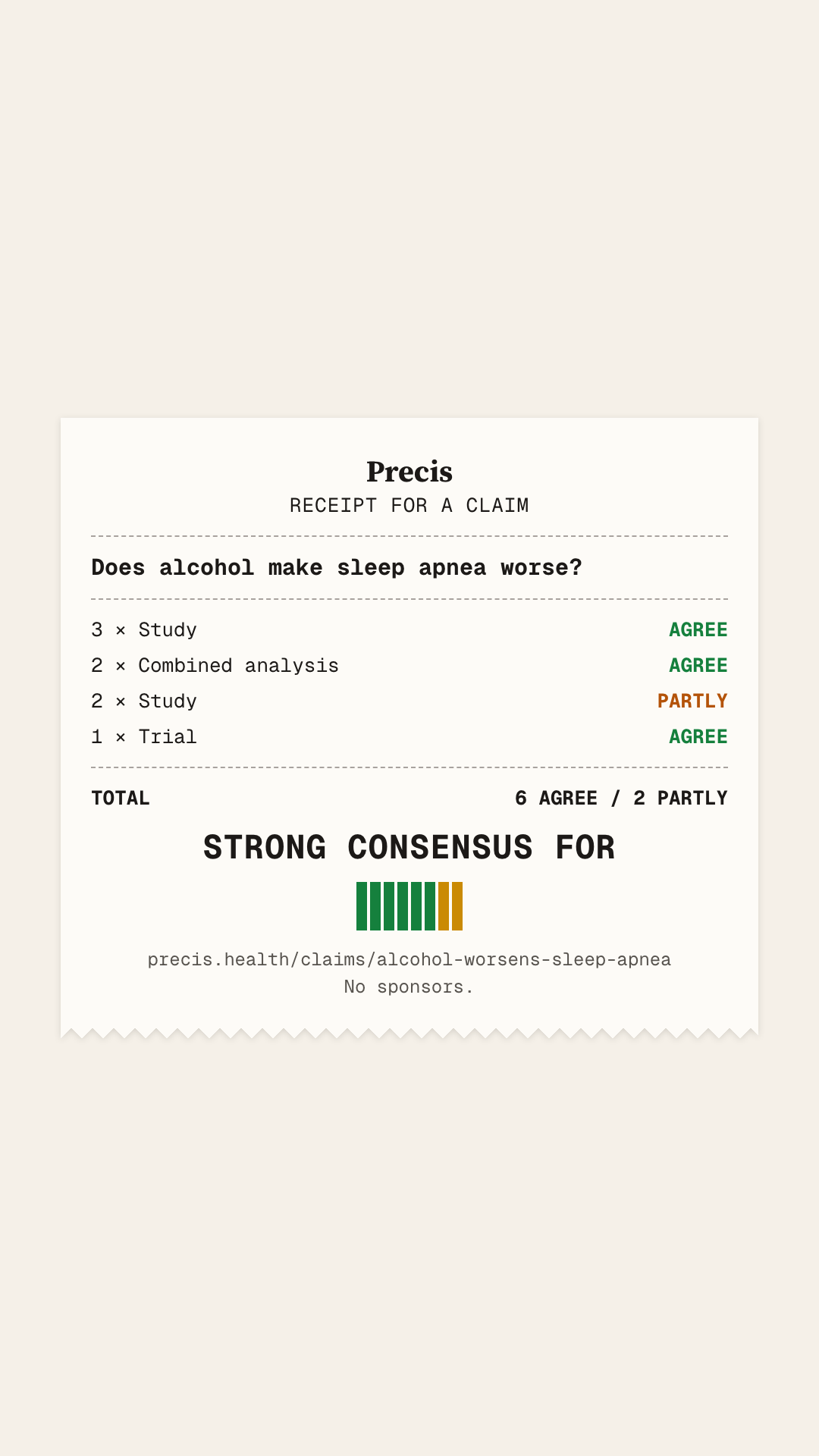
PrecisRECEIPT FOR A CLAIM


Does alcohol make sleep apnea worse?


  • 3 × StudyAGREE
  • 2 × Combined analysisAGREE
  • 2 × StudyPARTLY
  • 1 × TrialAGREE

TOTAL6 AGREE / 2 PARTLY

Strong consensus for

What do the studies say?

Strong consensus for

Six of eight studies agree, and none disagree. A pooled analysis of 14 trials gave the same people alcohol or a dummy drink, and found that alcohol can make sleep apnea worse. In a trial of 21 men who snored, the apnea-hypopnea index (AHI), the count of breathing pauses per hour of sleep, rose after a moderate drink. A second pooled analysis, of 21 studies, found a 25% higher risk of apnea in people who drank. Two studies partly agree. Both looked at who goes on to get apnea, not how bad it gets, and found a small or uncertain link.

Computed from 8 studies that test this point, each judged by two readers, in full. 10 more studies are waiting for a full read and do not count yet.

What was said on the podcast?

“Alcohol can affect the muscles involved in breathing, and opioids are particularly important because they interfere with the brain's control of breathing, and they can also contribute to sleep disordered breathing. So if your apnea gets dramatically worse after drinking”
Mark Hyman, The Doctor's Farmacy · Sleep Apnea: Why CPAP Isn't Fixing the Real Problem (This Does!) · 11:36 on YouTube
Episode check Blood pressure that stays high on treatment should make you think of sleep apnea, the episode says. Three of seven studies agree, and four partly agree. 10 claims checked against 86 studies See every claim we checked →
The point checked Strong consensus for

Drinking alcohol makes obstructive sleep apnea worse

Agree 6

controlled trial · 2000

“The mean apnoea/hypopnoea index rose from 7.1‹1.9 to 9.7‹2.1 events.h-1 (mean‹SEM, p=0.017); however, there was no significant change in the minimum”

Effect of moderate alcohol upon obstructive sleep apnoea. Eur Respir J
Who: 21 male habitual snorers aged 34-59 (mean 43.5, BMI 21-38) with mild-to-moderate OSA and moderate habitual alcohol use
PMID 11153591

pooled analysis · 2018

“Data from the current systematic review and meta-analysis indicate that alcohol consumption can also significantly exacerbate OSA.”

The impact of alcohol on breathing parameters during sleep: A systematic review and meta-analysis. Sleep Med Rev
Who: 422 subjects (71.9% male) in 14 crossover randomized trials of alcohol vs placebo: mostly healthy men, plus snorers, 2 COPD studies and 2 studies of patients with OSA
PMID 30017492

other primary study · 2022

“In this study, we found that alcohol consumption was an independent risk factor of OSA and OSA with hypoxia, and alcohol consumption was related with AHI significantly after adjustment, especially in female.”

Alcohol as an independent risk factor for obstructive sleep apnea. Ir J Med Sci
Who: 793 inpatients with suspected OSA at a Chinese tertiary hospital (688 OSA by polysomnography, about 106 controls), aged 16-90
PMID 34110582

pooled analysis · 2018

“A pooled analysis of the 21 studies from which relative risks could be estimated found the overall risk of OSA to be increased by 25% in people who consumed alcohol at all, or in higher amounts, than those who consumed no, or lower amounts of alcohol, respectively (pooled RR 1.25, 95% CI 1.13 to 1.38, I 2 = 82%; Fig. 2 ).”

Alcohol and the risk of sleep apnoea: a systematic review and meta-analysis. Sleep Med
Who: adults aged 18+ in 31 observational studies (20 cross-sectional, 9 case-control, 2 cohort) from Asia, the US, Australia, Europe and Africa
PMID 29458744

Show 2 more Show fewer

other primary study · 2016

“After adjusting for age and BMI, heavy drinkers [OR = 2.11 (1.30–3.44)] and light drinkers [OR = 2.06 (95% CI = 1.29–3.31)] were more likely to have severe SDB than were non-drinkers.”

Habitual Alcohol Consumption and Metabolic Syndrome in Patients with Sleep Disordered Breathing. PLoS One
Who: 683 Korean men aged 20-74 with sleep-disordered breathing (AHI >=5) seen in a hospital health checkup program
PMID 27536782

other primary study · 2025

“We present a case of dramatic and reversible increase in OSA severity driven by alcohol consumption.”

A Case of Mild OSA Exacerbated by Alcohol Use. Respirol Case Rep
Who: one 65-year-old man with persistent atrial fibrillation, BMI 26.6, referred for possible OSA
PMID 41019363

Partly agree 2

other primary study · 2024

“Although the significant relationship was confirmed by the weighted median and MR RAPS methods, MR-Egger showed a reverse direction, calling for further validation of this association ( Figure 3 , Supplementary Table 5 ).”

Effects of common lifestyle factors on obstructive sleep apnea: precautions in daily life based on causal inferences. Front Public Health
Who: European GWAS summary data: alcohol intake frequency in 462,346 UK Biobank adults aged 40-69 and alcohol consumption in 941,280 (GSCAN); OSA outcome from FinnGen (217,955 people, 16,761 OSA cases)
PMID 38504681

other primary study · 2026

“Fifth, we could not assess the severity of incident OSA, as clinical metrics such as the apnea-hypopnea index are not available in the NHID.”

The influence of habitual consumption of alcohol on the incidence of obstructive sleep apnea: a national population-based cohort study. Sleep Breath
Who: 3,988,993 Korean adults aged >=40 without prior sleep apnea who had a national health checkup in 2011-2012
PMID 41999469

Disagree 0· none of the studies we read

More on sleep and light

The Precis Weekly

Get each new check by email.

One email a week with the claims and episodes we checked, what the studies found and the minute each claim was said.

Free. Unsubscribe anytime.