A claim you hear on longevity podcasts

Do tongue exercises help sleep apnea?

Leaning for. Of 10 studies that test it, 6 agree, 2 partly agree and 2 disagree.

Best for:
Anyone looking for tongue exercises for sleep apnea
Price:
Free to read, with every receipt. Pro is $9 a month or $79 a year and adds AI Ask.

The claim checked: Exercises for the tongue and throat can be part of treating sleep apnea for some people Hear it at 16:07

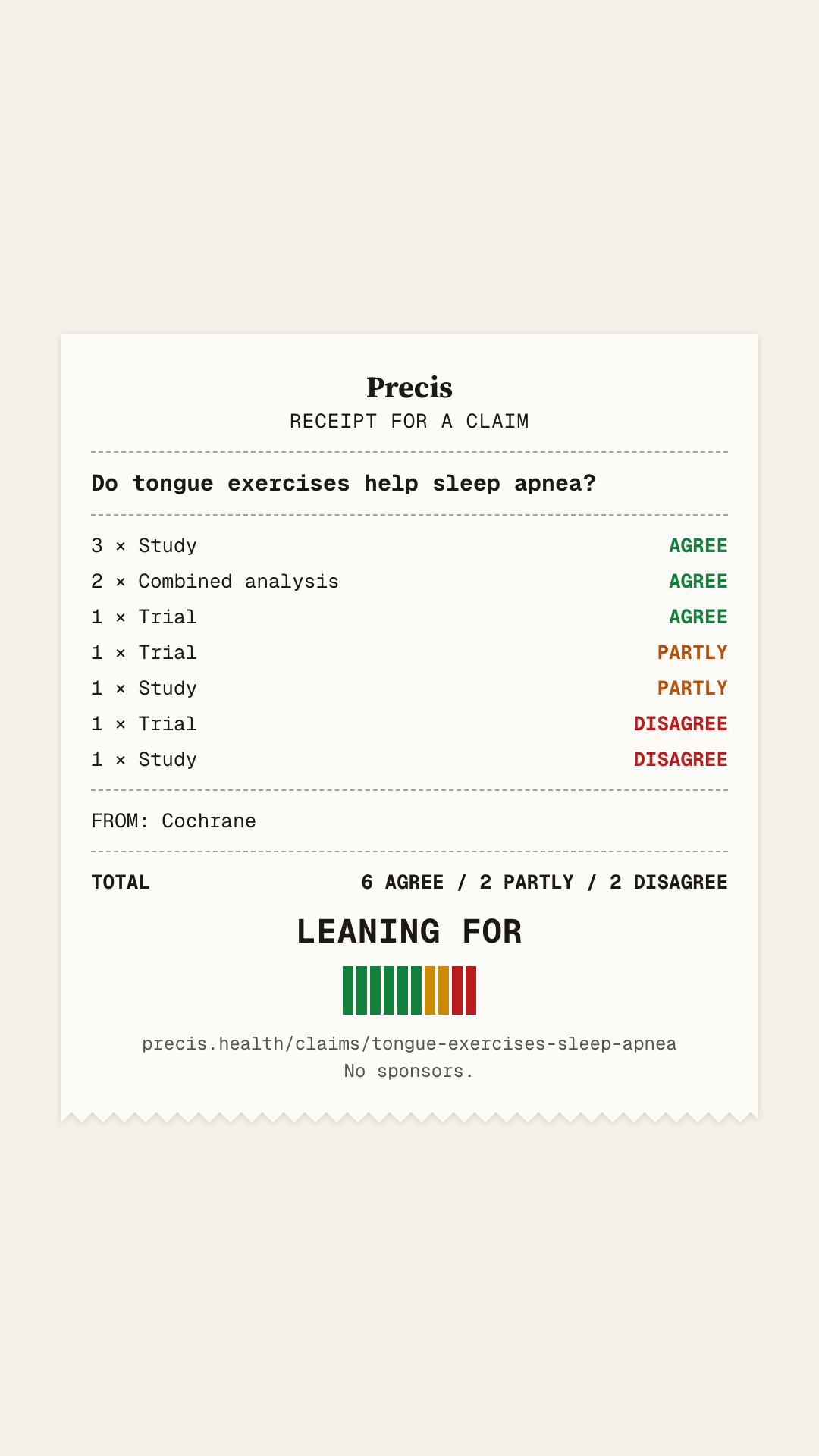
PrecisRECEIPT FOR A CLAIM


Do tongue exercises help sleep apnea?


  • 3 × StudyAGREE
  • 2 × Combined analysisAGREE
  • 1 × TrialAGREE
  • 1 × TrialPARTLY
  • 1 × StudyPARTLY
  • 1 × TrialDISAGREE
  • 1 × StudyDISAGREE

FROM: Cochrane


TOTAL6 AGREE / 2 PARTLY / 2 DISAGREE

Leaning for

What do the studies say?

Leaning for

Six of ten studies agree, two disagree and two partly agree. The studies call these exercises myofunctional therapy. A pooled analysis found it cut the apnea-hypopnea index (AHI), the count of breathing pauses per hour of sleep, by about 50% in adults. A Cochrane review of trials found it probably eases daytime sleepiness compared with sham exercises. But two trials found no real change in how severe the apnea was, and the two that partly agree found some gains, such as less sleepiness, while the breathing pauses did not drop by a clear margin.

Computed from 10 studies that test this point, each judged by two readers, in full. 10 more studies are waiting for a full read and do not count yet.

What was said on the podcast?

“There are exercises designed to strengthen and reposition the tongue and muscles of the mouth and upper airway. Now these can be part of treatment for selected patients.”
Mark Hyman, The Doctor's Farmacy · Sleep Apnea: Why CPAP Isn't Fixing the Real Problem (This Does!) · 16:07 on YouTube
Episode check Blood pressure that stays high on treatment should make you think of sleep apnea, the episode says. Three of seven studies agree, and four partly agree. 10 claims checked against 86 studies See every claim we checked →
The point checked Leaning for

Exercises for the tongue, mouth and upper airway can help treat obstructive sleep apnea in some patients

Agree 6

pooled analysis · 2015 · landmark

“Current literature demonstrates that myofunctional therapy decreases AHI by approximately 50% in adults and 62% in children.”

Myofunctional Therapy to Treat Obstructive Sleep Apnea: A Systematic Review and Meta-analysis. Sleep
Who: Adults (9 studies, mean age 44.5, BMI 28.9) and children (2 studies, mean age 8.4) with OSA treated with oral/oropharyngeal myofunctional therapy alone
PMID 25348130

controlled trial · 2020

“The AHI decreased by 53.36% from 44.7 (IQR 33.8-55.6) to 20.88 (IQR 14.02-27.7) events/hour ( P <.001) ( Figure 4 ).”

Myofunctional Therapy App for Severe Apnea-Hypopnea Sleep Obstructive Syndrome: Pilot Randomized Controlled Trial. JMIR Mhealth Uhealth
Who: Adults newly diagnosed with severe OSA (AHI >30), two hospitals in Andalucia, Spain
PMID 33093013

pooled analysis · 2020

“Compared to sham therapy, myofunctional therapy probably reduces daytime sleepiness and may increase sleep quality in the short term.”

Myofunctional therapy (oropharyngeal exercises) for obstructive sleep apnoea. Cochrane Database Syst Rev
Who: Adults (mean ages 46-51, mild to severe OSA) and 13 children with OSA in randomized controlled trials of myofunctional therapy
PMID 33141943

other primary study · 2018

“In conclusion, oropharyngeal muscle exercises reduced OSAS severity and increased sleep quality in stroke patients with moderate OSAS.”

Oropharyngeal Muscle Exercise Therapy Improves Signs and Symptoms of Post-stroke Moderate Obstructive Sleep Apnea Syndrome. Front Neurol
Who: Adults within 3 weeks of a first stroke in a rehabilitation unit with moderate OSA (AHI 15-30), Dalian, China
PMID 30420832

Show 2 more Show fewer

other primary study · 2021

“In the 35 adherent patients, the AHI changed significantly from 32.97 ± 1.8/h to 21.9 ± 14.5/h ( t = 6.360, p < 0.05) ( Figure 1 and Figure 2 ).”

Improving Adherence to Myofunctional Therapy in the Treatment of Sleep-Disordered Breathing. J Clin Med
Who: Adults with moderate or severe OSA who rejected CPAP and other options, two sleep units in Spain
PMID 34945068

other primary study · 2017

“In conclusion, OMFT in this patient with mild OSA markedly decreased the AHI and hypopnea index, and improved objective sleep and subjective symptoms of snoring and dry mouth.”

Lip muscle training improves obstructive sleep apnea and objective sleep: a case report. Sleep Sci
Who: One 20-year-old woman (BMI 18.6) with mild OSA, heavy snoring and dry mouth who could not tolerate a mandibular advancement device, Japan
PMID 29410742

Partly agree 2

controlled trial · 2022

“Comparing the changes between groups after 6 weeks of intervention, only the ESS score and tongue endurance differed significantly, in favour of the intervention group (Table 3 , Figure 2 ).”

The effect of tongue elevation muscle training in patients with obstructive sleep apnea: A randomised controlled trial. J Oral Rehabil
Who: Adults diagnosed with moderate OSA with low CPAP adherence (<4 h/night), Lausanne and Brussels sleep centres
PMID 36081312

other primary study · 2024

“While the AHI reduction was not significant, we found that the success rate for improvement in the lip exercise was correlated with AHI reduction in the supine position ( R s =-0.76; P =.03).”

Preliminary Assessment of an Ambulatory Device Dedicated to Upper Airway Muscle Training in Patients With Sleep Apnea: Proof-of-Concept Study. JMIR Biomed Eng
Who: Men and postmenopausal women aged 65 or younger with BMI 30 or less and untreated mild or moderate OSA, Quebec sleep clinic
PMID 38875673

Disagree 2

other primary study · 2021

“In the present study, pharyngeal muscle training was not associated with improvements in the objective and subjective sleep measurements in OSA patients.”

A Pilot Randomized Controlled Trial of Effect of Genioglossus Muscle Strengthening on Obstructive Sleep Apnea Outcomes. J Clin Med
Who: Adults aged 18-79 with OSA (AHI >10) on APAP, on an oral appliance with residual OSA, or untreated, UC San Diego
PMID 34640575

controlled trial · 2025

“Our results indicate that a 20-week program of OMT and cervical exercises did not produce significant differences in the severity of OSA compared to lifestyle and dietary measures.”

Effectiveness of strenghtning oropharyngeal myofunctional therapy combined with cervical spine exercises in mild to moderate obstructive sleep apnoea. Sleep Breath
Who: Adults aged 18-70 with mild to moderate OSA (AHI 5-30) who refused or were not candidates for CPAP or oral appliances, Santander, Spain
PMID 41205126

More on sleep and light

The Precis Weekly

Get each new check by email.

One email a week with the claims and episodes we checked, what the studies found and the minute each claim was said.

Free. Unsubscribe anytime.