A claim you hear on longevity podcasts

Can thin or fit people have sleep apnea?

Leaning for. Of 7 studies that test it, 4 partly agree and 3 agree.

Best for:
Anyone reading about sleep apnea in thin people
Price:
Free to read, with every receipt. Pro is $9 a month or $79 a year and adds AI Ask.

The claim checked: You can be thin or physically fit and still have sleep apnea Hear it at 3:20

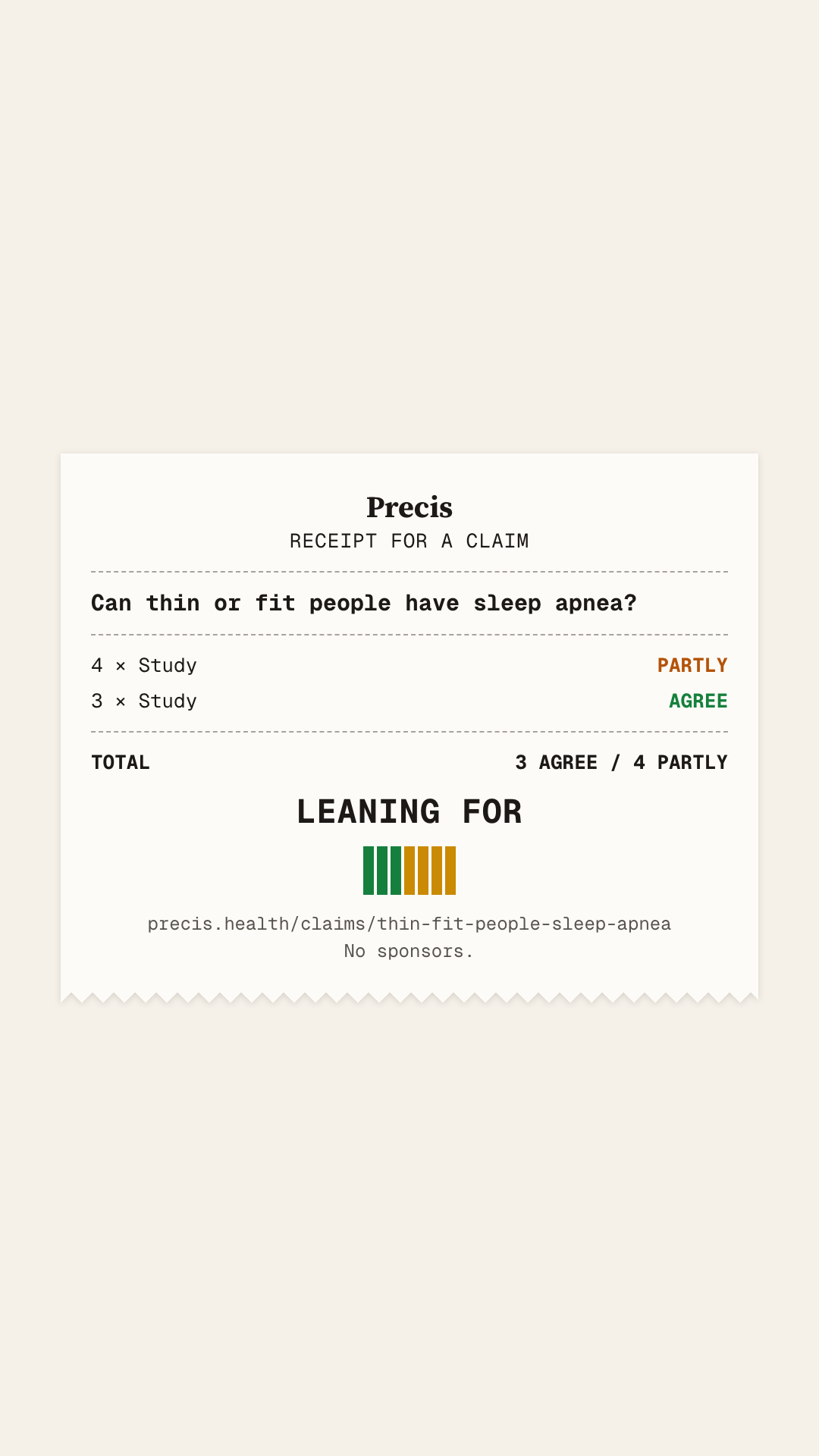
PrecisRECEIPT FOR A CLAIM


Can thin or fit people have sleep apnea?


  • 4 × StudyPARTLY
  • 3 × StudyAGREE

TOTAL3 AGREE / 4 PARTLY

Leaning for

What do the studies say?

Leaning for

Three of seven studies agree, four partly agree and none disagree. Of 163 adults sent to a Sydney sleep clinic, most of whom had apnea, 25% had a normal weight and 54% were not obese. In a Bangkok clinic, 63.4% of 194 people with apnea were not obese by that clinic's cutoff. A Wisconsin analysis found apnea in normal-weight adults too, from 2.5% of younger women to 26% of older men. The four that partly agree find that the risk still rises with weight, and that screening built around weight can miss thinner people.

Computed from 7 studies that test this point, each judged by two readers, in full. 10 more studies are waiting for a full read and do not count yet.

What was said on the podcast?

“You can be thin and have sleep apnea. You can be physically fit and have sleep apnea.”
Mark Hyman, The Doctor's Farmacy · Sleep Apnea: Why CPAP Isn't Fixing the Real Problem (This Does!) · 3:20 on YouTube
Episode check Blood pressure that stays high on treatment should make you think of sleep apnea, the episode says. Three of seven studies agree, and four partly agree. 10 claims checked against 86 studies See every claim we checked →
Point 1 of 2 Leaning for

Many people with obstructive sleep apnea are not overweight or obese, and the overweight stereotype misses them

Agree 3

other primary study · 2005 · landmark

“The prevalence of SDB in persons with BMI of <25 kg/m2, although much less than in higher BMI categories, is still of substantial public health importance, with the prevalence of mild or worse SDB ranging from 2.5% in normal weight younger women to 26% in normal weight older men.”

Excess weight and sleep-disordered breathing. J Appl Physiol (1985)
Who: Narrative review of community and clinical studies of adults, plus a new analysis of Wisconsin Sleep Cohort in-laboratory polysomnography data extrapolated to US adults aged 30-69 (2003 census and BRFSS BMI distributions)
PMID 16160020

other primary study · 2017

“Twenty-five percent had a BMI within the normal range (BMI < 25 kg/m2) and 54% had a BMI < 30 kg/m2 (non-obese).”

Obstructive Sleep Apnea without Obesity Is Common and Difficult to Treat: Evidence for a Distinct Pathophysiological Phenotype. J Clin Sleep Med
Who: 163 consecutive adults referred for suspected OSA to an academic teaching-hospital sleep clinic in Sydney, predominantly Caucasian
PMID 27655455

trial or observed group · 2013

“Among these 194 patients with OSA (RDI ≥ 5), 63.4% were non-obese and 36.6% were obese.”

Comparison of polysomnographic and clinical presentations and predictors for cardiovascular-related diseases between non-obese and obese obstructive sleep apnea among Asians. J Clin Sleep Med
Who: 194 Thai adults (>=18 y) with OSA (RDI>=5) referred to a Bangkok hospital sleep laboratory; non-obese defined as BMI<25
PMID 23772188

Partly agree 4

other primary study · 2013 · landmark

“The prevalence of SDB was substantially higher in men, older subjects, and subjects with higher BMIs.”

Increased prevalence of sleep-disordered breathing in adults. Am J Epidemiol
Who: 1,520 Wisconsin state employees aged 30-70 (96% non-Hispanic white) with in-laboratory polysomnography 1988-2011, extrapolated to US NHANES BMI distributions
PMID 23589584

trial or observed group · 2015 · landmark

“SDB was more prevalent in Hispanics and in Chinese, especially Chinese-American men, a group rarely recognized to be at increased risk for SDB.”

Racial/Ethnic Differences in Sleep Disturbances: The Multi-Ethnic Study of Atherosclerosis (MESA). Sleep
Who: 2,230 White, Black, Hispanic and Chinese adults aged 54-93 in six US communities (MESA Sleep, 2010-2013)
PMID 25409106

other primary study · 2022

“Given the historical reliance on BMI and age for detecting OSA, it is possible that the screening questionnaires may miss high risk of OSA in younger and thinner veterans with PTSD.”

STOP-BANG screener vs objective obstructive sleep apnea testing among younger veterans with PTSD and insomnia: STOP-BANG does not sufficiently detect risk. J Clin Sleep Med
Who: 48 treatment-seeking US veterans with PTSD and insomnia (mean age 43.7, 79.2% male, mean BMI 28.8)
PMID 34216197

trial or observed group · 2019

“Thirthy six patients with OSA (36.4%) were non-obese and 63 patients (63.6%) were obese.”

[The clinical and polysomnographic differences between obese and non-obese patients with obstructive sleep apnea]. Tuberk Toraks
Who: 99 Turkish adults with OSA (AHI>=5) out of 157 patients undergoing polysomnography at Ankara University; non-obese defined as BMI<30 (mean BMI 26.7)
PMID 32050867

Disagree 0· none of the studies we read

Point 2 of 2 Strong consensus for

Physically fit people can have obstructive sleep apnea

Six of eight studies agree, and none disagree. Apnea turned up in 19% of 137 NFL players, 55% of 40 college football players and 30% of 20 elite swimmers. Many of these athletes were heavy, though: the NFL players had an average body mass index (BMI) of 32.4, in the obese range. Two studies partly agree. Fitter Swedish men at age 18 had a lower risk of apnea later in life, and among non-obese Japanese workers, exercise did not protect against it.

Computed from 8 studies that test this point, each judged by two readers, in full. 10 more studies are waiting for a full read and do not count yet.

Agree 6

other primary study · 2010

“At least mild SDB (RDI of ≥ 5) was present in 19% (95% CI, 12.8%-26.6%) of the total population.”

Sleep-disordered breathing in the National Football League. Sleep
Who: 137 active veteran NFL players from 6 teams (mean age 27, mean BMI 32.4)
PMID 20550023

other primary study · 2017

“22/40 (55%) ASF participants demonstrated SDB with an apnea-hypopnea index (pAHI) ≥5.”

Sleep-Disordered Breathing and Cardiovascular Correlates in College Football Players. Am J Cardiol
Who: 40 NCAA Division I collegiate American-style football players (freshmen and sophomores, about 18 years old) at two US universities
PMID 28823486

other primary study · 2019

“We found that prevalence of obstructive sleep apnoea (OSA) in elite swimmers defined as oxygen desaturation index ≥5 was 30%.”

Sleep in elite swimmers: prevalence of sleepiness, obstructive sleep apnoea and poor sleep quality. BMJ Open Sport Exerc Med
Who: 20 elite swimmers from one squad (mean age 20.7, mean BMI 22.6, 10 male and 10 female) with overnight oximetry; questionnaire arm of 243 athletes and controls
PMID 32095263

other primary study · 2019

“The RDI level was 6.6 (0.6–16.6) and 12 participants (63%) suffered from SDB (RDI ≥5).”

Impact of sleep disordered breathing on performance in judo players. BMJ Open Sport Exerc Med
Who: 19 male heavyweight-class university judo players in Japan (body weight >=100 kg or BMI>=30; median BMI 33.9, median age 21)
PMID 31205742

Show 2 more Show fewer

other primary study · 2022

“Among the 42 elite Japanese rugby union athletes examined in this study, 64.3% had OSA with varying degrees of severity, which was associated with a larger neck circumference.”

Mandibular Advancement Device Therapy in Japanese Rugby Athletes with Poor Sleep Quality and Obstructive Sleep Apnea. Life (Basel)
Who: 42 Japanese male professional rugby union athletes (mean age 26.3, mean BMI 26.7)
PMID 36143335

other primary study · 2025

“In the current study, we demonstrate that collegiate football players from Colorado State University present with OSA at a rate of 35%, as defined by an AHI > 5 events/h determined by the in-home WatchPAT 300 device, which extends and refines our understanding of OSA prevalence in collegiate athletes.”

Prevalence and predictors of obstructive sleep apnea in collegiate football players. J Clin Sleep Med
Who: Male Colorado State University football players (mean age 20.3, mean BMI 29.2)
PMID 40135688

Partly agree 2

other primary study · 2019

“Low CRF at age 18 years was associated with subsequent increased risk of sleep apnea in adulthood, after adjusting for height, weight, and other potential confounders (Table 2, adjusted model 2, lowest vs. highest tertile: IRR, 1.44; 95% CI, 1.40–1.49; P<0.001).”

Cardiorespiratory fitness and long-term risk of sleep apnea: A national cohort study. J Sleep Res
Who: Swedish male military conscripts aged 18 (1969-1997), 97-98% of all 18-year-old men
PMID 30957362

other primary study · 2017

“Our results do not suggest that physical activity had a protective effect against the development of SDB among non-obese Japanese men.”

Association between physical activity and sleep-disordered breathing in male Japanese workers: a cross-sectional study. BMC Res Notes
Who: Non-obese (BMI<30) male workers at a Tokyo petroleum-related company who drove for work
PMID 28069061

Disagree 0· none of the studies we read

More on sleep and light

The Precis Weekly

Get each new check by email.

One email a week with the claims and episodes we checked, what the studies found and the minute each claim was said.

Free. Unsubscribe anytime.