A claim you hear on longevity podcasts

Can you have sleep apnea without feeling tired?

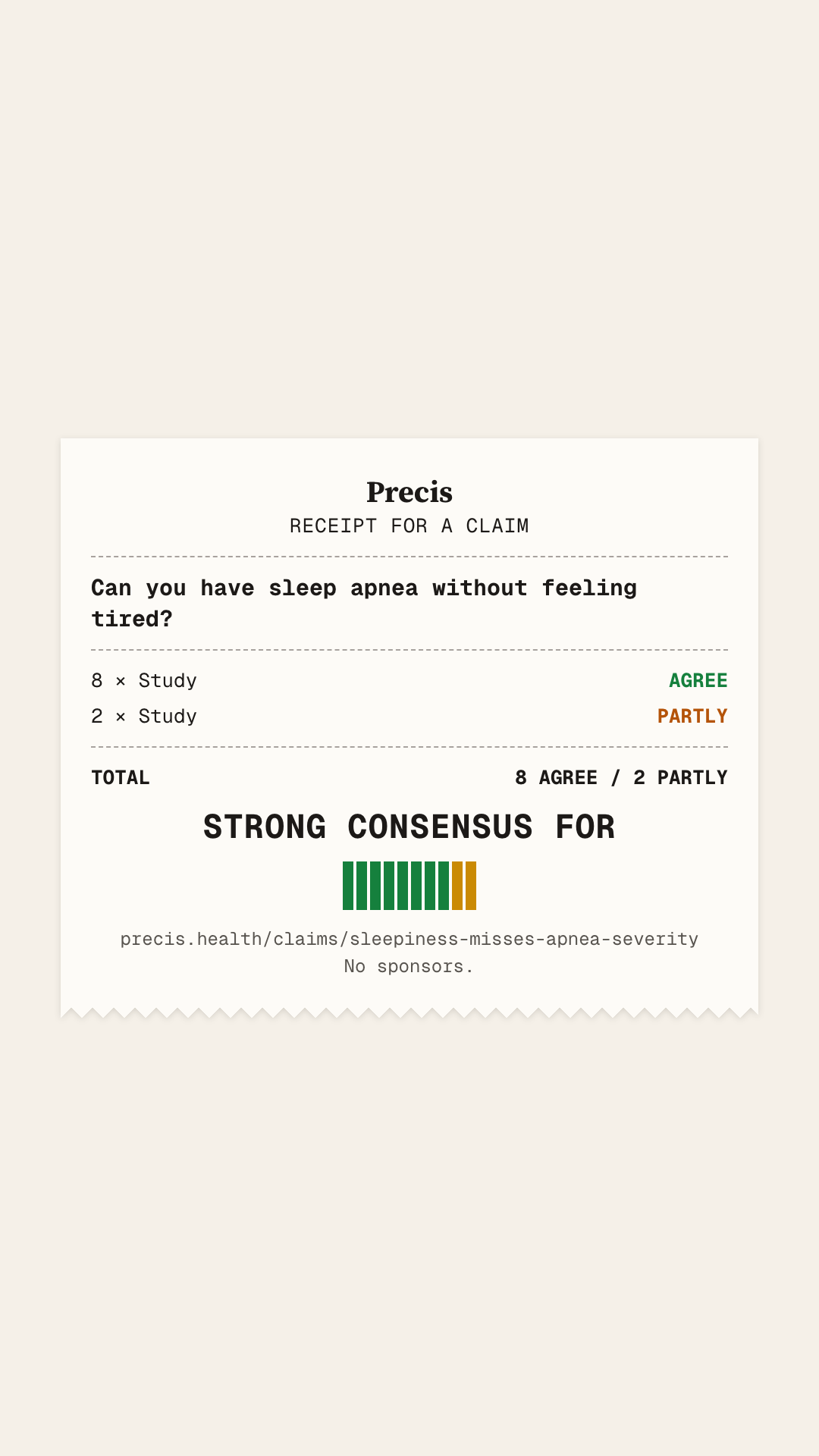
Strong consensus for. Of 10 studies that test it, 8 agree and 2 partly agree.

Best for:
Anyone who snores but feels fine during the day
Price:
Free to read, with every receipt. Pro is $9 a month or $79 a year and adds AI Ask.

The claim checked: How you feel is not a reliable measure of how bad your sleep apnea is Hear it at 12:42

PrecisRECEIPT FOR A CLAIM


Can you have sleep apnea without feeling tired?


  • 8 × StudyAGREE
  • 2 × StudyPARTLY

TOTAL8 AGREE / 2 PARTLY

Strong consensus for

What do the studies say?

Strong consensus for

Eight of ten studies agree, and none disagree. In a Swedish registry from 23 sleep centres, the link between daytime sleepiness and apnea severity was weak. Severity here is the apnea-hypopnea index (AHI), the count of breathing pauses per hour of sleep. In 6,593 adults tested at the Mayo Clinic, the standard sleepiness score did not track mild to moderate apnea in women. Two studies partly agree. In 362 patients, how far oxygen dropped tracked sleepiness better than the count of pauses, and a weighted sleepiness score picked out severe apnea well.

Computed from 10 studies that test this point, each judged by two readers, in full. 10 more studies are waiting for a full read and do not count yet.

What was said on the podcast?

“How you feel isn't always a reliable measure of severity. Some people with significant apnea don't realize how impaired their sleep has become.”
Mark Hyman, The Doctor's Farmacy · Sleep Apnea: Why CPAP Isn't Fixing the Real Problem (This Does!) · 12:42 on YouTube
Episode check Blood pressure that stays high on treatment should make you think of sleep apnea, the episode says. Three of seven studies agree, and four partly agree. 10 claims checked against 86 studies See every claim we checked →
Point 1 of 2 Strong consensus for

How sleepy or unwell a person feels does not reliably reflect how severe their obstructive sleep apnea is

Agree 8

other primary study · 2007

“Given that the remaining nocturnal variables investigated, including the apnoea/hypopnoea index, arousal index and sleep architecture, do not discriminate between patients with and without excessive daytime sleepiness, it was postulated that nocturnal hypoxaemia plays a major role in the pathogenesis of daytime sleepiness in patients with sleep apnoea syndrome.”

Daytime sleepiness and polysomnographic variables in sleep apnoea patients. Eur Respir J
Who: 40 consecutive male patients at a Palma de Mallorca sleep unit with AHI >20 events/h, selected as clearly sleepy (ESS >10 and MSLT <5 min, n=23) or clearly not sleepy (ESS <10 and MSLT >10 min, n=17)
PMID 17360730

other primary study · 2020

“In previously published papers on relation of OSA severity and EDS, majority of them reported no correlation between the AHI index and ESS score; similarly, we found no such correlation (data not shown).”

Association between excessive daytime sleepiness, REM phenotype and severity of obstructive sleep apnea. Sci Rep
Who: 292 adults (46.9% men, mean age 53.7) with mild to moderate OSA referred to a sleep centre in Lodz, Poland, 2011-2016: 102 REM-dependent OSA and 190 REM-independent OSA (AHI 5-30)
PMID 31913307

other primary study · 2022

“The correlation between severity of the obstructive sleep apnea condition, conventionally expressed by the AHI and daytime sleepiness was weak in our study in line with previously well established data (e.g., Kingshott et al., 1995 ).”

Correlates of excessive daytime sleepiness in obstructive sleep apnea: Results from the nationwide SESAR cohort including 34,684 patients. J Sleep Res
Who: Patients with newly diagnosed OSA in the Swedish Sleep Apnea Registry (SESAR), 23 sleep centres, April 2010-December 2019 (67% male, mean age 55.7, mean AHI 29.1, mean BMI 30.2); diagnosed by cardiorespiratory polygraphy in >99%
PMID 35869576

other primary study · 2019

“ESS is not correlated with SDB at mild to moderate levels in women and has a smaller association than in men with severe SDB.”

Correlation of the Epworth Sleepiness Scale and Sleep-Disordered Breathing in Men and Women. J Clin Sleep Med
Who: 6,593 consecutive adults (42% women; mean age 56-58) who completed the ESS and then attended in-laboratory polysomnography at Mayo Clinic, Rochester, January 2013-January 2015
PMID 30621827

Show 4 more Show fewer

other primary study · 2012

“Some of these differences can be explained by the presence or absence of OSA; there were weak, but statistically significant correlations between ESS score and PSG indices of OSA severity (RDI and lowest SaO2).”

Body mass index, gender, and ethnic variations alter the clinical implications of the epworth sleepiness scale in patients with suspected obstructive sleep apnea. Open Respir Med J
Who: 1900 consecutive patients aged 12 or older referred for polysomnography for suspected OSA at the Torr Sleep Center, Corpus Christi, Texas (1092 male, 805 female; mostly Caucasian or Hispanic; mean BMI in the obese range)
PMID 22670164

other primary study · 2021

“According to our study’s results, EDS is not a predictive symptom of OSA among women.”

Gender differences in the sleep variables contributing to excessive daytime sleepiness among patients with obstructive sleep apnea. Sleep Breath
Who: 858 adults over 18 (578 men, 280 women) with suspected OSA and no prior diagnosis, referred to the Sleep Medicine Institute at Assuta Medical Centers, Israel, who completed the ESS and a home sleep test
PMID 33464468

trial or observed group · 2007

“We noticed that there were no statistically significant differences (p>0.05) among the symptoms related to daily sleepiness, apnea, lack of concentration and attention, restless sleep, as well as findings of high BMI and positive Epworth scales, all comparative data with the results from polysomnographies classified as moderate to severe, versus the ones considered normal or mild.”

Comparative study between clinical history and polysomnogram in the obstructive sleep apnea/ hypopnea syndrome. Braz J Otorhinolaryngol
Who: 125 patients (75 male, 50 female; 6 under age 15) referred for polysomnography for suspected OSA at an otorhinolaryngology department in Brazil, November 2003-February 2004; 46% had a normal PSG
PMID 18278218

trial or observed group · 2007

“There was no statistically significant difference in the severity of OSA between the subjects with and without symptoms.”

[Clinical presentation of obese patients with polysomnographic diagnosis of obstructive sleep apnea]. Arq Bras Endocrinol Metabol
Who: 73 obese adults (BMI >=30 kg/m2, mean age 45.2, 57.5% male) with AHI >=5 on polysomnography at two sleep laboratories in Salvador, Brazil, July-December 2004
PMID 18157380

Partly agree 2

other primary study · 2019

“this results in a selection bias related to subjective sleepiness, because this study lacks subjectively”

Severity of Desaturations Reflects OSA-Related Daytime Sleepiness Better Than AHI. J Clin Sleep Med
Who: 362 OSA patients (AHI >=5, total sleep time >=4 h; 82% male; median age 68) with complaints of sleepiness who had polysomnography and next-day MSLT at Loewenstein Hospital, Israel, 2001-2003
PMID 31482835

other primary study · 2020

“The capability in predicting the patients without OSAS or with severe OSAS was strong, especially the latter, and the weighted ESS orchestrated manifest improvement in screening the patients with simple snoring.”

Weighted Epworth sleepiness scale predicted the apnea-hypopnea index better. Respir Res
Who: Chinese adults with suspected OSA at a tertiary university hospital: derivation cohort 756 (86% male, mean age 43.5, BMI 26.3) and validation cohort 810 (83% male, mean age 39.6), all with overnight polysomnography
PMID 32532260

Disagree 0· none of the studies we read

Point 2 of 2 Strong consensus for

Some people with significant obstructive sleep apnea do not feel sleepy or notice how disturbed their sleep is

All ten studies agree. In the Icelandic Sleep Apnoea Cohort of 822 people with moderate to severe apnea, over half were not clearly sleepy. In the Sleep Heart Health Study, 32.6% of people with moderate to severe apnea had few symptoms. In a Swedish registry, 41.4% of men and 44.6% of women scored as too sleepy, so most did not.

Computed from 10 studies that test this point, each judged by two readers, in full. 10 more studies are waiting for a full read and do not count yet.

Agree 10

other primary study · 2014 · landmark

“Patients in cluster 1 and cluster 2, which together made up over half of the sample, were less likely to present with clinically significant daytime sleepiness (i.e. mean ESS score <10).”

The different clinical faces of obstructive sleep apnoea: a cluster analysis. Eur Respir J
Who: 822 newly diagnosed adults with moderate-to-severe OSA (AHI >=15; 81% male, mean age 54.5, mean BMI 33.5, mean AHI 44.9) referred for PAP therapy in the Icelandic Sleep Apnoea Cohort
PMID 25186268

other primary study · 2022

“The proportion of patients with excessive daytime sleepiness was 41.4% in men and 44.6% in women when using a cutoff of ESS≥10, and 16.9% and 24.0%, respectively, when using a cutoff of ESS≥15.”

Correlates of excessive daytime sleepiness in obstructive sleep apnea: Results from the nationwide SESAR cohort including 34,684 patients. J Sleep Res
Who: Patients with newly diagnosed OSA in the Swedish Sleep Apnea Registry (SESAR), 23 sleep centres, April 2010-December 2019 (67% male, mean age 55.7, mean AHI 29.1, mean BMI 30.2); diagnosed by cardiorespiratory polygraphy in >99%
PMID 35869576

other primary study · 2021

“Our findings suggest that, despite evidence for moderate to severe OSA (REI3% ≥ 15), a large portion of individuals meeting clinical OSA criteria could go undiagnosed and untreated due to minimum symptoms/complaints present.”

Phenotypes of obstructive sleep apnea in the Hispanic Community Health Study/Study of Latinos. Sleep
Who: 1,605 community-dwelling Hispanic/Latino adults aged 18-74 with moderate-to-severe OSA on home sleep testing (REI3% >=15; mean age 52.4, 34% female, mean REI 33.8) in the HCHS/SOL cohort, 2008-2011
PMID 34272952

other primary study · 2019 · landmark

“Based on the distribution of observed symptoms, the subtypes were labeled as disturbed sleep (n = 147; 12.2%), minimally symptomatic (n = 394; 32.6%), excessively sleepy (n = 201; 16.7%), and moderately sleepy (n = 465; 38.5%).”

Symptom Subtypes of Obstructive Sleep Apnea Predict Incidence of Cardiovascular Outcomes. Am J Respir Crit Care Med
Who: 1,207 community-dwelling adults over 40 with moderate-to-severe OSA (AHI >=15; mean age 66, 67.3% men, mean AHI 30.7, mean ESS 8.7) in the Sleep Heart Health Study, plus 2,830 without OSA as comparators
PMID 30764637

Show 6 more Show fewer

trial or observed group · 2018 · landmark

“Overall, patients in this cluster appear resilient to usual clinical features of OSA, and thus, the impact of disease may not be reflected in measured symptoms.”

Recognizable clinical subtypes of obstructive sleep apnea across international sleep centers: a cluster analysis. Sleep
Who: 972 sleep-clinic patients with moderate-to-severe OSA (AHI >=15; mean age 51.9, 70.3% male, mean BMI 33.8, mean AHI 42.9) from 8 SAGIC centres in the US, Australia, Germany, Brazil, Taiwan and Iceland (215 Icelandic, 757 international)
PMID 29315434

other primary study · 2025 · landmark

“Physician-assessed SAS risk groups did not necessarily have reduced subjective sleep quality or higher ESS (Fig. 5 C and D and SI Appendix, Table S6).”

Discrepancies between subjective and objective sleep assessments revealed by in-home electroencephalography during real-world sleep. Proc Natl Acad Sci U S A
Who: 421 Japanese adults aged 20-79 (mean age 47.3, mean BMI 21.7, 46.6% male) from a commercial sleep health checkup service, not under treatment for sleep disorders, with 1-6 nights of in-home EEG and SpO2; 189 judged at risk of sleep apnea (121 mild, 68 moderate/severe by 3%ODI and EEG findings)
PMID 39819218

other primary study · 2016

“The three most common OSA symptoms observed were: snoring (92.4%), self-reported daytime sleepiness (79.2%) with a median ESS of 10 (6–14) and morning fatigue (69.8%).”

Obstructive Sleep Apnea: A Cluster Analysis at Time of Diagnosis. PLoS One
Who: 18,263 adults with OSA (AHI >15 or ODI >15) at first visit in the French national OSFP registry (median age 59, 72.8% male, median BMI 31, median AHI 35)
PMID 27314230

trial or observed group · 2014

“In contrast, both WASO and the number of awakenings were predominantly under-estimated.”

Sleep-wake misperception in sleep apnea patients undergoing diagnostic versus titration polysomnography. J Psychosom Res
Who: 405 patients over 16 with AHI or RDI >5 who had a diagnostic and then a CPAP titration polysomnogram at a Partners (Boston) sleep center, January 2009-June 2013; enriched for mild to moderate OSA (median AHI 13, RDI 27, median ESS 8)
PMID 24745776

other primary study · 2019

“However, just as shown in our study, a large number of patients do not have daytime sleepiness.”

Clinical Features and Contributing Factors of Excessive Daytime Sleepiness in Chinese Obstructive Sleep Apnea Patients: The Role of Comorbid Symptoms and Polysomnographic Variables. Can Respir J
Who: 874 consecutive newly diagnosed, treatment-naive OSA patients (739 men, 135 women; mean age 45.4, mean BMI 27.2, mean AHI 46.7) at a tertiary hospital in Ningbo, China, January 2015-June 2018
PMID 31360269

other primary study · 2020

“Patients in all subtypes were obese, were between 52.9 and 57.8 years of age, and had either moderate (the minimally symptomatic and disturbed sleep subtypes) or severe (the excessively sleepy and the excessively sleepy with disturbed sleep subtypes) OSA on average.”

Symptom subtypes and cognitive function in a clinic-based OSA cohort: a multi-centre Canadian study. Sleep Med
Who: 1,314 adults aged 18-80 with OSA (ODI >=5) referred for suspected OSA to sleep clinics at the Universities of Calgary, Saskatchewan and British Columbia (Canadian Sleep and Circadian Network), July 2016-February 2019; 185 without OSA as comparators
PMID 32841852
Partly agree 0· none of the studies we read

Disagree 0· none of the studies we read

More on sleep and light

The Precis Weekly

Get each new check by email.

One email a week with the claims and episodes we checked, what the studies found and the minute each claim was said.

Free. Unsubscribe anytime.