A claim you hear on longevity podcasts

Is sleep apnea common when high blood pressure resists treatment?

Leaning for. Of 7 studies that test it, 4 partly agree and 3 agree.

Best for:
Anyone with resistant high blood pressure
Price:
Free to read, with every receipt. Pro is $9 a month or $79 a year and adds AI Ask.

The claim checked: High blood pressure that resists treatment should make you think about sleep apnea Hear it at 5:18

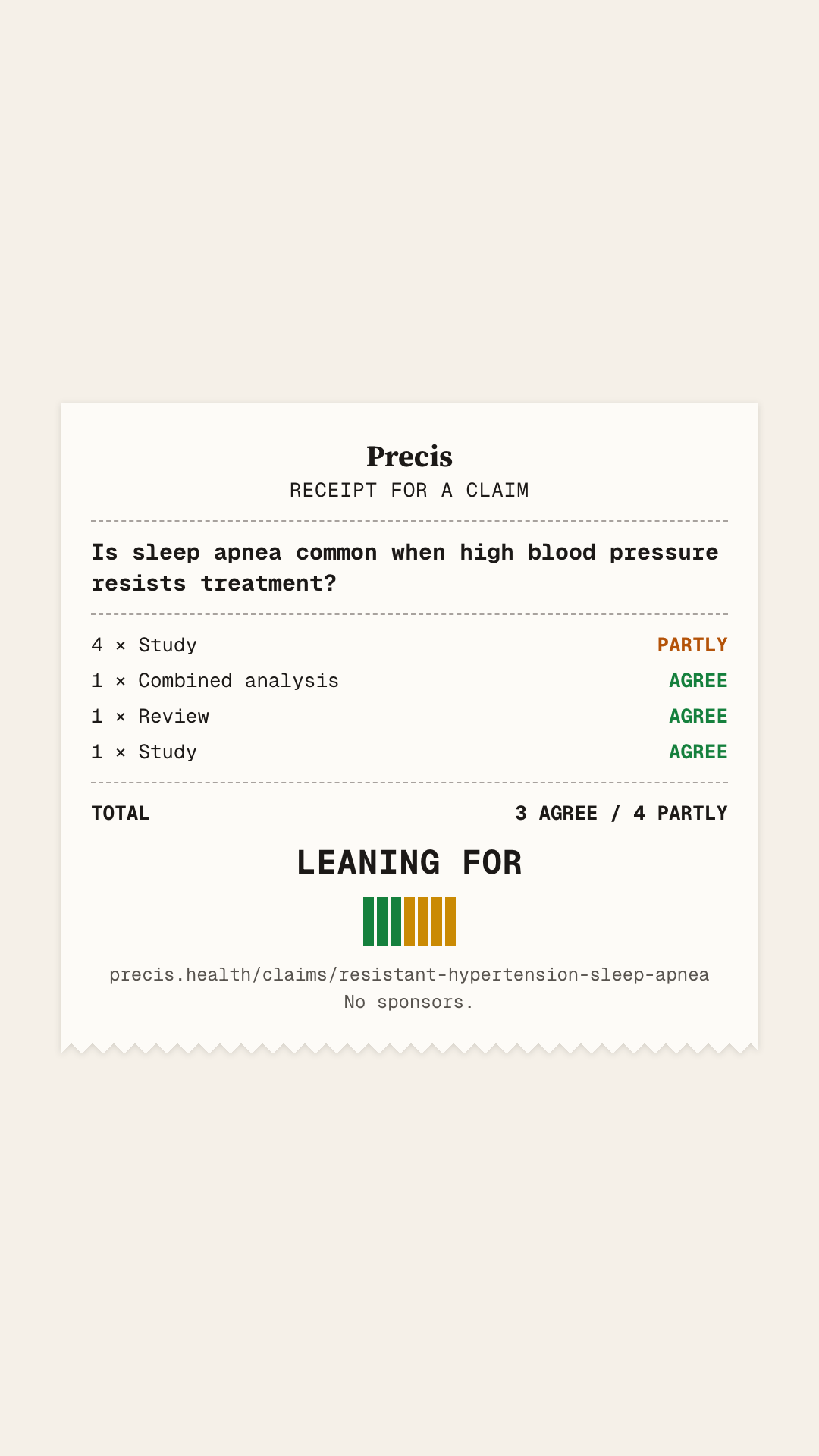
PrecisRECEIPT FOR A CLAIM


Is sleep apnea common when high blood pressure resists treatment?


  • 4 × StudyPARTLY
  • 1 × Combined analysisAGREE
  • 1 × ReviewAGREE
  • 1 × StudyAGREE

TOTAL3 AGREE / 4 PARTLY

Leaning for

What do the studies say?

Leaning for

Three of seven studies agree, four partly agree and none disagree. In 100 people whose blood pressure stayed high on several drugs, a sleep test found apnea in 94%. Two reviews that pool many studies tie apnea to blood pressure that resists treatment. The four that partly agree found a weaker or unclear link, for example only in people with kidney failure, or a lower rate in older patients in hospital.

Computed from 7 studies that test this point, each judged by two readers, in full. 10 more studies are waiting for a full read and do not count yet.

What was said on the podcast?

“That's one reason I want people with resistant high blood pressure and cardiovascular disease to think about sleep apnea. I always think about sleep apnea when someone has high blood pressure.”
Mark Hyman, The Doctor's Farmacy · Sleep Apnea: Why CPAP Isn't Fixing the Real Problem (This Does!) · 5:18 on YouTube
Episode check Blood pressure that stays high on treatment should make you think of sleep apnea, the episode says. Three of seven studies agree, and four partly agree. 10 claims checked against 86 studies See every claim we checked →
Point 1 of 2 Leaning for

Obstructive sleep apnea is common in people whose high blood pressure resists treatment

Agree 3

other primary study · 2026

“Among the 100 cases in Group 2, OSA was identified in 94% of the patients, of whom 37 (37%) had severe OSA, 9 (9%) had moderate OSA, and 48 (48%) had mild OSA.”

Prevalence of Obstructive Sleep Apnea Syndrome in Patients with Resistant Hypertension. J Clin Med
Who: 300 adults with symptoms suggesting OSA (snoring, daytime sleepiness, witnessed apnea) who had overnight polysomnography at a single center: 100 with guideline-defined resistant hypertension, 100 with controlled hypertension on 1-2 drugs, 100 normotensive; mean age 49.5
PMID 42074697

pooled analysis · 2018 · landmark

“The present study demonstrates that OSA is related to an increased risk of resistant hypertension, with a stronger association among Caucasian populations and male OSA patients.”

Association of obstructive sleep apnea with hypertension: A systematic review and meta-analysis. J Glob Health
Who: 26 observational publications (cross-sectional, case-control, cohort) with polysomnography-diagnosed OSA; 6 studies on resistant hypertension (5 Caucasian, 1 Asian), 20 on essential hypertension; mean age 51.8
PMID 29497502

systematic review · 2023

“This study provides strong qualitative and quantitative evidence to demonstrate that patients with OSAS are at increased risk for resistant hypertension.”

Association between obstructive sleep apnea and resistant hypertension: systematic review and meta-analysis. Front Med (Lausanne)
Who: 7 studies (5 cohort, 1 RCT, 1 case-control) of adults with OSA or resistant hypertension, OSA measured by AHI; hospital- and community-based samples from Brazil, the US, Canada and China
PMID 37332747

Partly agree 4

other primary study · 2012

“While resistant hypertension was associated with severe sleep apnea in participants with ESRD (odds ratio [OR] 7.1, 95% confidence interval [CI] 2.2-23.2), there was no significant association in the non-CKD (OR 3.5, 95% CI 0.8-15.4) or CKD groups (OR 1.2, 95% CI 0.4-3.7) after accounting for case-mix.”

Resistant hypertension and obstructive sleep apnea in the setting of kidney disease. J Hypertens
Who: 407 adults in Pittsburgh: 224 community-based non-CKD participants aged 45-75 (Sleep-SCORE study), 88 non-dialysis CKD patients (eGFR <=40) and 95 ESRD patients; resistant hypertension = BP >=140/90 mmHg despite >=3 antihypertensives
PMID 22388231

trial or observed group · 2017

“However, they did not show a higher prevalence of RHBP.”

Obstructive sleep apnea syndrome and sleep quality in hypertensive patients. Rev Assoc Med Bras (1992)
Who: 43 medication-adherent hypertensive outpatients at Faculdade de Medicina do ABC, Brazil (62.8% women, mean age 52.9); 17 using more than two antihypertensive drugs (classed as resistant) and 26 using up to two; OSA risk by Berlin questionnaire, not polysomnography
PMID 29489985

other primary study · 2023

“Further screening showed that, among the 43 patients with RHTN, 8 (18.6%) had chronic kidney disease, 8 (18.6%) had obstructive sleep apnea, 4 (9.3%) had primary aldosteronism, 2 (4.7%) had renovascular disease, and 21 (48.8%) had no specific secondary etiology (Figure 1 ).”

Associated factors and hemodynamic characteristics of resistant hypertension in the elderly. J Clin Hypertens (Greenwich)
Who: 283 hospitalized hypertensive patients aged >=60 (mean 75.6, 77% men) in the geriatric cardiovascular department of a Beijing tertiary hospital; 43 with resistant hypertension
PMID 36748961

other primary study · 2025

“In the participants aged over 60 years, the presence of OSA diagnosis was not significantly associated with the degree of uncontrolled hypertension.”

Association of Obstructive Sleep Apnea and Uncontrolled Hypertension in the Middle Aged 40-59 in Korean Population. J Korean Med Sci
Who: 694 Korean adults aged 40-59 with diagnosed hypertension from KNHANES 2019-2020 (302 on antihypertensive medication); OSA by STOP-Bang questionnaire or self-reported doctor diagnosis
PMID 40551608

Disagree 0· none of the studies we read

Point 2 of 2 Strong consensus for

Obstructive sleep apnea is common in people with high blood pressure

All ten studies agree. In the Wisconsin Sleep Cohort, people with more breathing pauses at the start were more likely to have high blood pressure four years later, and the risk rose with each step in severity. At a hypertension clinic in Thailand, 41.9% of the patients tested had apnea. A Swiss study of 2,121 adults found apnea tied to high blood pressure, mainly in the most severe cases.

Computed from 10 studies that test this point, each judged by two readers, in full. 10 more studies are waiting for a full read and do not count yet.

Agree 10

pooled analysis · 2018 · landmark

“Our findings suggest that OSA confers a significant association with both essential and resistant hypertension.”

Association of obstructive sleep apnea with hypertension: A systematic review and meta-analysis. J Glob Health
Who: 26 observational publications (cross-sectional, case-control, cohort) with polysomnography-diagnosed OSA; 20 studies on essential hypertension, 6 on resistant hypertension; mean age 51.8
PMID 29497502

trial or observed group · 2014

“As shown in Table 2 , OSA and short sleep duration were both individually associated with a significant increased risk for HTN after adjustment for age, gender, obesity, diabetes, depression, current smoking, use of thyroid hormones, excessive daytime sleepiness, poor sleep complaint, time spent in slow wave sleep, overall arousal index, time in bed, and study site (model 1).”

Cumulative association of obstructive sleep apnea severity and short sleep duration with the risk for hypertension. PLoS One
Who: 1,499 adults (mean age 54.3, 36% women) investigated by polysomnography for suspected OSA in 7 sleep centers in western France (IRSR sleep cohort); hypertension = prior diagnosis on antihypertensive drugs
PMID 25531468

systematic review · 2023

“The overall effects demonstrated that OSAS patients are four times more likely to develop resistant hypertension (OR: 4.16 [3.07, 5.64]) than non-OSAS patients, as in Figure 4 .”

Association between obstructive sleep apnea and resistant hypertension: systematic review and meta-analysis. Front Med (Lausanne)
Who: 7 studies (5 cohort, 1 RCT, 1 case-control) of adults with OSA or resistant hypertension, OSA measured by AHI; hospital- and community-based samples from Brazil, the US, Canada and China
PMID 37332747

other primary study · 2021

“Out of those, 253 (34.8%) were randomly studied and categorized as either non-OSA (147 patients, 58.1%) or OSA (106 patients, 41.9%).”

Prevalence and factors correlated with hypertension secondary from obstructive sleep apnea. Multidiscip Respir Med
Who: 253 randomly sampled adults treated at the hypertension clinic of Khon Kaen University, Thailand, tested with a portable cardiopulmonary monitor (Alice PDX); OSA = AHI >=5
PMID 34650797

Show 6 more Show fewer

other primary study · 2024

“Higher 3%ODI was significantly associated with higher prevalence of hypertension, especially in non-obese participants, in this Japanese cross-sectional study.”

Sleep-related breathing disorder in a Japanese occupational population and its association with hypertension-stratified analysis by obesity status. Hypertens Res
Who: 2,532 employees (mostly train and bus drivers; 96% men, mean age 43) of a railroad and bus company in Fukuoka, Japan, screened with home oximetry (3% oxygen desaturation index)
PMID 38438727

other primary study · 2025

“Of these, 347 had diagnosable OSA, and 347 did not.”

Association of Obstructive Sleep Apnea and Uncontrolled Hypertension in the Middle Aged 40-59 in Korean Population. J Korean Med Sci
Who: 4,061 Korean adults aged 40-59 from KNHANES 2019-2020, including 694 with diagnosed hypertension; OSA by STOP-Bang questionnaire or self-reported doctor diagnosis
PMID 40551608

other primary study · 2025

“In conclusion, this study showed a clear dose–response relationship between OSA risk and the prevalence of hypertension.”

Combined Effects of Obstructive Sleep Apnea and Sleep Duration on Hypertension in Korean Adults: A Nationwide Study. Biomedicines
Who: 14,579 Korean adults aged >=40 from KNHANES 2019-2022; OSA risk by STOP-Bang questionnaire (low 0-2, moderate 3-4, high 5-8)
PMID 40564194

other primary study · 2000 · landmark

“We found a dose–response association between sleep-disordered breathing at base line and the presence of hypertension four years later that was independent of known confounding factors.”

Prospective study of the association between sleep-disordered breathing and hypertension. N Engl J Med
Who: 709 adults (Wisconsin state agency employees) in the population-based Wisconsin Sleep Cohort Study, assessed by in-lab 18-channel polysomnography
PMID 10805822

other primary study · 2015 · landmark

“We recorded a much higher than previously estimated prevalence of sleep-disordered breathing and an independent association between the disorder and diabetes, hypertension, metabolic syndrome, and depression, albeit mainly in the highest severity quartile of the apnoea-hypopnoea index (>20·6 events per h).”

Prevalence of sleep-disordered breathing in the general population: the HypnoLaus study. Lancet Respir Med
Who: 2,121 randomly sampled adults aged 40-85 (median 57, 48% men) from the general population of Lausanne, Switzerland (CoLaus/PsyCoLaus cohort), with home polysomnography
PMID 25682233

other primary study · 2012 · landmark

“Compared with participants without OSA, the presence of OSA was associated with increased adjusted risk of incident hypertension; however, treatment with CPAP therapy was associated with a lower risk of hypertension.”

Association between treated and untreated obstructive sleep apnea and risk of hypertension. JAMA
Who: 1,889 adults without hypertension referred to a sleep center in Zaragoza, Spain, for suspected sleep-disordered breathing (1,579 with OSA, 310 controls with AHI <5)
PMID 22618924
Partly agree 0· none of the studies we read

Disagree 0· none of the studies we read

More on sleep and light

The Precis Weekly

Get each new check by email.

One email a week with the claims and episodes we checked, what the studies found and the minute each claim was said.

Free. Unsubscribe anytime.