A claim you hear on longevity podcasts

Is high blood pressure after preeclampsia common?

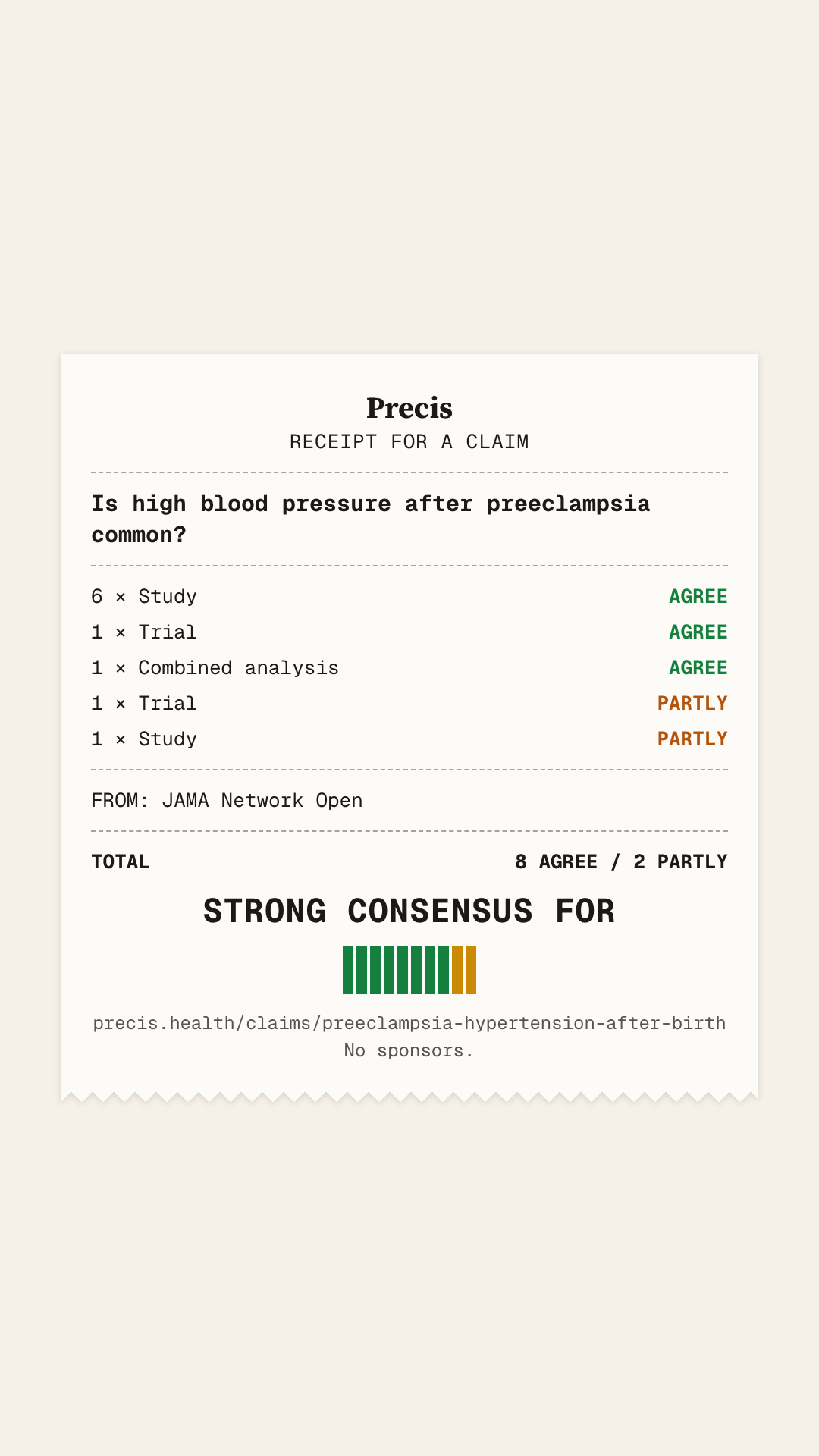
Strong consensus for. Of 10 studies that test it, 8 agree and 2 partly agree.

Best for:
anyone who had preeclampsia and is watching their blood pressure after birth.
Price:
Free to read, with every receipt. Pro is $9 a month or $79 a year and adds AI Ask.

The claim checked: After preeclampsia, many women need blood pressure medicine for weeks after birth Hear it at 53:40

PrecisRECEIPT FOR A CLAIM


Is high blood pressure after preeclampsia common?


  • 6 × StudyAGREE
  • 1 × TrialAGREE
  • 1 × Combined analysisAGREE
  • 1 × TrialPARTLY
  • 1 × StudyPARTLY

FROM: JAMA Network Open


TOTAL8 AGREE / 2 PARTLY

Strong consensus for

What do the studies say?

Strong consensus for

8 of 10 studies agree that high blood pressure often lasts well past delivery. Preeclampsia is high blood pressure in pregnancy with signs of organ strain. In one study, 21% of women with severe preeclampsia still had high blood pressure at 6 weeks. Another study followed women with high blood pressure in pregnancy, most of them with preeclampsia. Of those, 41.1% still had it at their 3-month visit. 2 partly agree. In one trial, high blood pressure settled in about 10 days on average. In the other study, most women had recovered by 6 weeks.

Computed from 10 studies that test this point, each judged by two readers, in full. 10 more studies are waiting for a full read and do not count yet.

What was said on the podcast?

“many women need um anti-hypertensive medications for several weeks after delivery. it can take like 6 12 weeks to kind of come back to more of a baseline.”
Kathryn Gray, a guest on The Drive · 410 ‒ The biology of pregnancy: physiologic adaptation, childbirth, and long-term maternal health · 53:40 on YouTube
Episode check Missing the microbes of a vaginal birth is probably not the thing to stress about, the episode says. Of 10 studies, 6 disagree. 10 claims checked against 114 studies See every claim we checked →
Point 1 of 2 Strong consensus for

After preeclampsia, many women still have high blood pressure in the weeks after delivery, and it can take 6 to 12 weeks to return to baseline

Agree 8

other primary study · 2020

“In this study, we found that, in the postpartum period, blood pressure decreased rapidly in the first 3 weeks and subsequently stabilized, although a substantial proportion of women continued to have hypertension at 6 weeks post partum.”

Racial Differences in Postpartum Blood Pressure Trajectories Among Women After a Hypertensive Disorder of Pregnancy. JAMA Netw Open
Who: 1077 women with gestational hypertension (41.5%) or preeclampsia (58.5%) in a postpartum remote blood pressure monitoring program at UPMC Magee-Womens Hospital, 2018-2019; prepregnancy chronic hypertension excluded
PMID 33351087

other primary study · 2021

“This study observed high rates of persistent hypertension regardless of HDP subtype (21% and 61% of women with gestational hypertension and pre-eclampsia, respectively).”

Persistent Hypertension Up to One Year Postpartum among Women with Hypertensive Disorders in Pregnancy in a Low-Resource Setting: A Prospective Cohort Study. Glob Heart
Who: 410 women with hypertensive disorders of pregnancy (205 pre-eclampsia, 82 eclampsia, 76 gestational hypertension, 47 chronic hypertension) delivering at eight tertiary hospitals in Nigeria, 2017-2018
PMID 34692386

other primary study · 2024

“The prevalence at six weeks was higher in the HIV group than HIV-negative group (54.6% vs 28.8%, p<0.001).”

Persistent hypertension among postpartum women with comorbid HIV and preeclampsia in Zambia. PLoS One
Who: 190 women with preeclampsia (59 living with HIV on ART) at two hospitals in Lusaka, Zambia, 2022-2023; essential hypertension and other comorbidities excluded
PMID 39231156

trial or observed group · 2024

“Of these 292 participants who attended their 3-month visit, 120 (41.1% (95% CI: 35.6%–46.9%) had persistent postpartum hypertension (Figure 1).”

Persistent postpartum hypertension 3 months post-delivery among women with hypertensive disorders of pregnancy in Tanzania: A multicenter cohort study. Pregnancy Hypertens
Who: 309 women with gestational hypertension, preeclampsia or eclampsia (69.5% preeclampsia) at three public hospitals in western Tanzania; known chronic hypertension or diabetes excluded
PMID 38176194

Show 4 more Show fewer

trial or observed group · 2025

“We found that 62.5% of participants remained hypertensive at three months postpartum, with early-onset preeclampsia conferring a 2.36-fold increased risk of persistent hypertension (95% CI: 1.16–4.82).”

Early preeclampsia is associated with persistence of hypertension 3 months postpartum in women: an observational study at a tertiary hospital in Brazil. Rev Bras Ginecol Obstet
Who: 24 postpartum women with preeclampsia at a tertiary hospital in Ribeirão Preto, Brazil, 2021-2024; chronic hypertension excluded
PMID 40673014

controlled trial · 2018

“Median treatment duration was 29 days (IQR 17 to 49) in the intervention group and 41 days (IQR 23 to 58) in the control group; adjusted mean difference -12 days (95% CI -30 to 6).”

Self-Management of Postnatal Hypertension: The SNAP-HT Trial. Hypertension
Who: 91 women in England with gestational hypertension or pre-eclampsia who needed postnatal antihypertensive treatment, randomized to self-management (45) or usual care (46)
PMID 29967037

pooled analysis · 2021

“Secondly, the risk of hypertension was highest in the immediate postpartum period (<6 months).”

Incidence of postpartum hypertension within 2 years of a pregnancy complicated by pre-eclampsia: a systematic review and meta-analysis. BJOG
Who: 15 observational studies comparing women after hypertensive disorders of pregnancy (mostly pre-eclampsia) with women after normotensive pregnancy, outcomes from 6 weeks to 2 years postpartum
PMID 32981216

other primary study · 2016

“Additionally, 21% of women in our study were found to have persistent hypertensive disease at 6 weeks postpartum.”

Factors associated with postpartum follow-up and persistent hypertension among women with severe preeclampsia. J Perinatol
Who: 193 women with preeclampsia with severe features diagnosed at >=34 weeks, delivering at the Hospital of the University of Pennsylvania, 2011-2013 (77% African American)
PMID 27583396

Partly agree 2

other primary study · 2026

“For preeclampsia, only the high-consistent rise SBP trajectory had a higher rate of BP nonrecovery at 6 weeks post partum (16/155, 10.3%) than the mid-mid stable (8/293, 2.7%) and low-stable (4/159, 2.5%) SBP trajectories ( Figure 2 ).”

Association Between Gestational Blood Pressure Trajectories and Postpartum Normotension Recovery in Hypertensive Disorders: Retrospective Cohort Study. JMIR Public Health Surveill
Who: 3162 women with hypertensive disorders of pregnancy (1674 gestational hypertension, 607 preeclampsia, 246 superimposed preeclampsia, 635 chronic hypertension) in western Guangdong, China, 2018-2024
PMID 42060921

controlled trial · 2021

“The average time to resolution of hypertension was 10 days with no difference between the two groups overall (Table 2).”

Furosemide for Accelerated Recovery of Blood Pressure Postpartum in women with a hypertensive disorder of pregnancy: A Randomized Controlled Trial. Hypertension
Who: 384 women with gestational hypertension, preeclampsia or superimposed preeclampsia at the Hospital of the University of Pennsylvania, 2018-2019 (about 75% Black, 66% non-severe)
PMID 33550824

Disagree 0· none of the studies we read

Point 2 of 2 Strong consensus for

Many women who had preeclampsia develop chronic high blood pressure within the next 5 to 10 years

8 of 10 studies agree. A pooled analysis, which adds up the results of many studies, found women who had preeclampsia were 3.70 times as likely to be diagnosed with high blood pressure later. In Denmark, 14-32% of women with high blood pressure in their first pregnancy developed it in the decade after. Among other women it was 4-11%. In US nurses, the risk was highest in the first five years. 2 partly agree: one measured blood pressure decades later, and the other was very small.

Computed from 10 studies that test this point, each judged by two readers, in full. 10 more studies are waiting for a full read and do not count yet.

Agree 8

pooled analysis · 2007 · landmark

“The relative risk of a later diagnosis of hypertension in women after pre-eclampsia was 3.70 (95% confidence interval 2.70 to 5.05) compared with women who did not develop pre-eclampsia.”

Pre-eclampsia and risk of cardiovascular disease and cancer in later life: systematic review and meta-analysis. BMJ
Who: Prospective and retrospective cohort studies of women with and without pre-eclampsia; hypertension analysis drew on 13 studies of 21,030 women, 3658 with pre-eclampsia
PMID 17975258

other primary study · 2017 · landmark

“In a large nationwide cohort, 14-32% of women with a hypertensive disorder of pregnancy in their first pregnancy developed hypertension in the decade after delivery, compared with 4-11% of women with normotensive first pregnancies.”

Risk of post-pregnancy hypertension in women with a history of hypertensive disorders of pregnancy: nationwide cohort study. BMJ
Who: Danish women with pregnancies of 20+ weeks in national registers, 1978-2012, excluding prior cardiovascular disease or pregestational hypertension
PMID 28701333

trial or observed group · 2018 · landmark

“Hazard ratios for chronic hypertension were strongest within the first five years: women with gestational hypertension had a 4.3-fold increased rate (CI: 3.2–5.8), while women with preeclamptic first births had a 4.0-fold increased rate (CI: 3.1–5.1), compared to women with normotensive pregnancies.”

Hypertensive Disorders of Pregnancy and Maternal Cardiovascular Disease Risk Factor Development: An Observational Cohort Study. Ann Intern Med
Who: 58,671 parous US registered nurses in the Nurses' Health Study II, free of CVD and its risk factors before first birth
PMID 29971437

trial or observed group · 2019

“The incidence of HTN in women with any APO was 10.8% but was 14.4% for women who had had preeclampsia during their index pregnancy.”

Association of Adverse Pregnancy Outcomes With Hypertension 2 to 7 Years Postpartum. J Am Heart Assoc
Who: Women from the US nuMoM2b cohort followed from their first pregnancy and examined in person 2-7 years after delivery; 270 had preeclampsia among those without baseline hypertension
PMID 31564189

Show 4 more Show fewer

other primary study · 2018

“The prevalence of hypertension was higher in women with preeclampsia compared with normotensive pregnancy throughout the entire age range, and the prevalence in women with preeclampsia increased more strongly after age 30 years, a decade earlier than the corresponding increase among women with normotensive pregnancy (Figure 3 A, Table S5 ).”

Life Course Trajectories of Cardiovascular Risk Factors in Women With and Without Hypertensive Disorders in First Pregnancy: The HUNT Study in Norway. J Am Heart Assoc
Who: 23,878 Norwegian women in the HUNT study with a first birth recorded 1967-2012 (1092 preeclampsia, 478 gestational hypertension); pre-pregnancy hypertension excluded
PMID 30371249

other primary study · 2018

“We found persistent excess risk of hypertension after pregnancy within 10 years after PE/GH, DM/GDM, and preterm delivery after adjusting for numerous covariates.”

Pregnancy-Related Risk Factors Are Associated With a Significant Burden of Treated Hypertension Within 10 Years of Delivery: Findings From a Population-Based Norwegian Cohort. J Am Heart Assoc
Who: 60,027 women in the Norwegian Mother and Child Cohort (MoBa) delivering 2004-2009, without pre-pregnancy hypertension (2146 preeclampsia/eclampsia, 1235 gestational hypertension)
PMID 29755036

pooled analysis · 2022

“The highest effect of HDP on the risk of hypertension was during the first 5 years after pregnancy, then it decreased over time.”

Risk of future cardiovascular diseases in different years postpartum after hypertensive disorders of pregnancy: A systematic review and meta-analysis. Medicine (Baltimore)
Who: Cohort studies comparing women with prior gestational hypertension or preeclampsia with women with normotensive pregnancies; hypertension outcome from 37 studies (16 preeclampsia-only)
PMID 35905265

other primary study · 2017

“Preeclampsia was associated with a threefold (OR=3.09) odds of hypertension at age 40 years in fully adjusted Model 2, gestational age < 32 weeks with a 1.57 fold increase, and SGA with a 1.33 fold increase odds of hypertension (Table 3) and the associations of younger at first birth with hypertension was more modest (OR=0.98 per additional age in years of first birth).”

Association of Pregnancy Complications and Characteristics With Future Risk of Elevated Blood Pressure: The Västerbotten Intervention Program. Hypertension
Who: 15,896 parous Swedish women in the Västerbotten Intervention Programme examined at age 40, free of pre-pregnancy hypertension (852 with preeclampsia)
PMID 28137991
Partly agree 2

other primary study · 2003 · landmark

“In total, 41.1% of the former and 48.8% of the latter provisionally fulfilled the WHO criteria for hypertension compared with 26.7% in the control group.”

Hypertensive diseases of pregnancy and risk of hypertension and stroke in later life: results from cohort study. BMJ
Who: 3593 Aberdeen women with a first singleton birth in 1951-1970: 1199 pre-eclampsia/eclampsia, 1197 gestational hypertension, 1197 matched normotensive controls; chronic hypertension excluded
PMID 12702615

other primary study · 2013

“Of note, the differences in blood pressure between the two study groups were small and the study groups are small.”

Normalized endothelial function but sustained cardiovascular risk profile 11 years following a pregnancy complicated by preeclampsia. Hypertens Res
Who: 15 Swedish women with a prior severe preeclampsia and 16 matched controls with an uncomplicated pregnancy, all previously examined at 1 year
PMID 23945964

Disagree 0· none of the studies we read

More on lifestyle and genes

The Precis Weekly

Get each new check by email.

One email a week with the claims and episodes we checked, what the studies found and the minute each claim was said.

Free. Unsubscribe anytime.