A claim you hear on longevity podcasts

Does PCOS raise the risk of sleep apnea?

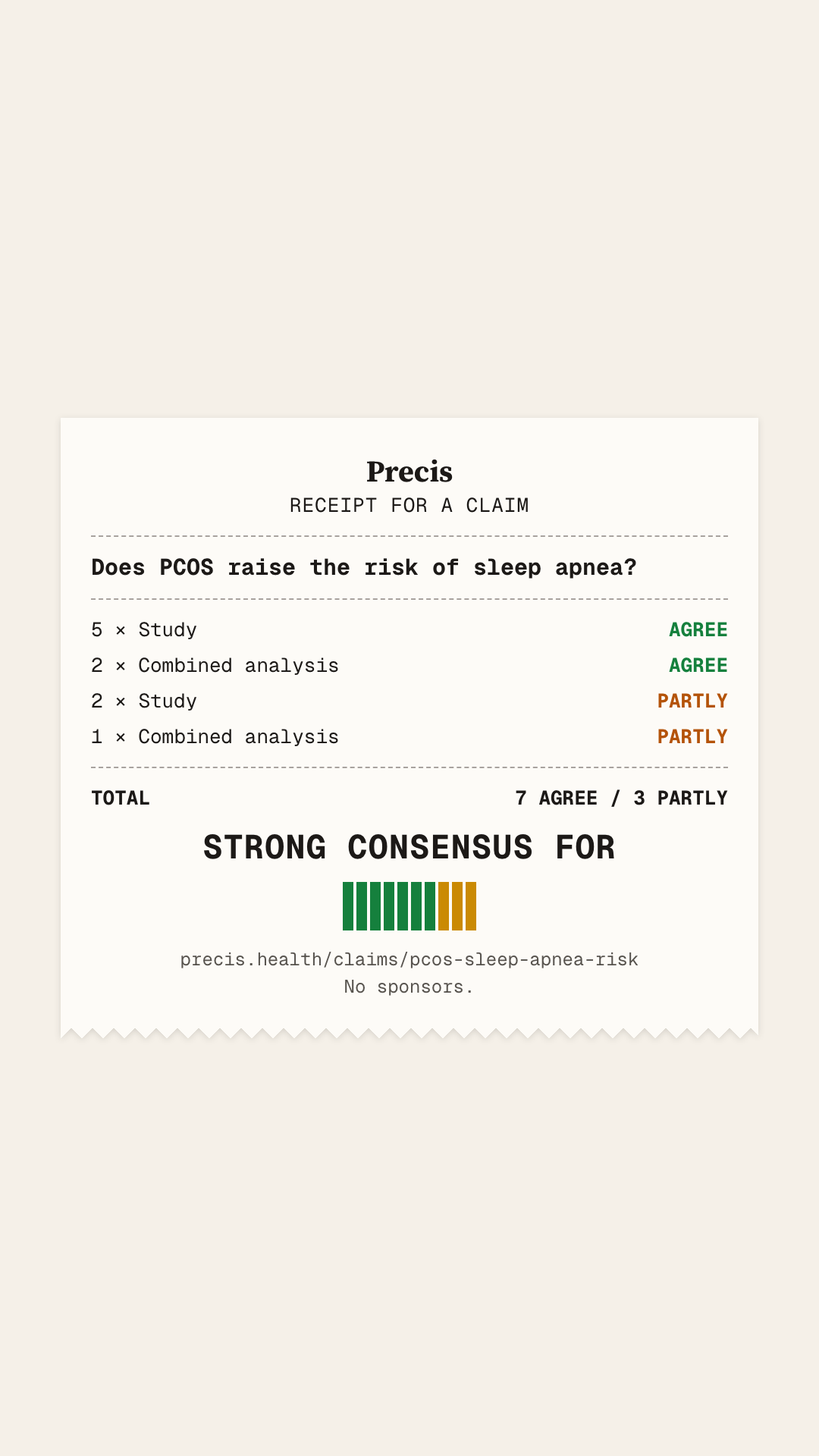
Strong consensus for. Of 10 studies that test it, 7 agree and 3 partly agree.

Best for:
Women reading about PCOS and sleep apnea
Price:
Free to read, with every receipt. Pro is $9 a month or $79 a year and adds AI Ask.

The claim checked: Polycystic ovary syndrome (PCOS) comes with a higher risk of sleep apnea, especially with insulin resistance and obesity Hear it at 10:13

PrecisRECEIPT FOR A CLAIM


Does PCOS raise the risk of sleep apnea?


  • 5 × StudyAGREE
  • 2 × Combined analysisAGREE
  • 2 × StudyPARTLY
  • 1 × Combined analysisPARTLY

TOTAL7 AGREE / 3 PARTLY

Strong consensus for

What do the studies say?

Strong consensus for

Seven of ten studies agree, and none disagree. In a UK study of 76,978 women with polycystic ovary syndrome (PCOS), a hormone condition, they were more than twice as likely to develop apnea as matched women, after taking weight into account (hazard ratio 2.26). A pooled analysis of 12 studies found women with PCOS were 2.86 times as likely to have apnea. Three studies partly agree. None of 18 lean women with PCOS in a small study had apnea, another found the higher risk only in obese women, and a pooled analysis called the extra risk unclear.

Computed from 10 studies that test this point, each judged by two readers, in full. 9 more studies are waiting for a full read and do not count yet.

What was said on the podcast?

“There are always hormonal conditions like polycystic ovarian syndrome, or PCOS, now known as polyendocrine metabolic ovarian syndrome, metabolic reproductive syndrome, all these different names, that are associated with an increased risk of sleep apnea, especially when insulin resistance and obesity are also present.”
Mark Hyman, The Doctor's Farmacy · Sleep Apnea: Why CPAP Isn't Fixing the Real Problem (This Does!) · 10:13 on YouTube
Episode check Blood pressure that stays high on treatment should make you think of sleep apnea, the episode says. Three of seven studies agree, and four partly agree. 10 claims checked against 86 studies See every claim we checked →
Point 1 of 2 Strong consensus for

Polycystic ovary syndrome is associated with a higher risk of obstructive sleep apnea

Agree 7

other primary study · 2017

“According to these studies, pooled risk of OSA is 8.3 (95% CI: 3.30–20.87) times higher in PCOS patients ( Fig. 3 ).”

Polycystic ovary syndrome and the risk of obstructive sleep apnea: a meta-analysis and review of the literature. Endocr Connect
Who: 13 polysomnography studies (8 adult, 5 adolescent) of women and girls with PCOS, most with controls
PMID 28739562

other primary study · 2012

“Post hoc analysis showed that OSA was much more prevalent in girls with PCOS compared to female controls (16/28 (57%) vs. 4/28(14.3%), p<0.01), and not significantly different from the prevalence in male controls (16/28(57%) vs. 21/28(75%), p=0.4).”

Sleep and cardiometabolic function in obese adolescent girls with polycystic ovary syndrome. Sleep Med
Who: 28 obese adolescent girls with PCOS (age 13-18) referred for polysomnography, 28 age- and BMI Z-score-matched female controls and 28 matched male controls
PMID 22921588

trial or observed group · 2019

“Women with PCOS remained at increased risk of developing OSA compared to women without PCOS following adjustment for age, Townsend score, BMI, hypothyroidism at baseline, baseline and incident diabetes/IGR (adjusted HR = 2.26, 95% CI: 1.89 to 2.69, P < 0.001) ( Table 3 ).”

Increased risk of obstructive sleep apnoea in women with polycystic ovary syndrome: a population-based cohort study. Eur J Endocrinol
Who: 76,978 women aged 18-50 with PCOS and 143,077 controls matched for practice, age and BMI in UK primary care (THIN database)
PMID 30763274

other primary study · 2011

“PCOS group had higher prevalence of SDB (45.6% vs. 27.8%, p=0.01) and EDS (54.4% vs. 35.6%, p<0.01) compared with age-, race-, and BMI Z-score-matched controls.”

Screening for sleep-disordered breathing and excessive daytime sleepiness in adolescent girls with polycystic ovarian syndrome. J Pediatr
Who: 103 adolescent girls aged 13-18 with PCOS and 90 age-, race- and BMI Z-score-matched controls, mostly Hispanic, about 92% overweight or obese
PMID 21645911

Show 3 more Show fewer

other primary study · 2019

“Women with obstructive sleep apnea were only diagnosed in the PCOS group.”

Sleep disorders in polycystic ovary syndrome: influence of obesity and hyperandrogenism. Rev Assoc Med Bras (1992)
Who: 30 women with PCOS (mean BMI 34.3) and 14 healthy normal-weight controls (mean BMI 22.4), aged 16-45, Sao Paulo, Brazil
PMID 30994836

pooled analysis · 2024

“Women affected by PCOS were 2.86 times more likely to have OSAHS than controls (OR: 2.86; 95% CI: 2.46 – 3.32; 12 studies).”

Polycystic ovary syndrome in obstructive sleep apnea-hypopnea syndrome: an updated meta-analysis. Front Endocrinol (Lausanne)
Who: 21 studies (24 datasets) of women and adolescent girls with PCOS from the USA, China, Europe, India and Brazil
PMID 39247914

pooled analysis · 2025

“The present systematic review and meta-analysis found that, independent of PCOS diagnostic criteria, the overall risk of OSAS is markedly higher in PCOS compared with non-PCOS populations, especially in adult women, those with overweight/obesity and of white ethnicity, and was more pronounced with increasing symptomatic OSAS severity.”

Obstructive sleep apnea syndrome in polycystic ovary syndrome: a systematic review and meta-analysis. Front Endocrinol (Lausanne)
Who: 8 controlled cross-sectional polysomnography studies: 280 females with PCOS and 662 without (6 adult, 2 adolescent studies)
PMID 40255502

Partly agree 3

pooled analysis · 2020

“Whether, and to what extent, women with PCOS are at increased risk of OSA, compared to women without PCOS, remains unclear.”

The prevalence of obstructive sleep apnoea in women with polycystic ovary syndrome: a systematic review and meta-analysis. Sleep Breath
Who: 17 cross-sectional polysomnography studies of women and adolescent girls with PCOS (adults, adolescents and mixed)
PMID 31111411

other primary study · 2012

“Our findings in this study indicate that women with PCOS are at high risk of OSA based on the Berlin questionnaire but the increased risk is only present amongst the obese women.”

Risk of obstructive sleep apnea in obese and nonobese women with polycystic ovary syndrome and healthy reproductively normal women. Fertil Steril
Who: 44 women with PCOS and 34 control women aged 18-40 at the University of Illinois, mixed ethnicity
PMID 22264851

other primary study · 2009

“None of the 28 women had an AHI greater than 5, which is the standard for OSA.”

Apnea-hypopnea index in nonobese women with polycystic ovary syndrome. Int J Gynaecol Obstet
Who: 18 untreated nonobese Taiwanese women with PCOS (mean BMI 21.7, age 29) and 10 age- and BMI-matched women without PCOS
PMID 19345941

Disagree 0· none of the studies we read

Point 2 of 2 Strong consensus for

In polycystic ovary syndrome, the added sleep apnea risk is greatest when insulin resistance and obesity are present

Seven of ten studies agree, and none disagree. Among women with PCOS, those with apnea tend to carry more weight and have more insulin resistance, when the body stops responding well to insulin. When two studies were pooled, the rate of apnea was 38 percentage points higher in women with PCOS and obesity than in those without obesity. Three studies partly agree. Two found that weight mattered more than PCOS itself, and a large UK study saw a stronger PCOS effect in overweight women than in obese women.

Computed from 10 studies that test this point, each judged by two readers, in full. 10 more studies are waiting for a full read and do not count yet.

Agree 7

other primary study · 2012

“Our sub-analysis suggests that among girls with PCOS-those with OSA have a higher prevalence of insulin resistance, MetS, and cardiometabolic abnormalities compared to those without OSA.”

Sleep and cardiometabolic function in obese adolescent girls with polycystic ovary syndrome. Sleep Med
Who: 28 obese adolescent girls aged 13-18 with PCOS referred for polysomnography for sleep complaints, plus 28 BMI-matched control girls and 28 control boys, Bronx, NY
PMID 22921588

pooled analysis · 2018

“OSA is associated with obesity and worse metabolic profiles in women with PCOS.”

The association between obstructive sleep apnea and metabolic abnormalities in women with polycystic ovary syndrome: a systematic review and meta-analysis. Sleep
Who: Women and postmenarchal girls with PCOS, compared with versus without polysomnography-diagnosed OSA, from 6 observational studies (mostly USA)
PMID 29722890

other primary study · 2011

“Within PCOS, those with SDB had higher BMI Z-score (2.1±0.5 vs.1.7±0.6, p< 0.01), higher homeostatic model assessment (HOMA) (5.1±2.3 vs. 4.1±3.5, p<0.01), and higher prevalence of the metabolic syndrome (MetS) (42.6% vs. 16.1%, p=0.003), compared with those without SDB.”

Screening for sleep-disordered breathing and excessive daytime sleepiness in adolescent girls with polycystic ovarian syndrome. J Pediatr
Who: 103 adolescent girls aged 13-18 with PCOS (mostly Hispanic, 92% of the sample overweight or obese) and 90 age-, race- and BMI Z-score-matched controls, Bronx, NY
PMID 21645911

other primary study · 2024

“Those with a high-risk BQ, compared with those without, had significantly (P < .05) higher waist:hip ratio, low-density-lipoprotein cholesterol, triglycerides, fasting insulin, 2-hour insulin, fasting glucose, 2-hour glucose, homeostatic model assessment for insulin resistance, hemoglobin A1C, C-reactive protein, free testosterone, and free androgen index and had lower high-density-lipoprotein cholesterol and sex hormone binding globulin.”

Metabolic and endocrine status associate with obstructive sleep apnea risk among patients with polycystic ovary syndrome. J Clin Sleep Med
Who: 309 patients aged 18-44 with Rotterdam-criteria PCOS at a single tertiary PCOS clinic (UCSF), 2017-2022
PMID 38217476

Show 3 more Show fewer

other primary study · 2025

“The analysis identified BMI (odds ratio (OR) = 1.446, 95% CI 1.236–1.692) and neck circumference (OR = 1.814, 95% CI 1.384–2.377) as independent risk factors for OSA in patients with PCOS ( p < 0.05) ( Table 9 ).”

Metabolic Risk Factors Evaluation of Obstructive Sleep Apnea Among Patients with Polycystic Ovary Syndrome. Int J Womens Health
Who: 126 women aged 40 or younger with Rotterdam-criteria PCOS (30 with OSA, 96 without) and 72 infertile women without PCOS, reproductive medicine center, Ningxia, China
PMID 41256762

other primary study · 2008

“PCOS women with OSA were more insulin resistant than those without OSA [homeostasis model assessment (HOMA) index 5.7 ± 0.4 vs. 3.5 ± 0.4; P = 0.006] after controlling for age, body mass index, and ethnicity.”

Impact of obstructive sleep apnea on insulin resistance and glucose tolerance in women with polycystic ovary syndrome. J Clin Endocrinol Metab
Who: 52 women with PCOS and 21 control women aged 18-40 of similar age and BMI, mostly obese, University of Chicago
PMID 18647805

pooled analysis · 2020

“When these two studies were pooled, the prevalence of OSA was 38% higher in women with obesity and PCOS compared to non-obese women with PCOS (prevalence difference = + 37.9%, 95% CI 15.0 to 60.9%).”

The prevalence of obstructive sleep apnoea in women with polycystic ovary syndrome: a systematic review and meta-analysis. Sleep Breath
Who: Women and adolescent girls with PCOS in 17 polysomnography studies (mostly USA, many with class II obesity)
PMID 31111411
Partly agree 3

other primary study · 2012

“BMI was the only independent predictor of OSA risk for the entire group of women consisting of PCOS and control as well as amongst women with PCOS alone.”

Risk of obstructive sleep apnea in obese and nonobese women with polycystic ovary syndrome and healthy reproductively normal women. Fertil Steril
Who: 44 women aged 18-40 with PCOS (NIH criteria; 17 non-obese, 27 obese) and 34 reproductively normal control women (26 non-obese, 8 obese), University of Illinois
PMID 22264851

trial or observed group · 2019

“The impact of PCOS on risk of OSA was stronger in overweight than in obese women; however, this needs to be interpreted with caution given the confidence intervals of effect sizes overlap.”

Increased risk of obstructive sleep apnoea in women with polycystic ovary syndrome: a population-based cohort study. Eur J Endocrinol
Who: 76,978 women aged 18-50 with PCOS and 143,077 controls matched for general practice, age and BMI, UK primary care (THIN database), 2000-2017
PMID 30763274

other primary study · 2009

“However, PCOS cannot induce OSA easily without the occurrence of obesity.”

Apnea-hypopnea index in nonobese women with polycystic ovary syndrome. Int J Gynaecol Obstet
Who: 18 untreated nonobese Taiwanese women with PCOS (BMI <27, mean BMI 21.7, age ~29) and 10 age- and BMI-matched women without PCOS
PMID 19345941

Disagree 0· none of the studies we read

More on sleep and light

The Precis Weekly

Get each new check by email.

One email a week with the claims and episodes we checked, what the studies found and the minute each claim was said.

Free. Unsubscribe anytime.