A claim you hear on longevity podcasts

Can you keep running and lifting weights while pregnant?

Strong consensus for. Of 8 studies that test it, 5 agree and 3 partly agree.

Best for:
anyone who already runs or lifts and wants to keep training while pregnant.
Price:
Free to read, with every receipt. Pro is $9 a month or $79 a year and adds AI Ask.

The claim checked: Women who already exercise can keep their program, lifting and running included, through a healthy pregnancy Hear it at 1:30:36

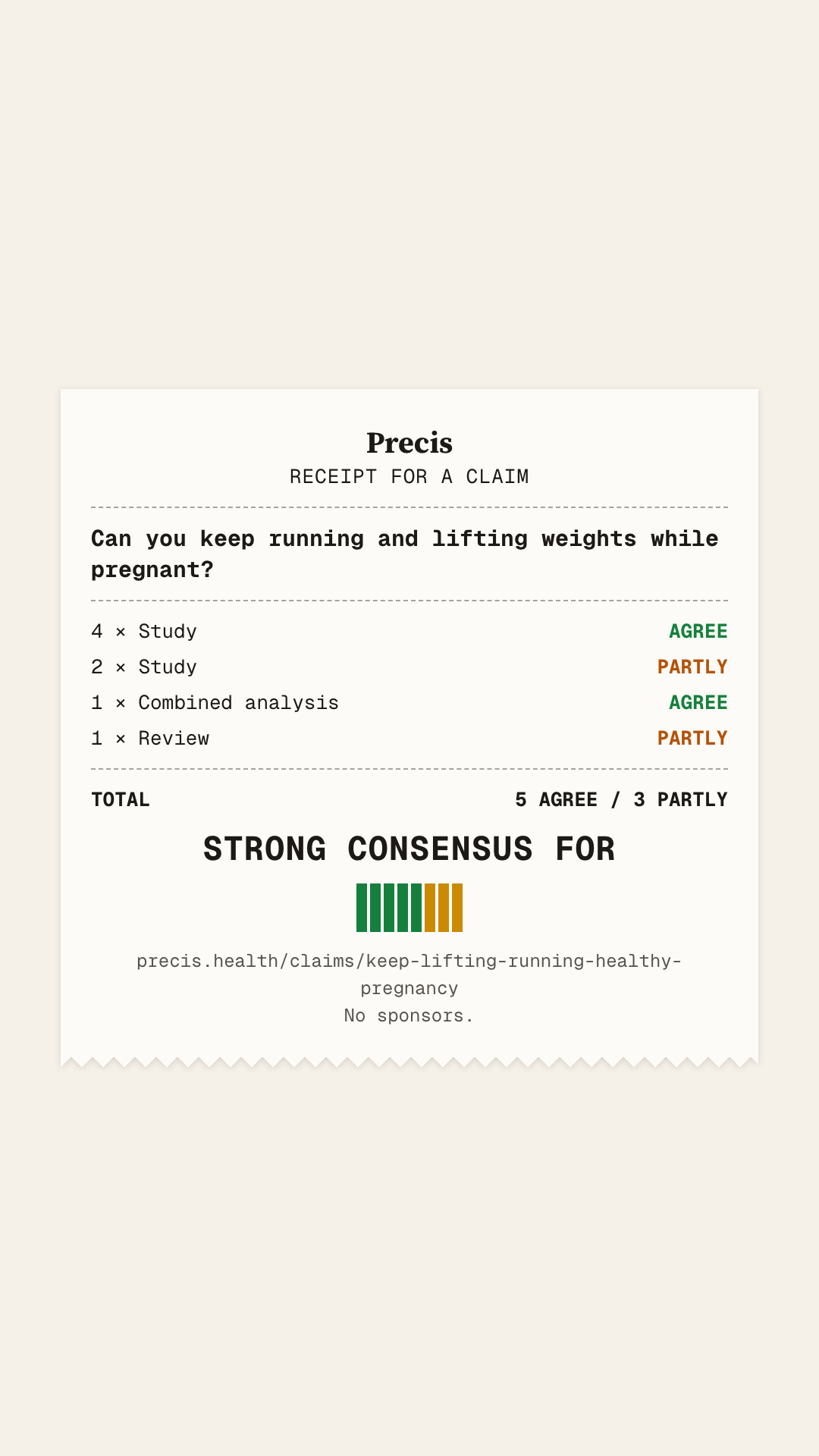
PrecisRECEIPT FOR A CLAIM


Can you keep running and lifting weights while pregnant?


  • 4 × StudyAGREE
  • 2 × StudyPARTLY
  • 1 × Combined analysisAGREE
  • 1 × ReviewPARTLY

TOTAL5 AGREE / 3 PARTLY

Strong consensus for

What do the studies say?

Strong consensus for

5 of 8 studies agree. A pooled analysis, which adds up the results of many studies, looked at vigorous exercise late in pregnancy. It did not harm birth outcomes for most low-risk pregnancies. Women who kept running did not have smaller or earlier babies. 3 partly agree. In a large Danish study, a link between exercise and miscarriage grew weaker when only data collected ahead of time was used. A small study saw brief dips in the baby's heart rate right after hard exercise, in a few very active women.

Computed from 8 studies that test this point, each judged by two readers, in full. 10 more studies are waiting for a full read and do not count yet.

What was said on the podcast?

“for patients who've been doing an exercise program, they're generally if everything in the pregnancy is going fine, it's like generally fine for them to continue it.”
Kathryn Gray, a guest on The Drive · 410 ‒ The biology of pregnancy: physiologic adaptation, childbirth, and long-term maternal health · 1:30:36 on YouTube
Episode check Missing the microbes of a vaginal birth is probably not the thing to stress about, the episode says. Of 10 studies, 6 disagree. 10 claims checked against 114 studies See every claim we checked →
Point 1 of 2 Strong consensus for

In a healthy pregnancy, women who already exercised can keep up their exercise program, vigorous exercise included, without harm to mother or baby

Agree 5

pooled analysis · 2019

“The findings from this meta-analysis indicate that vigorous intensity exercise during the third trimester appears not to compromise birth outcomes for most low-risk pregnancies.”

The effects of vigorous intensity exercise in the third trimester of pregnancy: a systematic review and meta-analysis. BMC Pregnancy Childbirth
Who: Low-risk pregnant women doing vigorous-intensity exercise (mostly aerobic: running, cycling, water aerobics, circuit) into the third trimester versus light/no exercise or standard care; RCT arms included previously inactive and overweight/obese women
PMID 31391016

other primary study · 2012

“In summary, first-trimester vigorous physical activity does not appear to be detrimental to the timing of birth or birthweight.”

A prospective study of the association between vigorous physical activity during pregnancy and length of gestation and birthweight. Matern Child Health J
Who: Pregnant volunteers (mostly white, college-educated, married) enrolled before 10 weeks in the Right From the Start cohort, central North Carolina, 2004-2007
PMID 21674218

other primary study · 2018

“On balance, on the basis of these findings and previous work, women who want to continue running during pregnancy can be reassured by their obstetricians that it will not affect the birth weight of their baby significantly or increase the likelihood of a preterm delivery.”

Is recreational running associated with earlier delivery and lower birth weight in women who continue to run during pregnancy? An international retrospective cohort study of running habits of 1293 female runners during pregnancy. BMJ Open Sport Exerc Med
Who: Female parkrun runners who became pregnant while running regularly, reporting their first pregnancy (>24 weeks) via online survey (international)
PMID 29644086

other primary study · 2025

“Findings from this small exploratory sample of Norwegian elite and recreational athletes suggest that engaging in high volumes of exercise, including high-intensity exercise and heavy load resistance training, during pregnancy does not appear to negatively impact maternal or neonatal health outcomes.”

Exceeding the guidelines: A descriptive study of exercise, pregnancy, maternal and neonatal health outcomes in elite and recreational athletes. BMC Pregnancy Childbirth
Who: Pregnant Norwegian elite athletes and recreational athletes exercising >=240 min/week (with high-intensity and/or heavy-load sessions), no contraindications to exercise, Oslo 2022-2024
PMID 40269794

Show 1 more Show fewer

other primary study · 2021

“In a small cohort of active pregnant women, HIIT appears to be a well-tolerated exercise modality with no acute adverse fetal response.”

Acute fetal response to high-intensity interval training in the second and third trimesters of pregnancy. Appl Physiol Nutr Metab
Who: Healthy, previously active (moderately or highly active in pregnancy and prior 6 months), Caucasian, normal-weight women with uncomplicated singleton pregnancies at 28-32 weeks, Kingston, Ontario
PMID 34433004

Partly agree 3

other primary study · 2007

“In the analyses based only on prospectively collected exposure data, the association did, however, attenuate, indicating a certain degree of recall bias.”

Leisure time physical exercise during pregnancy and the risk of miscarriage: a study within the Danish National Birth Cohort. BJOG
Who: Pregnant women in the Danish National Birth Cohort (1996-2002), interviewed at 12-16 weeks (or after miscarriage); about 47% exercised during pregnancy
PMID 17877774

systematic review · 2008

“Although light-to-moderate physical activity does not appear to be significantly associated with increased risk, more studies are needed to fill the gaps identified here.”

Physical activity during pregnancy and maternal-child health outcomes: a systematic literature review. Cad Saude Publica
Who: Pregnant women in observational studies (cohort, case-control, cross-sectional) of leisure-time and occupational physical activity, 1980-2005, mostly USA; athlete-only studies excluded
PMID 18797729

other primary study · 2012

“Second, a small subset of highly active women demonstrated transient fetal heart rate decelerations and alterations in umbilical and uterine artery Dopplers immediately post-exercise.”

Strenuous exercise during pregnancy: is there a limit? Am J Obstet Gynecol
Who: Healthy normal-weight women with low-risk pregnancies at 28-32 weeks (Johns Hopkins), grouped by activity in the 6 months before and into pregnancy: non-exercisers, regularly active, highly active (mostly runners, vigorous >4 days/week)
PMID 22939718

Disagree 0· none of the studies we read

Point 2 of 2 Not enough evidence

In a healthy pregnancy, strenuous resistance training and heavy lifting are fine for women already used to them

Only 2 studies we could read in full test heavy lifting. 1 agrees: in 60 Norwegian athletes, heavy resistance training during pregnancy did not appear to harm mother or baby. The authors call the sample small and exploratory. 1 partly agrees: interval training was well tolerated in a small group of active women, but the loads were light.

Computed from 2 studies that test this point, each judged by two readers, in full. Fewer than 3 sources so far. 10 more studies are waiting for a full read and do not count yet.

Agree 1

other primary study · 2025

“Findings from this small exploratory sample of Norwegian elite and recreational athletes suggest that engaging in high volumes of exercise, including high-intensity exercise and heavy load resistance training, during pregnancy does not appear to negatively impact maternal or neonatal health outcomes.”

Exceeding the guidelines: A descriptive study of exercise, pregnancy, maternal and neonatal health outcomes in elite and recreational athletes. BMC Pregnancy Childbirth
Who: 60 pregnant Norwegian athletes in Oslo (10 elite, 50 recreational) with singleton pregnancies, exercising >=240 min/week including high-intensity exercise and/or heavy load resistance training, excluded if they had medical or obstetric contraindications to exercise
PMID 40269794

Partly agree 1

other primary study · 2021

“In a small cohort of active pregnant women, HIIT appears to be a well-tolerated exercise modality with no acute adverse fetal response.”

Acute fetal response to high-intensity interval training in the second and third trimesters of pregnancy. Appl Physiol Nutr Metab
Who: Healthy, previously active (moderately or highly active in pregnancy and prior 6 months), Caucasian, normal-weight women with uncomplicated singleton pregnancies at 28-32 weeks, Kingston, Ontario
PMID 34433004

Disagree 0· none of the studies we read

More on exercise and muscle

The Precis Weekly

Get each new check by email.

One email a week with the claims and episodes we checked, what the studies found and the minute each claim was said.

Free. Unsubscribe anytime.