A claim you hear on longevity podcasts

Does gestational diabetes raise the baby's risk later in life?

Strong consensus for. Of 10 studies that test it, 8 agree and 2 partly agree.

Best for:
parents asking how gestational diabetes affects a child's later health.
Price:
Free to read, with every receipt. Pro is $9 a month or $79 a year and adds AI Ask.

The claim checked: Babies exposed to gestational diabetes have more blood sugar and weight problems later in life Hear it at 28:14

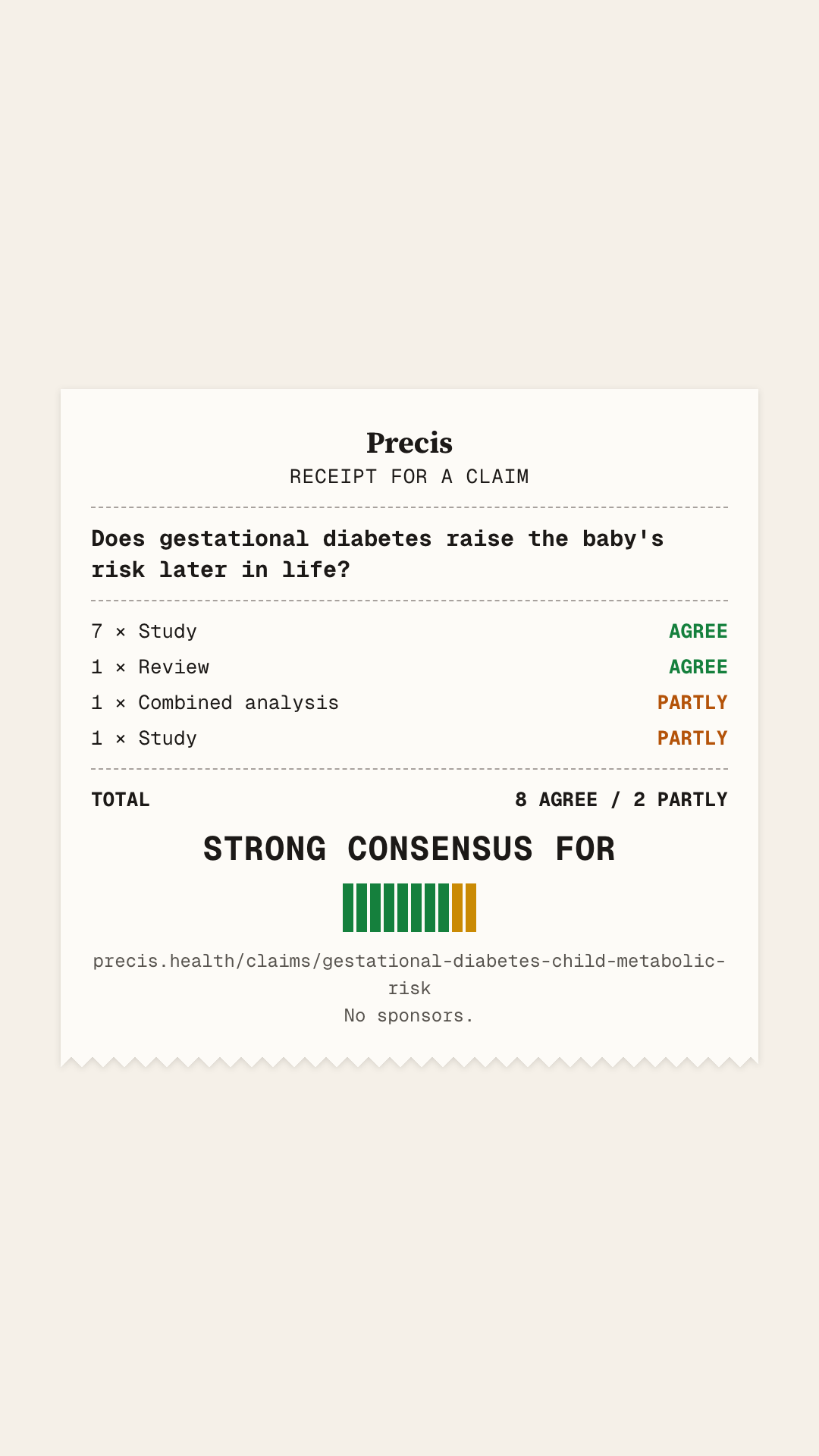
PrecisRECEIPT FOR A CLAIM


Does gestational diabetes raise the baby's risk later in life?


  • 7 × StudyAGREE
  • 1 × ReviewAGREE
  • 1 × Combined analysisPARTLY
  • 1 × StudyPARTLY

TOTAL8 AGREE / 2 PARTLY

Strong consensus for

What do the studies say?

Strong consensus for

8 of 10 studies agree. Gestational diabetes is high blood sugar that starts in pregnancy. One study followed 4,160 children aged 10 to 14. Those whose mothers had untreated gestational diabetes were at high risk of impaired glucose tolerance, an early step toward diabetes. Young people with type 2 diabetes had 7.3 times the odds of having been exposed to diabetes in the womb. 2 partly agree: a UK study found higher fasting blood sugar but no rise in insulin.

Computed from 10 studies that test this point, each judged by two readers, in full. 10 more studies are waiting for a full read and do not count yet.

What was said on the podcast?

“I think yes, they have a higher risk of um metabolic um issues long term and I think we don't fully understand all the reasons why that is the case.”
Kathryn Gray, a guest on The Drive · 410 ‒ The biology of pregnancy: physiologic adaptation, childbirth, and long-term maternal health · 28:14 on YouTube
Episode check Missing the microbes of a vaginal birth is probably not the thing to stress about, the episode says. Of 10 studies, 6 disagree. 10 claims checked against 114 studies See every claim we checked →
Point 1 of 2 Strong consensus for

Children exposed to gestational diabetes in the womb have a higher risk of insulin resistance, prediabetes or type 2 diabetes later in life

Agree 8

trial or observed group · 2019 · landmark

“This study demonstrated that offspring of mothers with untreated GDM by IADPSG/WHO criteria are at high risk for IGT 10–14 years postpartum.”

Hyperglycemia and Adverse Pregnancy Outcome Follow-up Study (HAPO FUS): Maternal Gestational Diabetes Mellitus and Childhood Glucose Metabolism. Diabetes Care
Who: 4,160 children aged 10-14 years (mean 11.4) from 10 HAPO field centers, born to mothers with blinded, untreated pregnancy OGTT results; 589 exposed to GDM by IADPSG/WHO criteria, 3,571 not exposed
PMID 30655380

trial or observed group · 2008 · landmark

“Type 2 diabetic youth were more likely to have been exposed to maternal diabetes in utero than control youth (OR 7.3 [95% CI 3.2–16.8]; P < 0.0001, adjusted for age, sex, and race).”

Association of intrauterine exposure to maternal diabetes and obesity with type 2 diabetes in youth: the SEARCH Case-Control Study. Diabetes Care
Who: Non-Hispanic white, African-American and Hispanic youth aged 10-22 years in Colorado and South Carolina: SEARCH youth with type 2 diabetes and nondiabetic control youth from primary care offices
PMID 18375420

other primary study · 2017 · landmark

“In additional analyses including further adjustment for being born large for gestational age, adiposity at birth, overweight or obesity, or adiposity at the time of follow-up, maternal glycemic levels and maternal GDM remained significantly associated with an increased risk of abnormal glucose tolerance in the offspring ( Table 3 ).”

In Utero Exposure to Maternal Hyperglycemia Increases Childhood Cardiometabolic Risk in Offspring. Diabetes Care
Who: Ethnic Chinese mother-child pairs from the Hong Kong HAPO center (mothers blinded and untreated), children assessed at about 7 years; 132 offspring of mothers with GDM (WHO 2013 criteria) vs 794 of mothers with normal glucose tolerance
PMID 28279981

trial or observed group · 2019 · landmark

“In summary, the current study demonstrates that maternal glucose levels during pregnancy across the spectrum are associated with higher glucose levels and insulin resistance during childhood independent of maternal and child BMI and family history of diabetes and that this relationship is continuous.”

Hyperglycemia and Adverse Pregnancy Outcome Follow-up Study (HAPO FUS): Maternal Glycemia and Childhood Glucose Metabolism. Diabetes Care
Who: 4,160 children aged 10-14 years from 10 HAPO field centers whose mothers had blinded, untreated pregnancy OGTTs at ~28 weeks
PMID 30617141

Show 4 more Show fewer

other primary study · 2010

“In a sample of normal children in India, ODMs, particularly girls, were more adipose and had higher systolic blood pressure and insulin resistance compared with control children at age 9.5 years.”

Intrauterine exposure to maternal diabetes is associated with higher adiposity and insulin resistance and clustering of cardiovascular risk markers in Indian children. Diabetes Care
Who: Children born 1997-1998 at Holdsworth Memorial Hospital, Mysore, India, to mothers who had an OGTT at 30 weeks; offspring of GDM mothers (Carpenter-Coustan) vs offspring of nondiabetic parents and of diabetic fathers
PMID 19918007

other primary study · 2010

“In the substudy on insulin resistance, OGDM had increased HOMA-IR compared with that of children of ONDM and of OT1D ( P = 0.04 and P = 0.03, adjusted for age and sex) ( Fig. 3 ).”

Prevalence and predictors of overweight and insulin resistance in offspring of mothers with gestational diabetes mellitus. Diabetes Care
Who: German Caucasian children followed from birth (1989-2000): offspring of mothers with GDM (German GDM offspring study) vs offspring of mothers with type 1 diabetes and of nondiabetic mothers (BABYDIAB)
PMID 20435793

trial or observed group · 2017

“In this longitudinal study of diverse young people aged 6–19 years, we have shown that intrauterine exposure to maternal diabetes was associated with greater insulin resistance during childhood and adolescence, independently of maternal pre-pregnancy obesity and offspring BMI.”

Fetal overnutrition and offspring insulin resistance and β-cell function: the Exploring Perinatal Outcomes among Children (EPOCH) study. Diabet Med
Who: Ethnically diverse offspring of Kaiser Permanente of Colorado members (EPOCH study) exposed (GDM or type 1 diabetes) or not exposed to maternal diabetes in utero, assessed at mean ages 10.5 and 16.5 years
PMID 28636758

systematic review · 2022

“The risks for overweight/obesity, T2D/glucose intolerance, metabolic syndrome, and CVD were increased for all types of maternal diabetes.”

How Do the Different Types of Maternal Diabetes during Pregnancy Influence Offspring Outcomes? Nutrients
Who: Human cohort studies (2007-2022) comparing offspring exposed to at least two types of maternal diabetes (GDM, type 1, type 2) with unexposed offspring; for type 2 diabetes/abnormal glucose: Danish young adults aged 18-27 (Clausen), Danish registry offspring to age 35 (Nielsen), Canadian offspring to age 30 (Wicklow)
PMID 36145247
Partly agree 2

pooled analysis · 2018

“Exposure to maternal hyperglycemia during pregnancy might be associated with offspring obesity and abnormal glucose tolerance, although the association depends on the duration and intensity of intrauterine exposure to hyperglycemia, and the evidence relies only on observational studies with low quality of evidence.”

Obesity and abnormal glucose tolerance in offspring of diabetic mothers: A systematic review and meta-analysis. PLoS One
Who: Observational cohort studies of offspring over 2 years old (ages 3-27) of mothers with GDM, type 1 or type 2 diabetes vs nondiabetic controls; Pima Indians excluded
PMID 29329330

other primary study · 2012

“Offspring of mothers who had existing or gestational diabetes during their pregnancy had higher fasting glucose, but this was not accompanied by an increase in fasting insulin.”

Associations of gestational diabetes, existing diabetes, and glycosuria with offspring obesity and cardiometabolic outcomes. Diabetes Care
Who: Adolescents (mean age 15.5 years) from the ALSPAC UK population-based birth cohort (births 1991-1992, 98% white British), grouped by maternal existing diabetes, gestational diabetes, glycosuria or none
PMID 22124718

Disagree 0· none of the studies we read

Point 2 of 2 Strong consensus for

Children exposed to gestational diabetes in the womb have a higher risk of obesity or excess body fat later in life

6 of 10 studies agree that these children carry more body fat, often around the belly. 4 partly agree. In Finland, the link showed up only when the mother was overweight. A pooled analysis found it faded once the mother's weight before pregnancy was taken into account.

Computed from 10 studies that test this point, each judged by two readers, in full. 10 more studies are waiting for a full read and do not count yet.

Agree 6

other primary study · 2017 · landmark

“In this prospective follow-up study of mothers and offspring from the HAPO cohort, we observed a graded effect of maternal glycemic levels during pregnancy on the offsprings’ risk of abnormal glucose tolerance, obesity, and adiposity at 7 years of age, after adjusting for antenatal, neonatal, and postnatal confounders.”

In Utero Exposure to Maternal Hyperglycemia Increases Childhood Cardiometabolic Risk in Offspring. Diabetes Care
Who: Ethnic Chinese mother-child pairs from the Hong Kong HAPO center (mothers blinded and untreated), children assessed at about 7 years; 132 offspring of mothers with GDM (WHO 2013 criteria) vs 794 of mothers with normal glucose tolerance
PMID 28279981

trial or observed group · 2019 · landmark

“In summary, the HAPO FUS provides new evidence for a continuous relationship between maternal glucose levels during pregnancy and childhood adiposity outcomes that is independent of maternal BMI.”

Maternal glucose levels during pregnancy and childhood adiposity in the Hyperglycemia and Adverse Pregnancy Outcome Follow-up Study. Diabetologia
Who: Children aged 10-14 years (mean 11.4) from ten HAPO centres whose mothers had a blinded, untreated 75 g OGTT at ~28 weeks gestation; multi-ethnic, multinational
PMID 30648193

other primary study · 2011

“In conclusion, our study suggests that in a relatively lean European population, as in the Pima Indian population, maternal diabetes in pregnancy is associated with greater offspring BMI in late adolescence/early adulthood and that this is not due to familial confounding but most likely due to intrauterine mechanisms.”

Association of maternal diabetes mellitus in pregnancy with offspring adiposity into early adulthood: sibling study in a prospective cohort of 280,866 men from 248,293 families. Circulation
Who: Swedish singleton-born men born 1973-1988 who completed military conscription examination (mean age 18), linked to the Medical Birth Register; includes within-brother comparisons
PMID 21220735

other primary study · 2010

“At age 9.5 years, female ODMs were larger in all anthropometric measurements, except height, than control subjects ( Table 1 ), even after adjusting for maternal BMI ( P < 0.05).”

Intrauterine exposure to maternal diabetes is associated with higher adiposity and insulin resistance and clustering of cardiovascular risk markers in Indian children. Diabetes Care
Who: Children born 1997-1998 at Holdsworth Memorial Hospital, Mysore, India, to mothers who had an OGTT at 30 weeks; offspring of GDM mothers (Carpenter-Coustan) vs offspring of nondiabetic parents and of diabetic fathers
PMID 19918007

Show 2 more Show fewer

other primary study · 2010

“This study shows an increased prevalence of overweight at 2, 8, and 11 years of age in OGDM compared with OT1D and ONDM.”

Prevalence and predictors of overweight and insulin resistance in offspring of mothers with gestational diabetes mellitus. Diabetes Care
Who: German Caucasian children followed from birth (1989-2000): 232 offspring of mothers with GDM vs 757 offspring of mothers with type 1 diabetes and 431 of nondiabetic mothers
PMID 20435793

other primary study · 2011

“We found that exposure to maternal GDM is associated with higher BMI, waist circumference, VAT, SAT and a more centralised fat distribution pattern in 6- to 13-year-old multiethnic youths from Colorado.”

Association of exposure to diabetes in utero with adiposity and fat distribution in a multiethnic population of youth: the Exploring Perinatal Outcomes among Children (EPOCH) Study. Diabetologia
Who: Multiethnic (non-Hispanic white, Hispanic, African-American) children aged 6-13 born 1992-2002 in Denver to Kaiser Permanente of Colorado members (EPOCH retrospective cohort)
PMID 20953862

Partly agree 4

other primary study · 2009

“GDM was associated with child adiposity as represented by the sum of skinfolds but not by BMI z-score.”

Intrauterine exposure to gestational diabetes, child adiposity, and blood pressure. Am J Hypertens
Who: Mother-child pairs in Project Viva, a prebirth cohort in eastern Massachusetts (recruited 1999-2002; mostly white, college-educated); 51 GDM, 152 IGT, 1,035 normoglycemic mothers; children assessed at age 3
PMID 19023272

other primary study · 2010

“In offspring of normal-weight women, no statistically significant risks for overweight and abdominal obesity were associated with prenatal exposure to GDM.”

Risks of overweight and abdominal obesity at age 16 years associated with prenatal exposures to maternal prepregnancy overweight and gestational diabetes mellitus. Diabetes Care
Who: 16-year-old adolescents from the Northern Finland Birth Cohort 1986 (white, born 1985-1986), grouped by maternal prepregnancy overweight and GDM status
PMID 20427685

systematic review · 2011

“In conclusion, this review demonstrates that studies of associations between maternal gestational DM on offspring overweight and obesity have yielded inconclusive results.”

Gestational diabetes mellitus and risk of childhood overweight and obesity in offspring: a systematic review. Exp Diabetes Res
Who: Cohort and case-control studies (1990-2011) of children aged 2-18 comparing offspring of mothers with GDM (not combined with pregestational diabetes) to a nondiabetic control group, with overweight/obesity as BMI >85th or >95th percentile
PMID 21960991

pooled analysis · 2018

“We found that GDM mothers had a significantly higher BMI z-scores in childhood than offspring of non-diabetic mothers although the association was no longer significant after adjustment for maternal pre-pregnancy BMI, which supported previous reviews [ 6 , 7 ].”

Obesity and abnormal glucose tolerance in offspring of diabetic mothers: A systematic review and meta-analysis. PLoS One
Who: Observational cohort studies of offspring over 2 years old (ages 3-27) of mothers with GDM, type 1 or type 2 diabetes vs nondiabetic controls; Pima Indians excluded
PMID 29329330

Disagree 0· none of the studies we read

More on lifestyle and genes

The Precis Weekly

Get each new check by email.

One email a week with the claims and episodes we checked, what the studies found and the minute each claim was said.

Free. Unsubscribe anytime.