A claim you hear on longevity podcasts

Do ice baths leave blood inflammation markers unchanged?

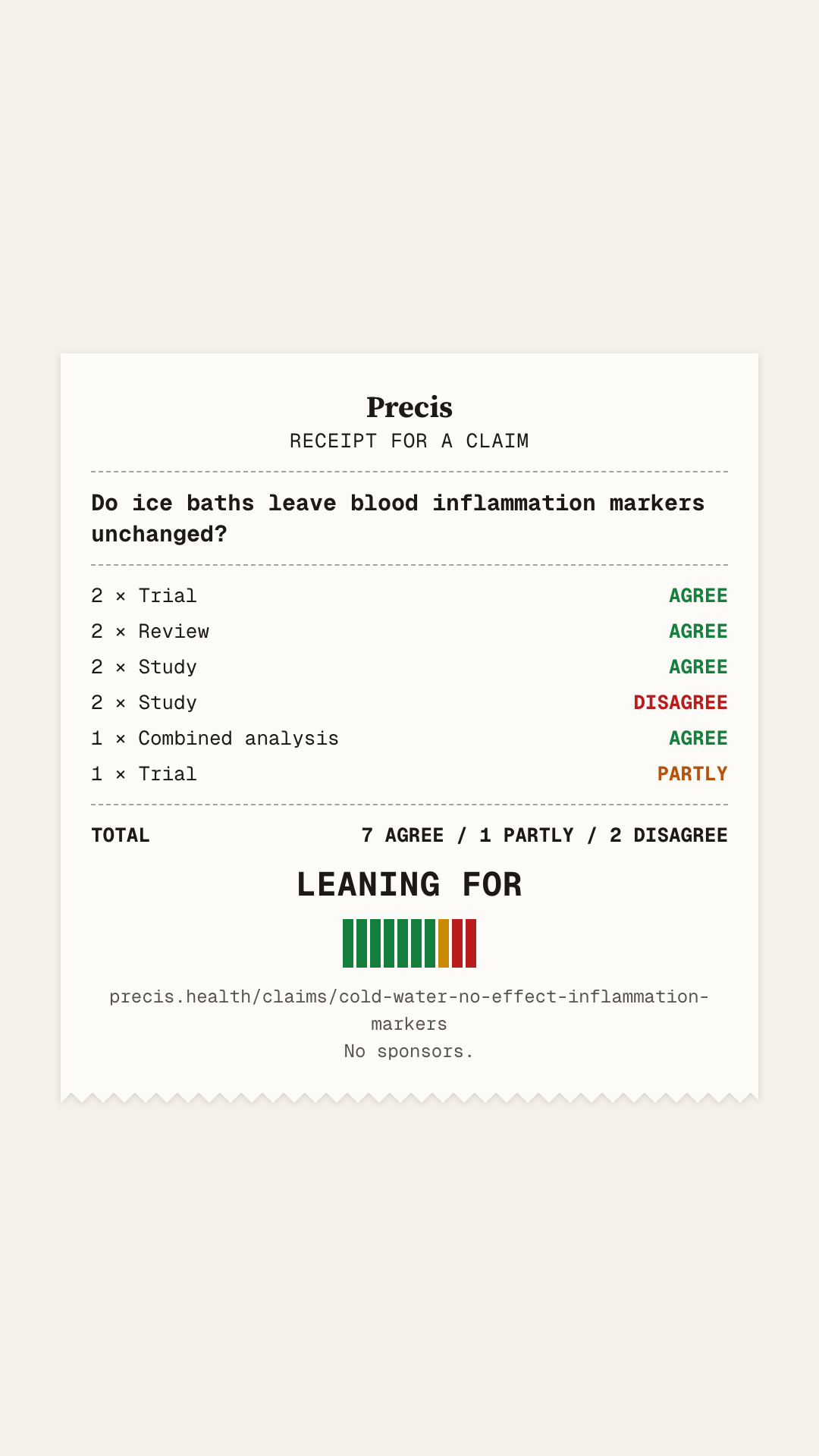
Leaning for. Of 10 studies that test it, 7 agree, 2 disagree and 1 partly agrees.

Best for:
Anyone who plunges to lower inflammation
Price:
Free to read, with every receipt. Pro is $9 a month or $79 a year and adds AI Ask.

The claim checked: Cold water eases soreness but does not lower inflammation markers Hear it at 53:04

PrecisRECEIPT FOR A CLAIM


Do ice baths leave blood inflammation markers unchanged?


  • 2 × TrialAGREE
  • 2 × ReviewAGREE
  • 2 × StudyAGREE
  • 2 × StudyDISAGREE
  • 1 × Combined analysisAGREE
  • 1 × TrialPARTLY

TOTAL7 AGREE / 1 PARTLY / 2 DISAGREE

Leaning for

What do the studies say?

Leaning for

Of 10 studies, 7 agree. Cold water after exercise did not change CRP or IL-6 in the blood. That includes a recent meta-analysis and a review of 15 reviews. 2 disagree: a review of recovery trials found water colder than 15 C lowered inflammation, and a trial in college students found the biggest drop in IL-6 after cold water. 1 partly agrees. CRP and IL-6 are blood markers of inflammation.

Computed from 10 studies that test this point, each judged by two readers, in full. 10 more studies are waiting for a full read and do not count yet.

The study behind the claim tested something else. See what it tested

What was said on the podcast?

“In this study, there weren't really significant changes in inflammatory cell cytoines, ho proteins, etc. between these different treatments. So although cold therapy seems to reduce subjective pain”
Peter Attia, The Drive · Cold therapy: pros, cons, and its impact on longevity (AMA #47 rebroadcast) · 53:04 on YouTube
Episode check An ice bath of 10 to 15 minutes is the sweet spot for soreness, the episode says. Of 10 studies, 5 agree. All 6 that tested colder water found it did no better. 8 claims checked against 40 studies See every claim we checked →
The study behind the claim The retelling misstates it

What did the study actually test?

On tape: nine men, crossover, 10 min at 50 F against easy cycling, biopsies at 2, 24 and 48 h, and no significant differences in inflammatory cells, cytokines or heat shock proteins between treatments. That retelling matches the abstract. The next sentence does not: he takes the study to show that cold "doesn't seem to have much of an effect on circulating inflammatory markers" while it reduces subjective pain. The study measured inflammation inside muscle (cell counts and mRNA in biopsies), not blood markers, and it measured no soreness or pain ratings. Its own conclusion stays with muscle. The blood IL-6 and CRP point is carried by the 2023 meta-analysis, read below. The effects of cold water immersion and active recovery on inflammation and cell stress responses in human skeletal muscle after resistance exercise. J Physiol, 2017. Randomized crossover trial: unilateral lower-body resistance exercise on two days at least 1 week apart, then 10 min of lower-body immersion at 10 C or 10 min of low-intensity cycling; muscle biopsies before and 2, 24 and 48 h after, 9 active men.

What was saidWhat the study did
What was measured Differs Circulating (blood) inflammatory markers, alongside reduced subjective pain Inflammatory cells, cytokine and neurotrophin mRNA and heat shock proteins in muscle biopsies; no blood markers, no pain ratings

What it found

“Changes in inflammatory cells, cytokines, neurotrophins and HSPs did not differ significantly between the recovery treatments.”

PMID 27704555

How the authors extend it

“These findings indicate that cold water immersion is no more effective than active recovery for reducing inflammation or cellular stress in muscle after a bout of resistance exercise.”

PMID 27704555

Not stated in the abstract; full text not cached or read. Two readers agreed on the label.

The study behind the claim The retelling matches it

What did the study actually test?

On tape: a 2023 meta-analysis found no significant effect on IL-6 at 0, 24 or 48 h, based on only a couple of studies, so the jury is still out; a meta-analysis of seven studies found no CRP difference at 0, 24 or 48 h. Both match this paper: CRP was recorded in 7 studies with no significant difference, and the authors say only a few articles fed the IL-6 analysis, "rendering the results meaningless". One small gap: the CRP result at 48 h came from 1 trial and the authors set it aside, so "no difference at 48 h" rests on no pooled estimate. Effects of cold water immersion after exercise on fatigue recovery and exercise performance--meta analysis. Front Physiol, 2023. Systematic review and meta-analysis of 20 randomized controlled and crossover studies (2002 to 2022) of cold water immersion (15 C or colder) after exercise against control, with outcomes at 0, 24 and 48 h, Active people, recreational and professional athletes in the included studies.

What was saidWhat the study did

What it found

“There was no significant difference in CRP at 0, 24, or 48 h (0 h MD -0.01 95%CL -0.06 to 0.04, 5 trials); (24 h MD 0.06 95%CL -0.45 to 0.57, 6 trials); (48 h MD -0.20 95%CL -0.96 to 0.56, 1trials).”

PMID 36744038

How the authors extend it

“However, post-exercise CWI does not produce any effect on CRP or IL-6 ( Table 2 ).”

PMID 36744038

Supported by the Tomsk State University Development Programme (Priority-2030). The authors declare no commercial or financial conflicts of interest. Two readers agreed on the label, and the paper was read in full.

The point checked Leaning for

Cold water immersion after exercise does not lower circulating inflammatory markers (IL-6, CRP) compared with control recovery

Agree 7

controlled trial · 2018

“However, this recovery strategy appears to be ineffective on systemic inflammation and ECM degradation markers and muscle function recovery.”

Multiple Cold-Water Immersions Attenuate Muscle Damage but not Alter Systemic Inflammation and Muscle Function Recovery: A Parallel Randomized Controlled Trial. Sci Rep
Who: Thirty physically active males, parallel RCT, CWI vs passive control after eccentric exercise-induced muscle damage
PMID 30026562

systematic review · 2023

“There was no significant difference in CRP at 0, 24, or 48 h (0 h MD -0.01 95%CL -0.06 to 0.04, 5 trials); (24 h MD 0.06 95%CL -0.45 to 0.57, 6 trials); (48 h MD -0.20 95%CL -0.96 to 0.56, 1trials).”

Effects of cold water immersion after exercise on fatigue recovery and exercise performance--meta analysis. Front Physiol
Who: healthy humans of any training status (mostly male athletes and active adults) receiving CWI after exercise
PMID 36744038

other primary study · 2020

“In the present study there were no differences in hs-CRP between recovery interventions, although CRP responded to and recovered from loading in all groups.”

Water immersion methods do not alter muscle damage and inflammation biomarkers after high-intensity sprinting and jumping exercise. Eur J Appl Physiol
Who: Nine healthy, physically active men (age 26 ± 3.7 y), randomised crossover of four recovery conditions after sprinting and jumping
PMID 32880050

pooled analysis · 2015

“Cooling did not affect objective recovery variables such as lactate-levels, CK-levels or IL6-levels.”

The Effect of Post-Exercise Cryotherapy on Recovery Characteristics: A Systematic Review and Meta-Analysis. PLoS One
Who: Randomised trials of post-exercise cooling (cold-water immersion, whole-body cryotherapy, cold air, ice) vs passive or control recovery in healthy exercising volunteers
PMID 26413718

Show 3 more Show fewer

controlled trial · 2011

“None of the treatments decreased the CRP levels significantly ( p > 0.05) from post-exercise values.”

Comparison between cold water immersion therapy (CWIT) and light emitting diode therapy (LEDT) in short-term skeletal muscle recovery after high-intensity exercise in athletes--preliminary results. Lasers Med Sci
Who: Young male futsal players from Brazil at the highest national level, after a Wingate cycle test
PMID 21088862

other primary study · 2022

“There was no significant difference between groups [ F (3, 35) = 0.217, P = 0.884, ηp 2 = 0.018] and no significant group × time interaction effect [ F (4.221, 49.240) = 0.645, P = 0.641, ηp 2 = 0.052].”

A combination of cherry juice and cold water immersion does not enhance marathon recovery compared to either treatment in isolation: A randomized placebo-controlled trial. Front Sports Act Living
Who: healthy male endurance runners (expected marathon time <=4.5 h) completing a competitive trail marathon
PMID 36060624

systematic review · 2026

“CRP showed no significant changes at any timepoint (SMD range = − 0.17 to 0.11; MD = − 0.20 to 0.06) [ 19 , 34 ], and IL-6 was not significantly altered between 1 and 72 h post-exercise (SMD = − 2.07 to 0.47) [ 19 ].”

Strategic Application of Post-exercise Cold-Water Immersion to Enhance Performance Recovery and Adaptation: An Umbrella Review of 15 Published Systematic Reviews with Meta-analysis. Sports Med Open
Who: Healthy young adults (predominantly males, ~10% female), untrained to well-trained, across 15 systematic reviews with meta-analysis of 161 original studies
PMID 42816732
Partly agree 1

controlled trial · 2019

“Although IL-6 concentration peaked 24 h post-match in both groups, no treatment effect was observed.”

Recovery following Rugby Union matches: effects of cold water immersion on markers of fatigue and damage. Appl Physiol Nutr Metab
Who: professional male Brazilian Rugby Union players (25.2 +/- 3.6 y), after a one-off friendly match
PMID 30321486

Disagree 2

other primary study · 2018 · landmark

“We observed that only immersion in water with a temperature lower than 15°C had a positive impact on inflammation.”

An Evidence-Based Approach for Choosing Post-exercise Recovery Techniques to Reduce Markers of Muscle Damage, Soreness, Fatigue, and Inflammation: A Systematic Review With Meta-Analysis. Front Physiol
Who: Healthy adults (>18 to <65 years) in randomized, crossover and repeated-measure trials of a single post-exercise recovery session
PMID 29755363

other primary study · 2025

“In this study, CWI demonstrated the most significant effect in reducing IL-6 levels, followed by FES.”

Comparative effects of recovery strategies on exercise-induced muscle fatigue:a randomized controlled trial. Front Physiol
Who: Healthy male college students randomised to six recovery groups after a fatiguing exercise protocol
PMID 41141855

More on heat and cold

The Precis Weekly

Get each new check by email.

One email a week with the claims and episodes we checked, what the studies found and the minute each claim was said.

Free. Unsubscribe anytime.