A claim you hear on longevity podcasts

Does cold exposure fail to cause meaningful weight loss?

Strong consensus for. Of 6 studies that test it, 4 agree and 2 partly agree.

Best for:
Anyone using cold to burn fat
Price:
Free to read, with every receipt. Pro is $9 a month or $79 a year and adds AI Ask.

The claim checked: Cold exposure is not a weight-loss tool Hear it at 38:15

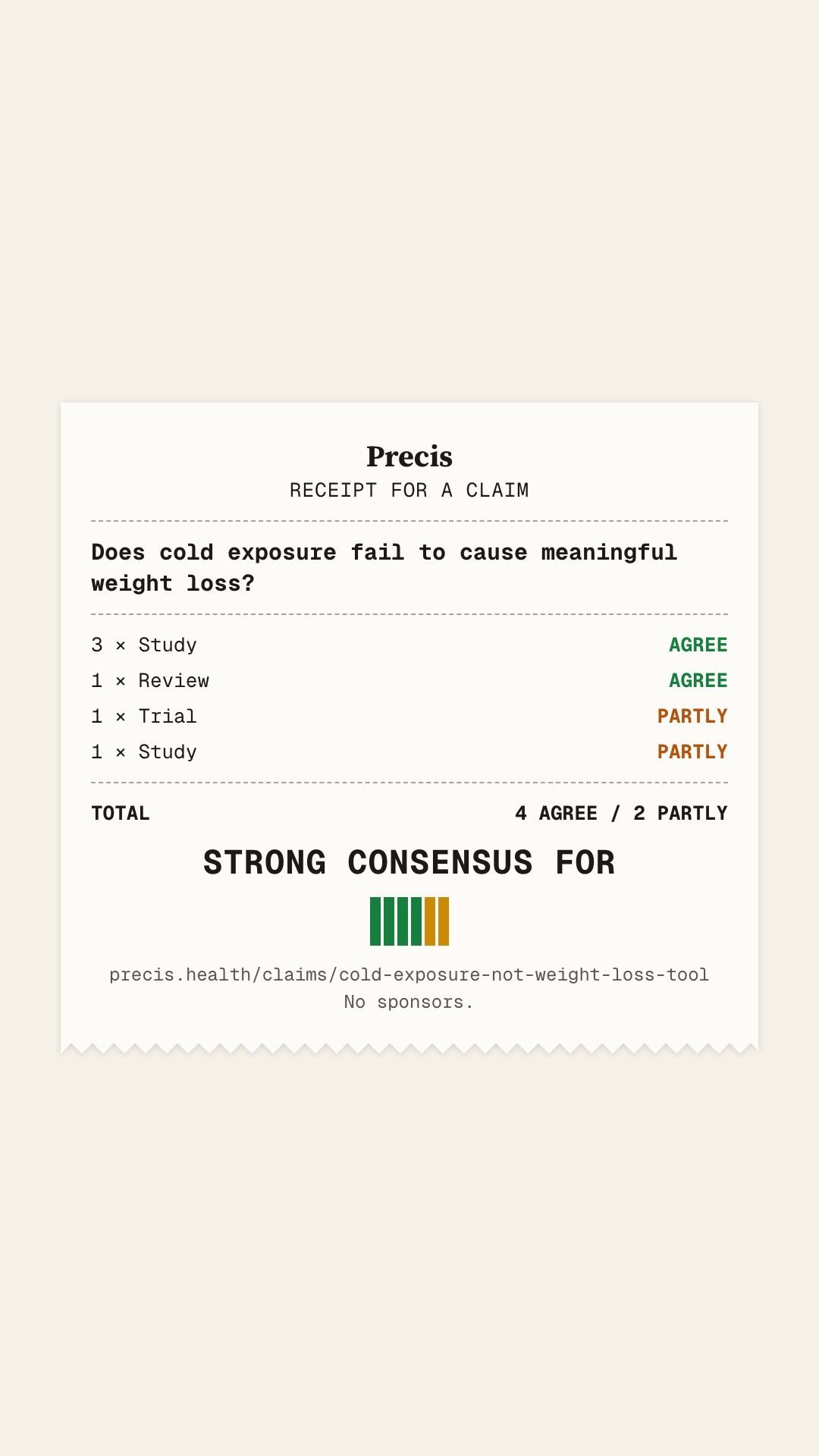
PrecisRECEIPT FOR A CLAIM


Does cold exposure fail to cause meaningful weight loss?


  • 3 × StudyAGREE
  • 1 × ReviewAGREE
  • 1 × TrialPARTLY
  • 1 × StudyPARTLY

TOTAL4 AGREE / 2 PARTLY

Strong consensus for

What do the studies say?

Strong consensus for

Of 6 studies, 4 agree. Cryotherapy added no weight loss in adults with obesity. A review of clinical trials found only one weight change after cold exposure, of 0.5 kg. Two more studies saw no change in weight or fat. 2 partly agree: in young men, 6 weeks of daily cold at 17 C cut body fat, and a clinic series of local fat freezing found a 0.53 kg drop.

Computed from 6 studies that test this point, each judged by two readers, in full. 4 more studies are waiting for a full read and do not count yet.

What was said on the podcast?

“So, the short answer is no. it just doesn't move the needle enough. So there's certainly no great evidence that cold exposure meaningfully increases in a clinically relevant way the quantity of bat”
Peter Attia, The Drive · Cold therapy: pros, cons, and its impact on longevity (AMA #47 rebroadcast) · 38:15 on YouTube
Episode check An ice bath of 10 to 15 minutes is the sweet spot for soreness, the episode says. Of 10 studies, 5 agree. All 6 that tested colder water found it did no better. 8 claims checked against 40 studies See every claim we checked →
Point 1 of 2 Strong consensus for

Repeated cold exposure does not produce clinically meaningful weight or fat loss in adults

Agree 4

trial or observed group · 2025

“WBC combined with a conventional obesity management intervention did not produce significantly greater body weight loss compared with the intervention alone in adults with obesity.”

Effects of Whole-Body Cryotherapy Combined With Conventional Obesity Management Versus Obesity Management Alone: A Clinical Trial. Obesity (Silver Spring)
Who: adults aged 18-50 with obesity (BMI > 30 kg/m2) in Finland, all on a conventional obesity management programme (VLCD then counselling)
PMID 40903800

other primary study · 2015

“It could be noticed that a 6-month-long exercise programme did not change body weight or BMI, or WHR, although a downward trend was observed.”

Body Composition, Lipid Profile, Adipokine Concentration, and Antioxidant Capacity Changes during Interventions to Treat Overweight with Exercise Programme and Whole-Body Cryostimulation. Oxid Med Cell Longev
Who: 45 overweight and obese men aged about 40 (BMI 30.39 ± 4.31), single-group exercise programme with whole-body cryostimulation, no diet change
PMID 26171117

systematic review · 2022

“Only one study produced a reduction in weight of 1.1 lbs (0.5 kg) (p>0.05) after cold exposure ( 56 ), indicating that cold exposure may not be a feasible treatment for weight reduction in obese patients.”

Interventions associated with brown adipose tissue activation and the impact on energy expenditure and weight loss: A systematic review. Front Endocrinol (Lausanne)
Who: Human clinical trials (2000-2022) of interventions linked to BAT activation; 28 of them tested cold exposure, alone or combined
PMID 36568070

other primary study · 2023

“Following resistance exercise, we found that repeated CWI or HWI does not influence whole-body lean, nor fat mass.”

No effect of repeated post-resistance exercise cold or hot water immersion on in-season body composition and performance responses in academy rugby players: a randomised controlled cross-over design. Eur J Appl Physiol
Who: Sub-elite male academy Super Rugby players in-season, randomised controlled cross-over design
PMID 36284024

Partly agree 2

controlled trial · 2013 · landmark

“Daily 2-hour cold exposure at 17°C for 6 weeks resulted in a parallel increase in BAT activity and CIT and a concomitant decrease in body fat mass.”

Recruited brown adipose tissue as an antiobesity agent in humans. J Clin Invest
Who: Healthy young nonobese men (age 24.4 years, BMI 22.0) with low or undetectable BAT activity
PMID 23867622

other primary study · 2018

“As shown in Figure 3 , in addition to a significant ( p =0.003) decline in waist circumference (mean 2.8 cm; 3.3%), significant reductions in both body weight (mean 0.53 kg; 0.73%; p =0.005) and BMI (0.2 units; 1.1%; p =0.012) were recorded following three procedures ( Figure 3 ).”

Mechanism Underlying Tissue Cryotherapy to Combat Obesity/Overweight: Triggering Thermogenesis. J Obes
Who: Retrospective series of clinic clients in Paris receiving local abdominal tissue cryotherapy (mostly women, BMI 18.9-32.7)
PMID 29854439

Disagree 0· none of the studies we read

Point 2 of 2 Leaning for

Cold-induced brown fat thermogenesis raises daily energy use in adults by only a small amount

Of 7 studies, 2 agree that brown fat burns very little. One found 15 to 25 kcal a day in people with large brown fat stores, and another found 4 kcal a day. 5 partly agree. Cold raised energy use, by up to 201 kcal a day while people were cold. But these were short lab tests, and in one, weight did not change because people ate more.

Computed from 7 studies that test this point, each judged by two readers, in full. 10 more studies are waiting for a full read and do not count yet.

Agree 2

other primary study · 2013

“Mild cold-induced thermogenesis in BAT accounts for 15–25 kcal/d in subjects with relatively large BAT depots.”

15O PET measurement of blood flow and oxygen consumption in cold-activated human brown fat. J Nucl Med
Who: 25 healthy adults (15 women, 10 men; mean age 30 ± 7 y), split into high-BAT and low-BAT groups by 18F-FDG uptake
PMID 23362317

controlled trial · 2016

“Change (∆) in BAT DEE as a result of cold stress was estimated to be 4 ± 3 kcal/day; this accounted for merely 1 % of the total change (∆) in whole-body EE (352 ± 372 kcal/day, a range of 45–898 kcal/day).”

Human brown adipose tissue [(15)O]O2 PET imaging in the presence and absence of cold stimulus. Eur J Nucl Med Mol Imaging
Who: Healthy adults of both genders with normal oral glucose tolerance and cardiovascular status
PMID 26993316

Partly agree 5

trial or observed group · 2011 · landmark

“Very interestingly, mean energy expenditure after cold exposure increased significantly within the BAT-positive group, but not within the BAT-negative group (+15.5±8.9% versus +3.6±8.9%, P = 0.001, Figure 2C ).”

Brown adipose tissue in morbidly obese subjects. PLoS One
Who: 15 morbidly obese adults (2 male, 13 female; no diabetes or beta-blockers), pooled with previously reported lean and obese male subjects for the BAT-positive vs BAT-negative analysis
PMID 21390318

other primary study · 2013 · landmark

“However, in the current study, no significant changes in body weight and body composition were observed, which may indicate that increased energy expen- diture was compensated by increased food intake or reduced physical activity.”

Cold acclimation recruits human brown fat and increases nonshivering thermogenesis. J Clin Invest
Who: 17 healthy lean young adults (9 female, 8 male; age 23 +/- 3.2 years; BMI 21.6 kg/m2)
PMID 23867626

trial or observed group · 2016

“However, twenty-four-hour energy expenditure (2166±206 vs. 2118±188 kcal/day; p=0.15) and TEF150% (7.4±2.7% vs. 7.7±1.6%; p=0.78) were unchanged.”

The thermogenic responses to overfeeding and cold are differentially regulated. Obesity (Silver Spring)
Who: healthy lean men aged 18-35 (23 ± 3 years, BMI 23.0) at Pennington Biomedical Research Center
PMID 26592725

systematic review · 2022

“Only one study produced a reduction in weight of 1.1 lbs (0.5 kg) (p>0.05) after cold exposure ( 56 ), indicating that cold exposure may not be a feasible treatment for weight reduction in obese patients.”

Interventions associated with brown adipose tissue activation and the impact on energy expenditure and weight loss: A systematic review. Front Endocrinol (Lausanne)
Who: Clinical trials (2000-2022) in adults of interventions linked to BAT activation; 21 trials of cold exposure, mostly small and in lean subjects
PMID 36568070

Show 1 more Show fewer

other primary study · 2020

“The resting EE increased during cold air exposure by 201 kcal/day as compared to baseline, thermo-neutral conditions (13.14 % rise, p<0.0001; Table 2).”

Brown fat activity determined by infrared thermography and thermogenesis measurement using whole body calorimetry (BRIGHT Study). Physiol Res
Who: 17 healthy lean Chinese males (24 ± 0.52 years, BMI 21.7) in Singapore
PMID 31852199

Disagree 0· none of the studies we read

More on heat and cold

The Precis Weekly

Get each new check by email.

One email a week with the claims and episodes we checked, what the studies found and the minute each claim was said.

Free. Unsubscribe anytime.