A claim you hear on longevity podcasts

Do ice baths reduce muscle soreness?

Strong consensus for. Of 10 studies that test it, 8 agree and 2 partly agree.

Best for:
Anyone using cold water to recover from hard exercise
Price:
Free to read, with every receipt. Pro is $9 a month or $79 a year and adds AI Ask.

The claim checked: A cold-water bath after hard exercise cuts next-day soreness Hear it at 17:44

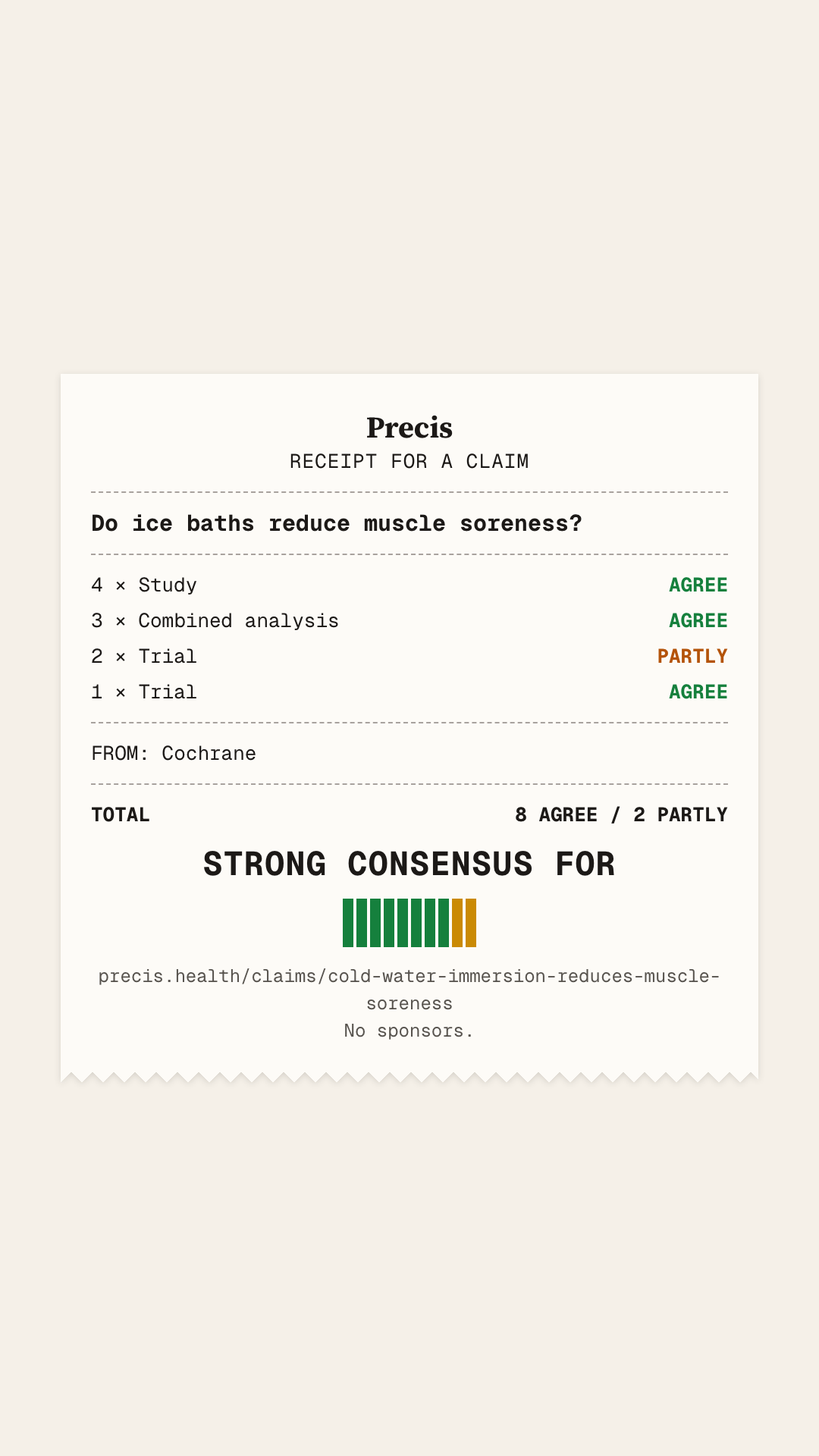
PrecisRECEIPT FOR A CLAIM


Do ice baths reduce muscle soreness?


  • 4 × StudyAGREE
  • 3 × Combined analysisAGREE
  • 2 × TrialPARTLY
  • 1 × TrialAGREE

FROM: Cochrane


TOTAL8 AGREE / 2 PARTLY

Strong consensus for

What do the studies say?

Strong consensus for

Of 10 studies, 8 agree. Cold water after hard exercise eased soreness a day or more later. That held in a large meta-analysis, in a Cochrane review, and in trials of runners, fighters and women after drop jumps. Most of the effects were small. 2 partly agree: in jiu-jitsu athletes, soreness did not differ by recovery method, and in young men after drop jumps, it eased only days later.

Computed from 10 studies that test this point, each judged by two readers, in full. 10 more studies are waiting for a full read and do not count yet.

The study behind the claim tested something else. See what it tested

What was said on the podcast?

“When they looked at DOMS, again, delayed onset muscle soreness 24 hours after high-intensity workout, they saw a significant reduction.”
Peter Attia, The Drive · Cold therapy: pros, cons, and its impact on longevity (AMA #47 rebroadcast) · 17:44 on YouTube
Episode check An ice bath of 10 to 15 minutes is the sweet spot for soreness, the episode says. Of 10 studies, 5 agree. All 6 that tested colder water found it did no better. 8 claims checked against 40 studies See every claim we checked →
The study behind the claim The retelling overstates it

What did the study actually test?

On tape: soreness 24 h after high-intensity exercise fell a lot (SMD -0.89), and after eccentric exercise there was a smaller "still statistically significant" drop of -0.48; power improved 0.34 (eccentric) and 0.22 (high-intensity). The -0.89, 0.34 and 0.22 match the paper at 24 h. The -0.48 does not belong at 24 h: it is the eccentric result at 48 h. At 24 h after eccentric exercise the paper reports SMD -0.51 with p = 0.09, which it calls not effective, and its conclusion says that after eccentric exercise cold water helped only muscular power at 24 h. So the eccentric soreness benefit is retold one day early and as significant when it was not. Impact of Cold-Water Immersion Compared with Passive Recovery Following a Single Bout of Strenuous Exercise on Athletic Performance in Physically Active Participants: A Systematic Review with Meta-analysis and Meta-regression. Sports Med, 2022. Systematic review and meta-analysis of 52 randomized controlled trials: cold water immersion within 15 min after one bout of strenuous exercise against passive recovery, split into eccentric and high-intensity exercise subgroups, with meta-regression on water temperature and duration, Adults over 18 who exercise regularly or play sport.

What was saidWhat the study did

What it found

“CWI was not effective in reducing DOMS 24 h after eccentric exercise (Fig. 5 ; Table 2 ; small effect; p = 0.09; GRADE = moderate).”

PMID 35157264

How the authors extend it

“Cold-water immersion is more likely to positively influence muscular power performance, muscle soreness, serum creatine kinase, and perceived recovery after high-intensity exercise when compared with passive recovery.”

PMID 35157264

Emma Moore is supported by a Research Training Program (Domestic) Scholarship from the Australian Commonwealth Department of Education and Training. Open Access funding enabled and organized by CAUL and its Member Institutions. Two readers agreed on the label, and the paper was read in full.

Point 1 of 2 Strong consensus for

Cold water immersion after strenuous exercise reduces delayed onset muscle soreness at 24 hours compared with passive recovery

Agree 8

other primary study · 2018 · landmark

“Immersion The effect of cold water immersion (CWI) on DOMS and perceived fatigue was significant, but the effect size was small in terms of DOMS.”

An Evidence-Based Approach for Choosing Post-exercise Recovery Techniques to Reduce Markers of Muscle Damage, Soreness, Fatigue, and Inflammation: A Systematic Review With Meta-Analysis. Front Physiol
Who: healthy human adults (competitive athletes, recreational athletes or inactive people) in randomized controlled or crossover trials of a single post-exercise recovery session
PMID 29755363

pooled analysis · 2016

“Overall pooled results, independent of water temperature, showed a statistically significant difference in favor of CWI (MD = 0.315, 95 % CI 0.048, 0.581; p = 0.021).”

Can Water Temperature and Immersion Time Influence the Effect of Cold Water Immersion on Muscle Soreness? A Systematic Review and Meta-Analysis. Sports Med
Who: Physically active people and athletes in RCTs of a single post-exercise CWI session vs passive recovery (male n = 141, female n = 28)
PMID 26581833

pooled analysis · 2015

“One main finding of this study was, that cold therapy (CWI) significantly alleviated the symptoms of DOMS 24 hrs, 48 hrs and 96 hrs after the cooling application.”

The Effect of Post-Exercise Cryotherapy on Recovery Characteristics: A Systematic Review and Meta-Analysis. PLoS One
Who: Healthy non-injured male and female volunteers of any training status in trials of post-exercise cryotherapy vs passive control
PMID 26413718

other primary study · 2012

“There was some evidence that cold‐water immersion reduces delayed onset muscle soreness after exercise compared with passive interventions involving rest or no intervention.”

Cold-water immersion (cryotherapy) for preventing and treating muscle soreness after exercise. Cochrane Database Syst Rev
Who: Randomised and quasi-randomised trials of people doing exercise followed by cold-water immersion (<15 C); 14 trials compared with passive intervention
PMID 22336838

Show 4 more Show fewer

pooled analysis · 2022 · cited on tape

“CWI was effective in reducing DOMS 24 h after high-intensity exercise (Fig. 5 ; Table 2 ; moderate effect; p = 0.003; GRADE = moderate).”

Impact of Cold-Water Immersion Compared with Passive Recovery Following a Single Bout of Strenuous Exercise on Athletic Performance in Physically Active Participants: A Systematic Review with Meta-analysis and Meta-regression. Sports Med
Who: Regularly exercising adults over 18 in RCTs using CWI within 15 min after a single bout of strenuous exercise vs passive recovery
PMID 35157264

controlled trial · 2020

“DOMS was lower in the PBC and CWI group compared with the CON group throughout the 72‐hour follow‐up period ( P < .05 for all [PBC vs CON and CWI vs CON] between group differences,).”

Partial-body cryotherapy (-135°C) and cold-water immersion (10°C) after muscle damage in females. Scand J Med Sci Sports
Who: Thirty healthy recreationally trained females (age 22.5 ± 2.7 years) after a muscle-damaging protocol, randomised to PBC, CWI or control
PMID 31677292

trial or observed group · 2018

“Both CWI and MAS were still beneficial for reducing muscle soreness (CWI vs. PAS: ES = −1.49; MAS vs. PAS: ES = −1.12), with MAS being harmful to Dm (MAS vs. PAS: ES = 0.42) and the serum concentration of IGF-1 (MAS vs. PAS: ES = −0.34).”

Effects of different recovery strategies following a half-marathon on fatigue markers in recreational runners. PLoS One
Who: Healthy male recreational runners after a competitive half-marathon, randomized within matched quartets to active recovery, CWI, massage or passive recovery
PMID 30412626

other primary study · 2018

“However, at POST-24, moderate to large differences between CON and CWI were noted for changes in total Hooper scores ( d = 1.93), DOMS ( d = 0.60), sensations of fatigue ( d = 1.51), sleep quality ( d = 1.36) and perceived stress ( d = 1.56), with CWI having a positive effect on the exercise-mediated changes within these variables.”

Cold Water Immersion Enhanced Athletes' Wellness and 10-m Short Sprint Performance 24-h After a Simulated Mixed Martial Arts Combat. Front Physiol
Who: Twelve male well-trained MMA athletes (age 26.5 ± 5.0 years), randomized crossover after simulated MMA combat
PMID 30443221
Partly agree 2

controlled trial · 2016

“Perceived muscle soreness was not affected by conditions and was affected only by measurement time; the sensation of muscle soreness remained high compared with pretraining up to 24 hours after the training session, returning to baseline within 48 hours.”

Use of Cold-Water Immersion to Reduce Muscle Damage and Delayed-Onset Muscle Soreness and Preserve Muscle Power in Jiu-Jitsu Athletes. J Athl Train
Who: Highly trained male jiu-jitsu athletes, randomized crossover
PMID 27575565

controlled trial · 2018

“Multiple CWIs during the first 72 h attenuated muscle damage by an early reduction of muscle thickness, and a delayed reduction of DOMS and CK activity.”

Multiple Cold-Water Immersions Attenuate Muscle Damage but not Alter Systemic Inflammation and Muscle Function Recovery: A Parallel Randomized Controlled Trial. Sci Rep
Who: Physically active, non-strength-trained men after 5 x 20 drop jumps (parallel RCT, CWI vs passive seated control)
PMID 30026562

Disagree 0· none of the studies we read

Point 2 of 2 Conflicting

Cold water immersion after strenuous exercise improves perceived recovery and slightly improves muscular power 24 hours later

The studies split evenly. Of 10, 4 agree. A large meta-analysis found better perceived recovery 24 h after high-intensity exercise, and three more found faster recovery of sprints or jumps. 4 disagree: a review and three trials found no difference in recovery or power at 24 and 48 h. 2 partly agree.

Computed from 10 studies that test this point, each judged by two readers, in full. Sources land on both sides. 10 more studies are waiting for a full read and do not count yet.

Agree 4

pooled analysis · 2022 · cited on tape

“CWI was effective in increasing feelings of perceived recovery 24 h following high-intensity exercise (Table 2 ; moderate effect; p = 0.001; GRADE = moderate).”

Impact of Cold-Water Immersion Compared with Passive Recovery Following a Single Bout of Strenuous Exercise on Athletic Performance in Physically Active Participants: A Systematic Review with Meta-analysis and Meta-regression. Sports Med
Who: Randomised controlled trials in regularly exercising adults over 18 using CWI within 15 min after a single bout of strenuous exercise vs passive recovery
PMID 35157264

other primary study · 2018

“The use of CWI resulted in an enhanced recovery of 10-m sprint performance, as well as improved perceived wellness 24 h following simulated MMA combat.”

Cold Water Immersion Enhanced Athletes' Wellness and 10-m Short Sprint Performance 24-h After a Simulated Mixed Martial Arts Combat. Front Physiol
Who: Twelve male well-trained MMA athletes (age 26.5 ± 5.0 years), crossover CWI vs passive recovery after simulated MMA combat
PMID 30443221

other primary study · 2023

“Our results indicate that CWI accelerated jumping and RSA performance recovery after LIST and that these beneficial effects would not be related to CWI-induced lower muscle damage but was placebo effect related.”

Cold water immersion after a soccer match: Does the placebo effect occur? Front Physiol
Who: Twelve semi-professional male soccer players (age 21.1 +/- 2.2 years) from a Tunisian senior squad, habitual CWI users
PMID 36895634

systematic review · 2025

“For the JUMP indicator, compared to the control group, MD-LT-CWI (10–15 min, 5°C–10°C) [SMD = 0.48, 95% CI (0.20, 0.77), P = 0.01] and MD-MT-CWI (10–15 min, 11°C–15°C) [SMD = 0.42, 95% CI (0.15, 0.70), P = 0.02] significantly improved jump height, a measure of performance recovery from acute exercise-induced muscle damage ( Figure 5B ).”

Impact of different doses of cold water immersion (duration and temperature variations) on recovery from acute exercise-induced muscle damage: a network meta-analysis. Front Physiol
Who: Healthy individuals in RCTs of CWI after acute exercise-induced muscle damage; mostly male athletes and non-athletes
PMID 40078372

Partly agree 2

controlled trial · 2016

“For the rating of perceived recovery (Figure 4), we noted an effect only of measurement time (F1.92, 26.82 = 15.37; P < .001; η2 = 0.523), with higher recovery values at pretraining than at 120 minutes (difference = −4.8 ± 1.4 au; P < .001; 95% CI = −5.6, −2.1; d = 0.9), postrecovery (difference = −4.5 ± 3.6 au; P < .001; 95% CI = −6.4, −2.6; d = 0.7), and 24 hours (difference = −2.2 ± 2.0 au; P = .003; 95% CI = −3.3, −1.1; d = 0.6).”

Use of Cold-Water Immersion to Reduce Muscle Damage and Delayed-Onset Muscle Soreness and Preserve Muscle Power in Jiu-Jitsu Athletes. J Athl Train
Who: highly trained male jiu-jitsu athletes (blue or purple belt, age 24.0 +/- 3.6 years)
PMID 27575565

controlled trial · 2018

“However, the recovery of maximal muscle strength, vertical jump height, systemic cytokine kinetics and ECM degradation did not differ between control and CWI groups.”

Multiple Cold-Water Immersions Attenuate Muscle Damage but not Alter Systemic Inflammation and Muscle Function Recovery: A Parallel Randomized Controlled Trial. Sci Rep
Who: physically active young men (about 20 years) not in regular strength training, after 100 drop jumps; parallel-group RCT in Brazil
PMID 30026562

Disagree 4

systematic review · 2023

“One of the main findings of this review was that post-exercise CWI reduced DOMS and RPE immediately, but with no significant effect on DOMS and RPE at 24 and 48 h ( Table 2 ).”

Effects of cold water immersion after exercise on fatigue recovery and exercise performance--meta analysis. Front Physiol
Who: Healthy humans in RCTs and crossover trials of CWI (≤15 C) after exercise
PMID 36744038

other primary study · 2017

“However, there was no difference between the five recovery strategies at 24 and 48 h for perceptual and performance recovery.”

Influence of recovery strategies upon performance and perceptions following fatiguing exercise: a randomized controlled trial. BMC Sports Sci Med Rehabil
Who: Recreationally active, healthy non-elite males (mean age 27) after fatiguing exercise; randomized crossover of CWI, CWT, active, combined and passive control recovery
PMID 29299318

other primary study · 2018

“Both CWI, continuous and intermittent protocols, were ineffective for promoting superior recovery of CMJ performance and TMG muscle mechanical responses.”

Effectiveness of Two Cold Water Immersion Protocols on Neuromuscular Function Recovery: A Tensiomyography Study. Front Physiol
Who: 39 healthy active male students (21.8 ± 2.8 years), randomised to intermittent CWI, continuous CWI or control (13 per group) after a jump fatigue protocol
PMID 29997522

other primary study · 2021

“Despite the expected post-match muscle damage and impaired performance, neither Bioceramic nor CWI interventions improved post-match recovery.”

Post-Match Recovery in Soccer with Far-Infrared Emitting Ceramic Material or Cold-Water Immersion. J Sports Sci Med
Who: Brazilian university-level male soccer players after a soccer match, randomized to bioceramic clothing, CWI or passive control
PMID 35321145

More on heat and cold

The Precis Weekly

Get each new check by email.

One email a week with the claims and episodes we checked, what the studies found and the minute each claim was said.

Free. Unsubscribe anytime.