For Substack, Beehiiv and email. We redraw the image when the verdict changes.
[](https://precis.health/claims/cold-water-after-lifting-blunts-muscle-gain)
For GitHub, Notion and forums that take Markdown.
Free to share with credit. Never on a product page or in an ad.
What do the studies say?
Leaning for
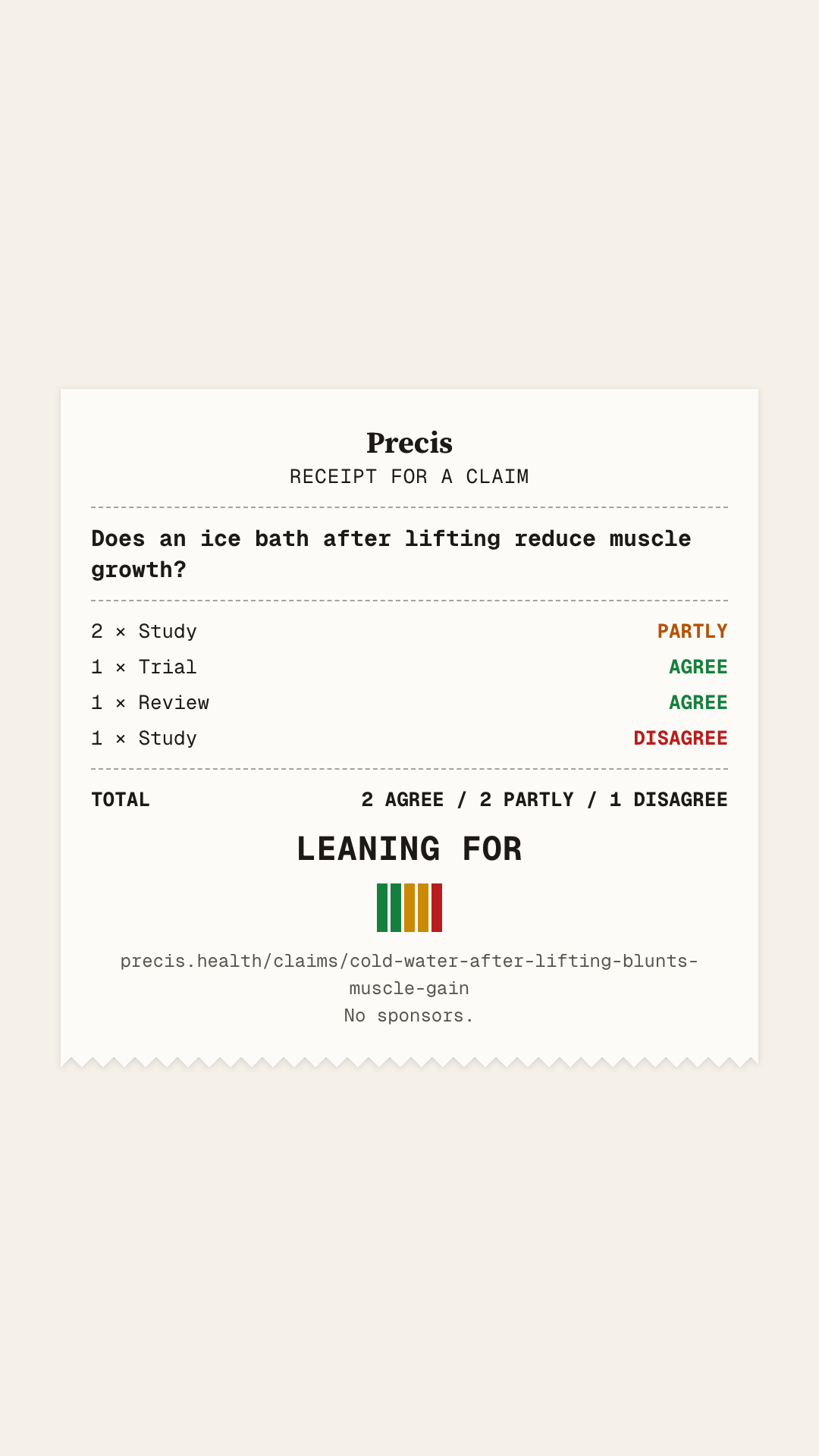
Of 5 studies, 2 agree. In a training trial, 21 men who sat in cold water after their sessions added less muscle than men who did active recovery. A review of reviews also advises against cold water after lifting while you build muscle. 1 disagrees: in academy rugby players, cold water after lifting did not change lean mass. 2 partly agree. One found cold water slowed muscle protein building but did not measure muscle size. The other, a network analysis of 87 trials, ranked cold water close to rest for short-term strength.
Computed from 5 studies that test this point, each judged by two readers, in full.
8 more studies are waiting for a full read and do not count yet.
The study behind the claimThe retelling overstates it
What did the study actually test?
On tape: cold water right after strength training can blunt gains in muscle size and some strength. The study matches the retelling closely: waist-deep immersion for 10 min at 10.1 C (50 F) within 5 min of each session, against 10 min of easy cycling, for 12 weeks. Leg press 1RM rose 201 kg with active recovery against 133 kg with cold water, and quadriceps mass rose 309 g against 103 g. The tape says 24 young men; 24 enrolled and 21 finished. The one gap is who it covers: young, active men only, and the tape states the effect for anyone who lifts.
Post-exercise cold water immersion attenuates acute anabolic signalling and long-term adaptations in muscle to strength training.J Physiol, 2015. Randomized controlled trial (Study 1): 12 weeks of lower-body strength training, 2 days a week, with 10 min of cold water immersion or 10 min of low-intensity cycling after each session; plus a separate 9-man crossover biopsy study (Study 2), 24 physically active young men enrolled in Study 1 (mean age about 21); 21 finished (one cold water and two active recovery dropouts from injury); no women.
What was saidWhat the study did
Who took part
DiffersAnyone who does strength trainingPhysically active young men (mean age about 21), 21 completers
What it found
“However, the change in muscle mass accretion was significantly smaller in the cold water immersion group compared with the active recovery group (206 g; d = −4.1; P < 0.001).”
“These data suggest that CWI attenuates the acute changes in satellite cell numbers and activity of kinases that regulate muscle hypertrophy, which may translate to smaller long-term training gains in muscle strength and hypertrophy.”
Funded by research grants from the American College of Sports Medicine Research Foundation and Exercise and Sport Science Australia, and a grant from Queensland University of Technology. All authors declare no competing interests. Two readers agreed on the label, and the paper was read in full.
The point checkedLeaning for
Regular cold water immersion right after resistance training reduces long-term gains in muscle size and strength compared with no immersion or active recovery
Agree 2
controlled trial · 2015 · cited on tape
“However, the change in muscle mass accretion was significantly smaller in the cold water immersion group compared with the active recovery group (206 g; d = −4.1; P < 0.001).”
Post-exercise cold water immersion attenuates acute anabolic signalling and long-term adaptations in muscle to strength training. J Physiol Who: Study 1: 21 physically active men strength training (CWI vs active recovery); Study 2: 9 active men, acute single-leg strength exercise with biopsies
PMID 26174323
systematic review · 2026
“Importantly, during strength‑ or hypertrophy‑focused training phases, routine CWI immediately after resistance sessions should be avoided due to its dampening effect on anabolic signalling, protein synthesis, and subsequent adaptation [ 5 , 20 , 21 , 27 ].”
Strategic Application of Post-exercise Cold-Water Immersion to Enhance Performance Recovery and Adaptation: An Umbrella Review of 15 Published Systematic Reviews with Meta-analysis. Sports Med Open Who: Umbrella review of systematic reviews with meta-analysis of post-exercise CWI; chronic adaptation data from SRMAs of resistance-training trials
PMID 42816732
Partly agree 2
other primary study · 2020
“In addition, when applied consistently CWI during recovery from resistance‐type exercise lowers myofibrillar protein synthesis rates during more prolonged resistance‐type exercise training and, as such, may attenuate skeletal muscle conditioning.”
Postexercise cooling impairs muscle protein synthesis rates in recreational athletes. J Physiol Who: Twelve healthy, recreationally active young men (aged 21 +/- 2 years)
PMID 31788800
other primary study · 2026
“SUCRA rankings revealed RT_Cold_Long (86.2%) and RT_Control (81.6%) as the top-ranked interventions, with passive recovery ranking 8th (47.1%), comparable to the majority of CWI protocols (Table 6 a).”
Cold water immersion protocol optimization across exercise modalities: a systematic review and network meta-analysis of resistance training, endurance exercise, and team sport applications. BMC Sports Sci Med Rehabil Who: 87 trials of mostly young male athletes (85% of studies male-only; recreational, competitive and elite) doing resistance, endurance or team-sport exercise; 32 resistance-training studies
PMID 41845491
Disagree 1
other primary study · 2023
“Our study found that repeated post-resistance exercise water immersion (i.e., CWI, HWI) did not affect body composition (i.e., lean nor fat mass) following resistance exercise in this cohort of male, academy Super Rugby players.”
No effect of repeated post-resistance exercise cold or hot water immersion on in-season body composition and performance responses in academy rugby players: a randomised controlled cross-over design. Eur J Appl Physiol Who: male academy Super Rugby players (age 19.9 +/- 1.5 y), resistance trained at least twice weekly for >12 months, during an in-season competition phase
PMID 36284024