A claim you hear on longevity podcasts

Is 10 to 15 minutes at 50 to 59 F the best ice bath for soreness?

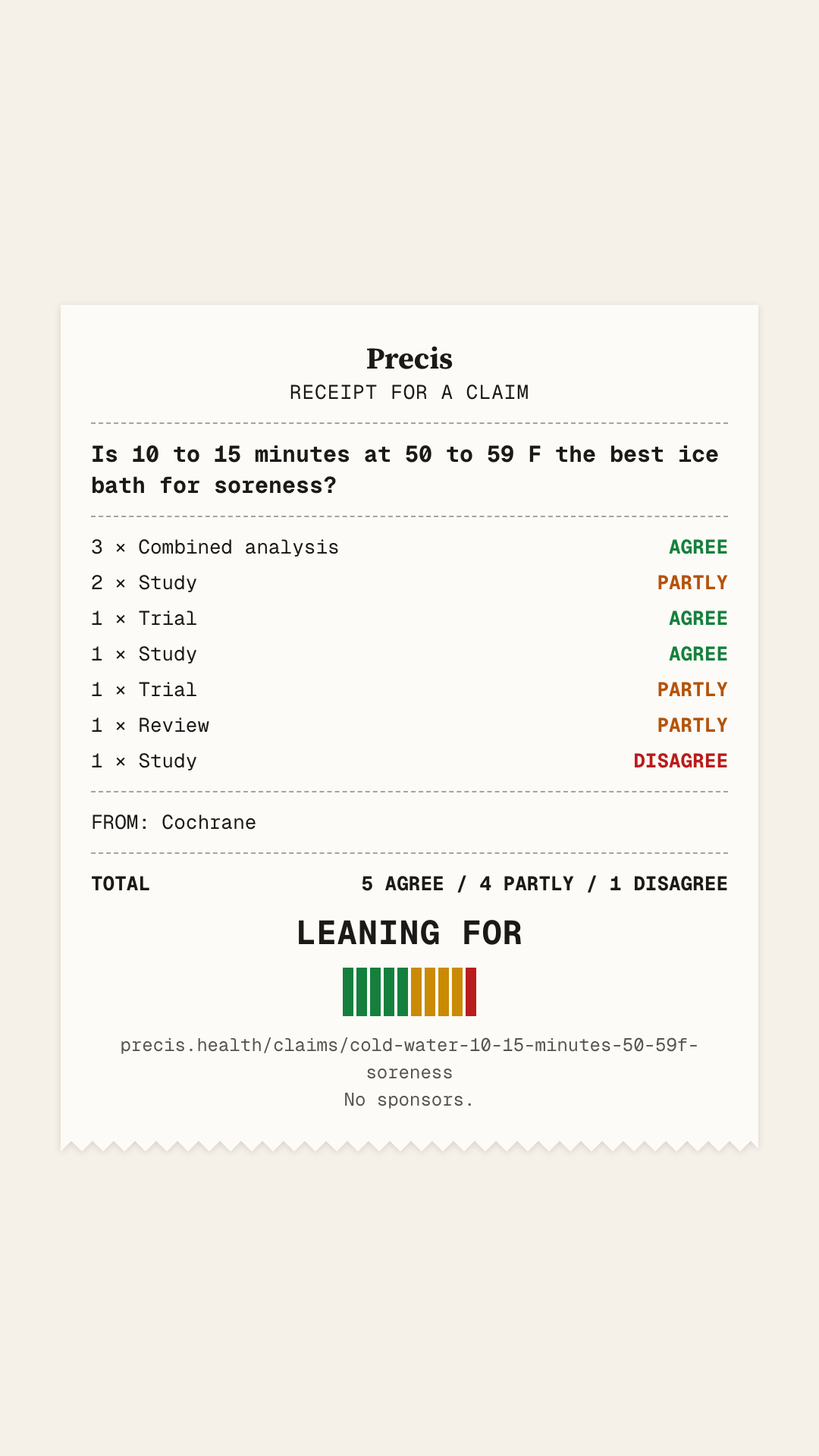
Leaning for. Of 10 studies that test it, 5 agree, 4 partly agree and 1 disagrees.

Best for:
Anyone setting a cold plunge for recovery
Price:
Free to read, with every receipt. Pro is $9 a month or $79 a year and adds AI Ask.

The claim checked: 10 to 15 minutes in 50 to 59 F water is the sweet spot for soreness Hear it at 59:07

PrecisRECEIPT FOR A CLAIM


Is 10 to 15 minutes at 50 to 59 F the best ice bath for soreness?


  • 3 × Combined analysisAGREE
  • 2 × StudyPARTLY
  • 1 × TrialAGREE
  • 1 × StudyAGREE
  • 1 × TrialPARTLY
  • 1 × ReviewPARTLY
  • 1 × StudyDISAGREE

FROM: Cochrane


TOTAL5 AGREE / 4 PARTLY / 1 DISAGREE

Leaning for

What do the studies say?

Leaning for

Of 10 studies, 5 agree that cold water after exercise eases soreness. One meta-analysis found the best results at 11 to 15 C for 11 to 15 minutes. 1 disagrees: in university soccer players, cold water made no difference to soreness. 4 partly agree, because the effect was small, short-lived or seen only days later.

Computed from 10 studies that test this point, each judged by two readers, in full. 10 more studies are waiting for a full read and do not count yet.

What was said on the podcast?

“a 2016 meta analysis came to the conclusion that 10 to 15 minutes immediately following exercise in water between 50 and 59° F was probably the sweet spot.”
Peter Attia, The Drive · Cold therapy: pros, cons, and its impact on longevity (AMA #47 rebroadcast) · 59:07 on YouTube
Episode check An ice bath of 10 to 15 minutes is the sweet spot for soreness, the episode says. Of 10 studies, 5 agree. All 6 that tested colder water found it did no better. 8 claims checked against 40 studies See every claim we checked →
The study behind the claim The retelling matches it

What did the study actually test?

On tape: a 2016 meta-analysis found 10 to 15 minutes in water of 50 to 59 F (10 to 15 C) right after exercise to be the sweet spot. This is the right study and the abstract's own results sentence says "between 10 and 15 °C" and "between 10 and 15 min". The analysis groups and the authors' conclusion are a little narrower: the best group is 11 to 15 C for 11 to 15 min, and trials at exactly 10 C sat in the "severe cold" group (5 to 10 C), which showed no significant effect. So 50 F itself is at the edge of the group that did not work. The effect is small ("slightly better than passive recovery") and the authors rate the trials as low quality; the tape calls it "probably" the sweet spot, which is fair. Can Water Temperature and Immersion Time Influence the Effect of Cold Water Immersion on Muscle Soreness? A Systematic Review and Meta-Analysis. Sports Med, 2016. Systematic review and meta-analysis of 9 randomized controlled trials of one cold water immersion within 1 h after a single exercise session against passive recovery, with subgroups by water temperature (5-10 C against 11-15 C) and immersion time, Healthy young adults and athletes in the 9 trials (mostly men; one trial of female athletes); no age, sex or training-level restriction in the search.

What was saidWhat the study did
What was given Matches 10 to 15 minutes in water at 50 to 59 F (10 to 15 C) Best subgroup 11 to 15 C and 11 to 15 min; 10 C trials fell in the 5 to 10 C group, which showed no significant effect (the abstract results sentence itself says 10 to 15 C and 10 to 15 min)

What it found

“Analysis of subgroups revealed that water at temperatures of between 11 and 15 °C were more effective than temperatures of ≤10 °C (severe cold: MD = 0.057, 95 % CI −1.483, 1.598, p = 0.942; moderate cold: MD = 0.317, 95 % CI 0.102, 0.532, p = 0.004).”

PMID 26581833

How the authors extend it

“The results also demonstrate the presence of a dose–response relationship, indicating that CWI provides the best results at temperatures between 11 and 15 °C for 11–15 min.”

PMID 26581833

Supported by The São Paulo Research Foundation (FAPESP) scholarships (2013/12474-7 and 2014/0338-5) and the National Council for Scientific and Technological Development (CNPq, 482749/2012-1). The authors declare no conflicts of interest relevant to the review. Two readers agreed on the label, and the paper was read in full.

Point 1 of 2 Leaning for

Cold water immersion of 10 to 15 minutes at 10 to 15 C after exercise reduces delayed onset muscle soreness more than passive recovery

Agree 5

pooled analysis · 2016 · cited on tape

“The results also demonstrate the presence of a dose–response relationship, indicating that CWI provides the best results at temperatures between 11 and 15 °C for 11–15 min.”

Can Water Temperature and Immersion Time Influence the Effect of Cold Water Immersion on Muscle Soreness? A Systematic Review and Meta-Analysis. Sports Med
Who: Physically active people and athletes in RCTs of single-session CWI within 1 h after exercise vs passive recovery
PMID 26581833

pooled analysis · 2015

“To sum up the results of the individual studies: the mean temperature of the studies, showing a significant result favouring cooling compared to the passive recovery intervention, was 10°C (range: 5°C to 13°C).”

The Effect of Post-Exercise Cryotherapy on Recovery Characteristics: A Systematic Review and Meta-Analysis. PLoS One
Who: Non-injured participants (mainly male) in trials of post-exercise cooling (28 studies CWI of the legs) vs passive control after exhaustive or muscle-damaging exercise
PMID 26413718

pooled analysis · 2022

“CWI was effective at reducing DOMS after eccentric exercise at 48, 72, and 96 h (Table 2 ; all small effects; GRADE = high).”

Impact of Cold-Water Immersion Compared with Passive Recovery Following a Single Bout of Strenuous Exercise on Athletic Performance in Physically Active Participants: A Systematic Review with Meta-analysis and Meta-regression. Sports Med
Who: Physically active adults over 18 in RCTs doing a single bout of strenuous (eccentric or high-intensity) exercise, CWI vs passive recovery
PMID 35157264

controlled trial · 2020

“DOMS was lower in the PBC and CWI group compared with the CON group throughout the 72‐hour follow‐up period ( P < .05 for all [PBC vs CON and CWI vs CON] between group differences,).”

Partial-body cryotherapy (-135°C) and cold-water immersion (10°C) after muscle damage in females. Scand J Med Sci Sports
Who: Healthy recreationally trained females (age 22.5 +/- 2.7 years) after 100 drop jumps
PMID 31677292

Show 1 more Show fewer

other primary study · 2023

“Indeed, DOMS score increased significantly from baseline to 24 and 48 h after LIST and was significantly higher in Rest condition compared to CWI and Pla conditions at 24 h and only compared to Pla at 48 h.”

Cold water immersion after a soccer match: Does the placebo effect occur? Front Physiol
Who: 12 semi-professional male Tunisian soccer players (21.1 ± 2.2 years) after the Loughborough Intermittent Shuttle Test
PMID 36895634

Partly agree 4

other primary study · 2012

“There was some evidence that cold‐water immersion reduces delayed onset muscle soreness after exercise compared with passive interventions involving rest or no intervention.”

Cold-water immersion (cryotherapy) for preventing and treating muscle soreness after exercise. Cochrane Database Syst Rev
Who: Adults in 17 small randomised/quasi-randomised trials of cold-water immersion (<15 C) after exercise; 14 trials vs passive intervention
PMID 22336838

controlled trial · 2018

“Accordingly, the present study showed lower rates of DOMS in the CWI group compared to the control group at 168 h.”

Multiple Cold-Water Immersions Attenuate Muscle Damage but not Alter Systemic Inflammation and Muscle Function Recovery: A Parallel Randomized Controlled Trial. Sci Rep
Who: Physically active males randomized to CWI or control after drop-jump exercise-induced muscle damage
PMID 30026562

systematic review · 2023

“The results showed that post-exercise CWI intervention was effective in reducing DOMS immediately, but not for prolonged periods of time (24 h, 48 h).”

Effects of cold water immersion after exercise on fatigue recovery and exercise performance--meta analysis. Front Physiol
Who: RCTs and crossover studies in healthy humans (active, recreational and professional athletes) receiving CWI at ≤15°C after exercise vs passive control
PMID 36744038

other primary study · 2018

“Specifically, CWI ‘almost certainly’ resulted in improved sleep quality ( d = 1.36; -2.04 to -0.68), stress ( d = 1.56; -2.24 to -0.88) and perceived fatigue ( d = 1.51; -2.19 to -0.84), and ‘likely’ resulted in a moderate decrease in DOMS ( d = 0.60; -1.27 to 0.08).”

Cold Water Immersion Enhanced Athletes' Wellness and 10-m Short Sprint Performance 24-h After a Simulated Mixed Martial Arts Combat. Front Physiol
Who: well-trained male MMA athletes (age 26.5 +/- 5.0 years) after a simulated MMA combat (3 x 5-min rounds)
PMID 30443221

Disagree 1

other primary study · 2021

“No differences were reported in DOMS and perceptual recovery between treatments.”

Post-Match Recovery in Soccer with Far-Infrared Emitting Ceramic Material or Cold-Water Immersion. J Sports Sci Med
Who: Twenty-five university-level male soccer players after a friendly soccer match
PMID 35321145

Point 2 of 2 Strong consensus for

Water colder than 10 C (41 to 50 F) adds no further reduction in soreness over 10 to 15 C

All 6 studies agree that colder water adds nothing for soreness. One meta-analysis found 11 to 15 C worked better than 10 C or colder. A network analysis ranked 10 to 15 minutes at 11 to 15 C best. Three more reviews found no extra benefit from colder water.

Computed from 6 studies that test this point, each judged by two readers, in full. 10 more studies are waiting for a full read and do not count yet.

Agree 6

pooled analysis · 2016 · cited on tape

“Analysis of subgroups revealed that water at temperatures of between 11 and 15 °C were more effective than temperatures of ≤10 °C (severe cold: MD = 0.057, 95 % CI −1.483, 1.598, p = 0.942; moderate cold: MD = 0.317, 95 % CI 0.102, 0.532, p = 0.004).”

Can Water Temperature and Immersion Time Influence the Effect of Cold Water Immersion on Muscle Soreness? A Systematic Review and Meta-Analysis. Sports Med
Who: physically active people and athletes in randomized controlled trials of single post-exercise CWI versus passive recovery (141 male, 28 female)
PMID 26581833

systematic review · 2025

“In this network meta-analysis, MD-MT-CWI (10–15 min, 11°C–15°C) demonstrated the best efficacy in alleviating delayed onset muscle soreness (DOMS).”

Impact of different doses of cold water immersion (duration and temperature variations) on recovery from acute exercise-induced muscle damage: a network meta-analysis. Front Physiol
Who: Healthy individuals (mostly male athletes and non-athletes) in RCTs of CWI after exercise-induced muscle damage
PMID 40078372

systematic review · 2026

“Current evidence does not establish that one water-temperature range is superior for any outcome: numerically larger DOMS reductions were observed at approximately 10–15 °C than at ≈5 °C, but this pattern was not supported by the formal subgroup-difference test or the continuous meta-regression and requires confirmation in adequately powered, direct temperature-comparison trials; CK and Mb showed no detectable temperature dependence within the range studied.”

Temperature-dependent effects of post-exercise cold-water immersion on recovery: a systematic review and meta-analysis. BMC Sports Sci Med Rehabil
Who: Participants in controlled studies of post-exercise cold-water immersion (at least lower limbs) vs passive recovery
PMID 42870311

pooled analysis · 2022

“Water temperature and exposure duration did not have significant moderating effects at any timepoint.”

Impact of Cold-Water Immersion Compared with Passive Recovery Following a Single Bout of Strenuous Exercise on Athletic Performance in Physically Active Participants: A Systematic Review with Meta-analysis and Meta-regression. Sports Med
Who: Physically active participants in randomised controlled trials of a single bout of eccentric or high-intensity exercise followed by cold-water immersion vs passive recovery
PMID 35157264

Show 2 more Show fewer

systematic review · 2023

“Also, it was discovered that at <10°C or ≥10°C, post-exercise CWI was both ineffective in changing DOMS at 24 and 48 h.”

Effects of cold water immersion after exercise on fatigue recovery and exercise performance--meta analysis. Front Physiol
Who: Healthy humans of any training status (mostly athletes) in RCTs and crossover studies of post-exercise cold water immersion at 15 C or below vs passive control
PMID 36744038

systematic review · 2026

“While both temperature ranges enhanced recovery of soreness and CK [ 23 , 24 , 36 ], 10–15 °C tended to be superior for soreness, whereas 5–10 °C benefited CK and jump performance [ 36 ], suggesting an outcome-specific approach to selecting protocols.”

Strategic Application of Post-exercise Cold-Water Immersion to Enhance Performance Recovery and Adaptation: An Umbrella Review of 15 Published Systematic Reviews with Meta-analysis. Sports Med Open
Who: Umbrella review of 15 systematic reviews with meta-analysis of post-exercise cold-water immersion; 2823 male and 320 female participants
PMID 42816732
Partly agree 0· none of the studies we read

Disagree 0· none of the studies we read

More on heat and cold

The Precis Weekly

Get each new check by email.

One email a week with the claims and episodes we checked, what the studies found and the minute each claim was said.

Free. Unsubscribe anytime.