A claim you hear on longevity podcasts

Can your body only use so much protein at once?

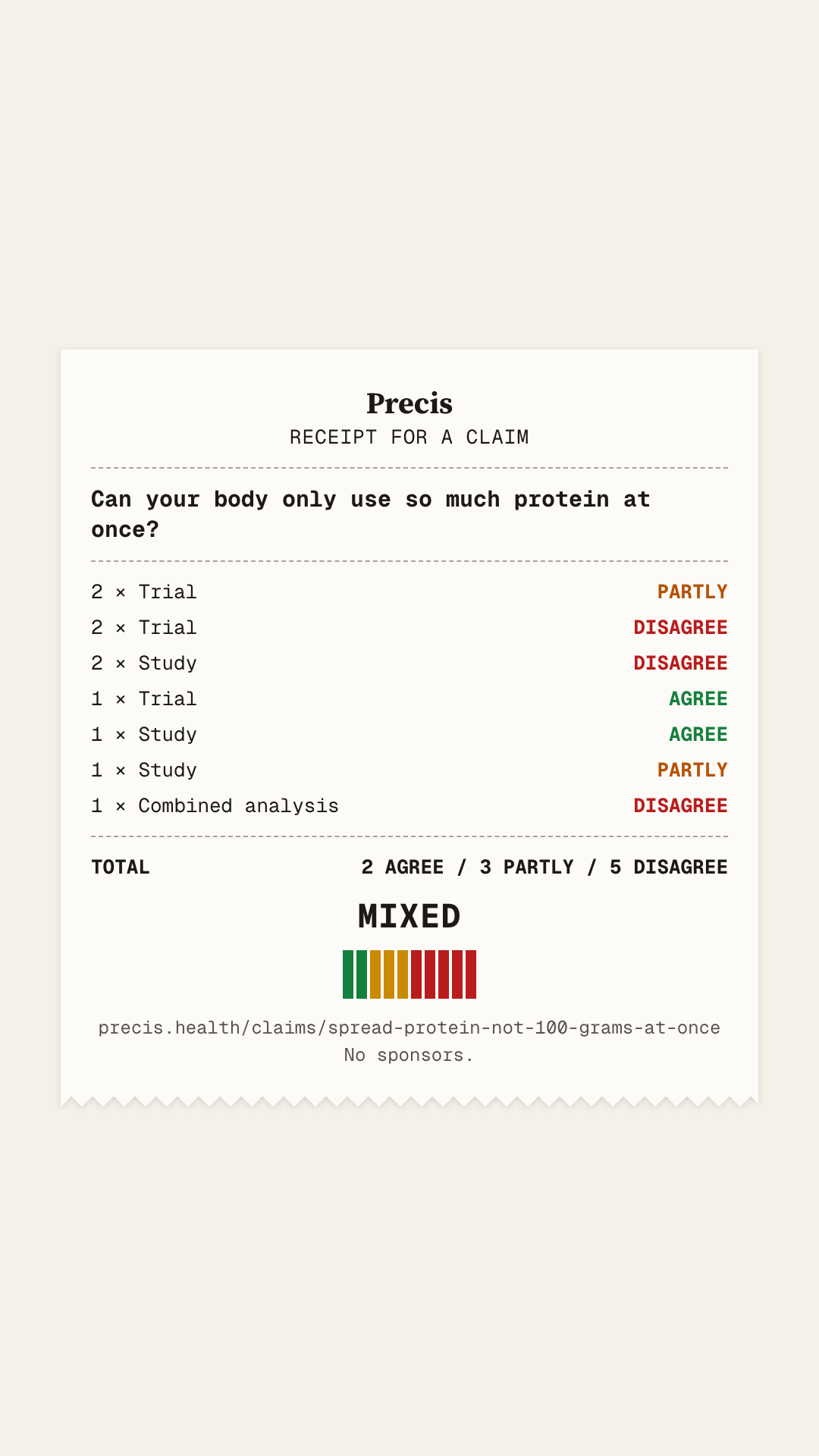
Mixed. Of 10 studies that test it, 5 disagree, 3 partly agree and 2 agree.

Best for:
Anyone planning how to split protein across meals
Price:
Free to read, with every receipt. Pro is $9 a month or $79 a year and adds AI Ask.

The claim checked: Your body can't use a big dose of protein at once, so spread it through the day Hear it at 17:29

PrecisRECEIPT FOR A CLAIM


Can your body only use so much protein at once?


  • 2 × TrialPARTLY
  • 2 × TrialDISAGREE
  • 2 × StudyDISAGREE
  • 1 × TrialAGREE
  • 1 × StudyAGREE
  • 1 × StudyPARTLY
  • 1 × Combined analysisDISAGREE

TOTAL2 AGREE / 3 PARTLY / 5 DISAGREE

Mixed

What do the studies say?

Mixed

Of 10 studies, 2 agree, 5 disagree and 3 partly agree. In a small trial, muscle building over 24 hours was about 25% higher when protein was spread evenly. But a pooled analysis of trials found no difference between even and uneven protein, and trials in older adults found the same muscle building and strength either way.

Computed from 10 studies that test this point, each judged by two readers, in full. 10 more studies are waiting for a full read and do not count yet.

What was said on the podcast?

“your body can't really process large amounts of protein at once. It you need little spread out during the day.”
Mark Hyman, The Doctor's Farmacy · How Much Protein Do You Actually Need? (Most People Are Getting This Wrong) · 17:29 on YouTube
Episode check A protein meal needs a set dose of leucine to build muscle, the episode says. Of 10 studies, none agree and 5 disagree. 6 claims checked against 66 studies · 10 chapters not checked yet See the whole episode →
Point 1 of 2 Mixed

Spreading protein evenly through the day builds more muscle than eating most of it in one meal

Agree 2

other primary study · 2022

“In conclusion, we find further support for the relationship between the evenness of dietary protein intake and lean mass.”

Evenness of Dietary Protein Intake Is Positively Associated with Lean Mass and Strength in Healthy Women. Nutr Metab Insights
Who: Healthy women aged 18-79 y (mean 41.9 y), North Dakota, USA
PMID 35734029

controlled trial · 2014

“Specifically, 24-h muscle protein synthesis was ∼25% greater when protein intake was evenly distributed, compared with the SKEW diet.”

Dietary protein distribution positively influences 24-h muscle protein synthesis in healthy adults. J Nutr
Who: Healthy physically active adults aged 25-55 y (mean 36.9 y; 5 men, 3 women)
PMID 24477298

Partly agree 3

controlled trial · 2013 · landmark

“Consequently, INT elicited a greater rate of myofibrillar FSR during the entire 1–12 h period compared to both PULSE and BOLUS (31 and 48% difference, respectively; P < 0.02).”

Timing and distribution of protein ingestion during prolonged recovery from resistance exercise alters myofibrillar protein synthesis. J Physiol
Who: Young healthy resistance-trained men (mean age ~25 y) after one bout of leg-extension resistance exercise
PMID 23459753

controlled trial · 2020

“The HBR group had greater increase in total LTM (HBR compared with LBR: 2.50 ± 0.25 kg compared with 1.77 ± 0.26 kg; P = 0.056; d = 0.795) than the LBR group, although there was no significant difference in the change of AppLTM (HBR compared with LBR: 1.14 ± 0.18 kg compared with 1.14 ± 0.17 kg; P = 0.991; d = 0.004; Figure 3A ).”

Evenly Distributed Protein Intake over 3 Meals Augments Resistance Exercise-Induced Muscle Hypertrophy in Healthy Young Men. J Nutr
Who: Healthy untrained young Japanese men aged 18-26 y doing a 12-wk resistance training program
PMID 32321161

other primary study · 2013

“A major limitation of the study is its cross-sectional design which does not allow any statements on causal relationship.”

Distribution but not amount of protein intake is associated with frailty: a cross-sectional investigation in the region of Nürnberg. Nutr J
Who: Community-dwelling older adults aged 75 y or older (median 83 y), Nurnberg region, Germany
PMID 23915061

Disagree 5

pooled analysis · 2020

“In meta-analysis comparing even with skewed protein supplementation, no pattern presented a superior effect to the other (MD: -0.29 kg; 95% CI: -1.20 to 0.62 kg, P = 0.62, I2 = 15%) (Figure 5).”

The Role of Protein Intake and its Timing on Body Composition and Muscle Function in Healthy Adults: A Systematic Review and Meta-Analysis of Randomized Controlled Trials. J Nutr
Who: Healthy free-living adults in RCTs of at least 2 wk; the head-to-head even-vs-skewed analysis was only in obese adults (mean BMI 27.2-33.5 kg/m2)
PMID 32232404

other primary study · 2017

“Nonetheless, no positive association between the evenness of protein intake and muscle mass, strength, or power was observed.”

Amount, Distribution, and Quality of Protein Intake Are Not Associated with Muscle Mass, Strength, and Power in Healthy Older Adults without Functional Limitations-An enable Study. Nutrients
Who: Healthy community-dwelling adults aged 75-85 y without functional limitations (SPPB 10 or more), Nuremberg, Germany
PMID 29240672

controlled trial · 2022

“It was found that a sufficient daily protein intake at 1.5 g protein per kg LBM with either an even or skewed distribution resulted in the same rates of muscle protein synthesis, as well as similar utilization of the dietary-protein-derived amino acids for synthesis of muscle proteins.”

Comparing Even with Skewed Dietary Protein Distribution Shows No Difference in Muscle Protein Synthesis or Amino Acid Utilization in Healthy Older Individuals: A Randomized Controlled Trial. Nutrients
Who: Healthy older adults aged 65-80 y (mean ~70 y; 12 men, 12 women), Denmark
PMID 36364705

controlled trial · 2018

“We conclude that over an 8-week intervention period, the protein intake distribution pattern in mixed meals does not play an important role in determining anabolic response, muscle strength, or functional outcomes.”

Protein intake distribution pattern does not affect anabolic response, lean body mass, muscle strength or function over 8 weeks in older adults: A randomized-controlled trial. Clin Nutr
Who: Healthy older adults aged 51-69 y with BMI 25-30 kg/m2 (EVEN 4 men/3 women, UNEVEN 2 men/5 women)
PMID 28318687

Show 1 more Show fewer

other primary study · 2018

“Bulk MyoPS (%/day) was similar between the BAL and SKEW groups in both the ER and the ER + RT phases.”

Effect of resistance training and protein intake pattern on myofibrillar protein synthesis and proteome kinetics in older men in energy restriction. J Physiol
Who: Overweight/obese older men (66 +/- 4 y, BMI 31 +/- 5 kg/m2) on a hypocaloric diet, Canada
PMID 29532476

Point 2 of 2 Leaning for

A large protein dose eaten at once, such as 100 g, is not all used to build muscle

Of 10 studies, 2 agree, 2 disagree and 6 partly agree. In one trial, 340 g of lean beef gave no more muscle building than a smaller portion. But a trial that gave young men a much larger protein dose after exercise found muscle building went on longer, with no clear upper limit. Most studies partly agree: the doses they tested stopped well short of the amount on tape.

Computed from 10 studies that test this point, each judged by two readers, in full. 10 more studies are waiting for a full read and do not count yet.

Agree 2

controlled trial · 2009

“Despite a 3-fold increase in protein and energy content, there was no further increase in protein synthesis following ingestion of 340 g of lean beef in either age group.”

A moderate serving of high-quality protein maximally stimulates skeletal muscle protein synthesis in young and elderly subjects. J Am Diet Assoc
Who: Healthy physically active adults: 17 young (34 +/- 3 y) and 17 elderly (68 +/- 2 y)
PMID 19699838

controlled trial · 2014

“Reconciling total daily protein intake by end-loading protein during the SKEW evening meal (EVEN vs. SKEW: 32.7 ± 1.6 vs. 63.4 ± 3.7 g protein) failed to make up the difference in 24-h muscle protein synthesis.”

Dietary protein distribution positively influences 24-h muscle protein synthesis in healthy adults. J Nutr
Who: 8 healthy adults (5 men, 3 women) aged 25-55 y (mean 36.9 y, BMI 25.7), physically active but not athletically trained
PMID 24477298

Partly agree 6

controlled trial · 2013 · landmark

“Consequently, INT elicited a greater rate of myofibrillar FSR during the entire 1–12 h period compared to both PULSE and BOLUS (31 and 48% difference, respectively; P < 0.02).”

Timing and distribution of protein ingestion during prolonged recovery from resistance exercise alters myofibrillar protein synthesis. J Physiol
Who: Young healthy resistance-trained men (mean age ~25 y) after one bout of leg-extension resistance exercise
PMID 23459753

controlled trial · 2020

“Post hoc analysis revealed that MyoPS rates were higher in 30 g PRO ( P < 0.01) and 45 g PRO ( P < 0.001) than in 0 g PRO but were not significantly different from each other ( P = 0.91).”

Dose-response effects of dietary protein on muscle protein synthesis during recovery from endurance exercise in young men: a double-blind randomized trial. Am J Clin Nutr
Who: Healthy endurance-trained young men (27 +/- 1 y) after 90 min of cycling
PMID 32359142

controlled trial · 2019

“Whole-body net protein balance and dietary protein-derived amino acid incorporation into myofibrillar protein show dose-dependent increases.”

Dose-Dependent Increases in Whole-Body Net Protein Balance and Dietary Protein-Derived Amino Acid Incorporation into Myofibrillar Protein During Recovery from Resistance Exercise in Older Men. J Nutr
Who: Healthy normoglycemic older men aged 55-80 y (mean 66 y) after a resistance exercise bout
PMID 30722014

systematic review · 2023

“While there is a clear dose–response of ingested leucine with postexercise MPS rates in older individuals, our data do not identify a precise leucine threshold , as no evident plateau was identified, and a maximal MPS response appears to be achievable in young individuals with protein ingestion per se irrespective of leucine content.”

Association of postprandial postexercise muscle protein synthesis rates with dietary leucine: A systematic review. Physiol Rep
Who: Healthy young (19-29 y) and older (57-74 y) adults in RCTs giving a single protein or amino acid bolus within 1 h of resistance exercise
PMID 37537134

Show 2 more Show fewer

pooled analysis · 2025

“Another study conducted with female participants showed that supplementation with 15 g, 30 g, and 60 g of whey protein immediately after exercise increased the FSR by 1.5, 2.0, and 1.5 fold compared to the baseline, respectively [ 35 ].”

Whey Protein Supplementation Combined with Exercise on Muscle Protein Synthesis and the AKT/mTOR Pathway in Healthy Adults: A Systematic Review and Meta-Analysis. Nutrients
Who: Healthy, non-sedentary adults aged 18-50 (338 male, 33 female), mostly resistance-trained, doing a single bout of resistance or cycling exercise
PMID 40871607

systematic review · 2026

“After 35 g/d, the incremental LBM response appeared to diminish, although this estimate is based on 10 dose-arm data points and should be interpreted as exploratory, which is in agreement with the saturation of post-exercise MPS at the meal level.”

Dose-structure-population interactions of protein supplementation combined with resistance training on body composition: a Bayesian network meta-analysis with dose-response modeling. Front Nutr
Who: Healthy adults aged 18+ (range 19-72 y; 9 RCTs in adults 65+; 72% of RCTs male-only) doing supervised resistance training at least twice a week for at least 6 weeks
PMID 42625626
Disagree 2

other primary study · 2023

“Here, we show that the anabolic response to protein ingestion has no apparent upper limit in magnitude and duration in vivo in humans.”

The anabolic response to protein ingestion during recovery from exercise has no upper limit in magnitude and duration in vivo in humans. Cell Rep Med
Who: Healthy recreationally active young men aged 18-40 y after a whole-body resistance exercise bout, Maastricht
PMID 38118410

controlled trial · 2020

“Changes in MPS from the fasted state were greater in HIGH compared to MOD ( p = 0.03) ( Figure 5 ).”

The Anabolic Response to Dietary Protein Is Not Limited by the Maximal Stimulation of Protein Synthesis in Healthy Older Adults: A Randomized Crossover Trial. Nutrients
Who: Healthy older adults (4 men, 4 women), age 69.3 +/- 1.8 y
PMID 33114585

More on food and fasting

The Precis Weekly

Get each new check by email.

One email a week with the claims and episodes we checked, what the studies found and the minute each claim was said.

Free. Unsubscribe anytime.