A claim you hear on longevity podcasts

Does 0.7 to 1 gram of protein per pound build more muscle?

Leaning for. Of 10 studies that test it, 6 agree, 2 partly agree and 2 disagree.

Best for:
Anyone strength training and counting protein
Price:
Free to read, with every receipt. Pro is $9 a month or $79 a year and adds AI Ask.

The claim checked: If you strength train, eat about 0.7 to 1 gram of protein per pound of ideal body weight Hear it at 2:54

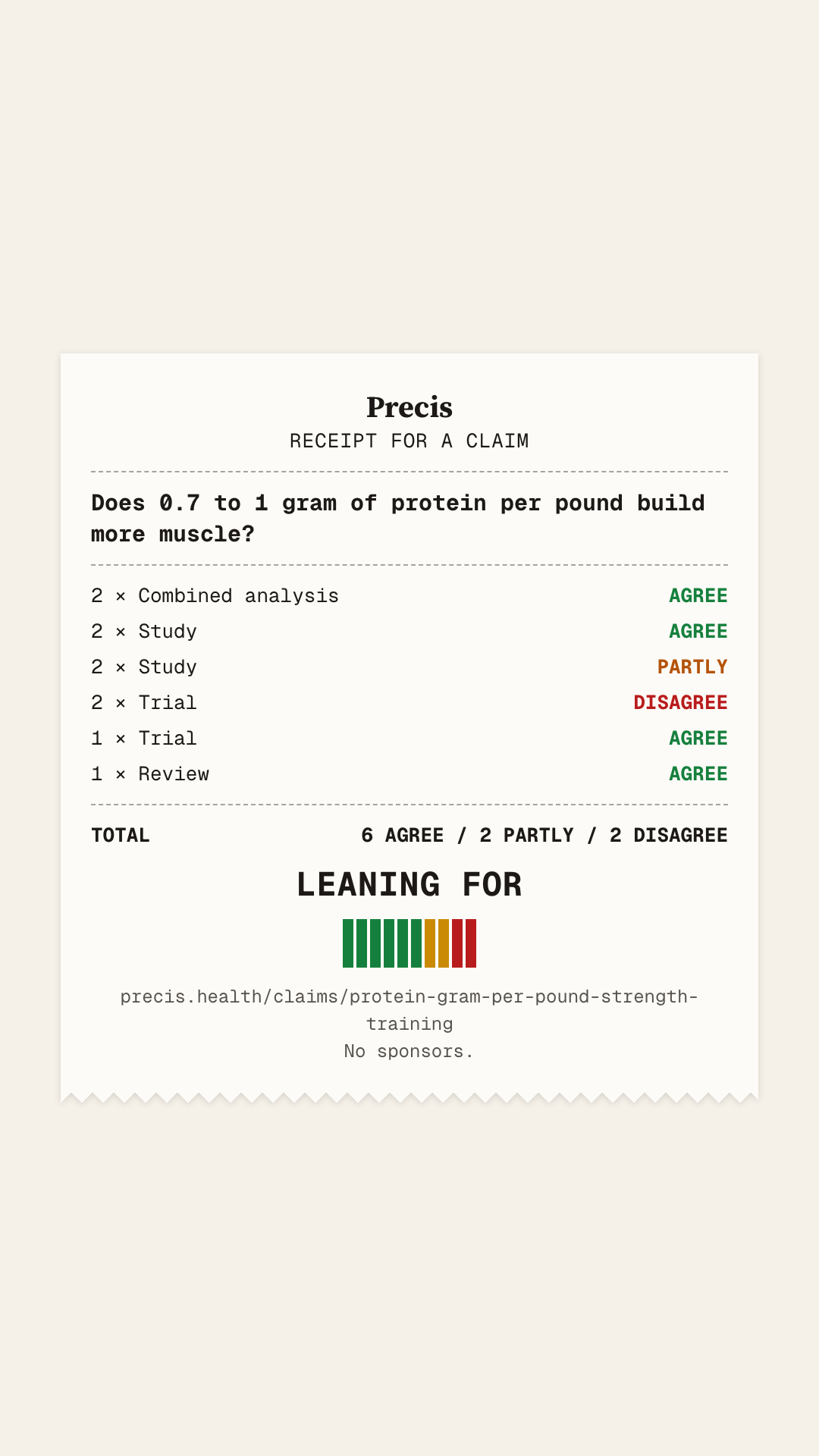
PrecisRECEIPT FOR A CLAIM


Does 0.7 to 1 gram of protein per pound build more muscle?


  • 2 × Combined analysisAGREE
  • 2 × StudyAGREE
  • 2 × StudyPARTLY
  • 2 × TrialDISAGREE
  • 1 × TrialAGREE
  • 1 × ReviewAGREE

TOTAL6 AGREE / 2 PARTLY / 2 DISAGREE

Leaning for

What do the studies say?

Leaning for

6 of 10 studies agree, 2 disagree and 2 partly agree. A pooled analysis of training studies found extra protein helped muscle and strength up to about 1.6 g per kilogram of body weight a day. Another found gains stopped rising after about 1.5 g per kilogram. In untrained men over 55, 1.6 g per kilogram did better than 0.8 g. Two small trials, in young men and in women after menopause, found no extra gain from eating more. Studies count protein per kilogram; a kilogram is a bit over two pounds.

Computed from 10 studies that test this point, each judged by two readers, in full. 6 more studies are waiting for a full read and do not count yet.

What was said on the podcast?

“If you are strength training and you which most of you should be, you want to eat about a a gram per pound of ideal body weight.”
Mark Hyman, The Doctor's Farmacy · How Much Protein Do You Actually Need? (Most People Are Getting This Wrong) · 2:54 on YouTube
Episode check A protein meal needs a set dose of leucine to build muscle, the episode says. Of 10 studies, none agree and 5 disagree. 6 claims checked against 66 studies · 10 chapters not checked yet See the whole episode →
The point checked Leaning for

For people strength training, about 0.7 to 1 g of protein per pound a day (about 1.5 to 2.2 g per kg) builds more muscle than eating less

Agree 6

pooled analysis · 2018 · landmark

“This analysis shows that dietary protein supplementation can be, if protein intake is less than 1.6 g protein/kg/day, both sufficient and necessary to optimise RET-induced changes in FFM and 1RM strength.”

A systematic review, meta-analysis and meta-regression of the effect of protein supplementation on resistance training-induced gains in muscle mass and strength in healthy adults. Br J Sports Med
Who: Healthy, non-energy-restricted adults doing resistance exercise training at least twice a week in RCTs (mean age 35±20 years; 10 studies in resistance-trained participants)
PMID 28698222

pooled analysis · 2022 · landmark

“Alternatively, the evidence in this meta‐analysis supports the hypothesis that additional protein ingestion (1.6 g of protein/kg/day or higher) leads to small increments in lean body mass in studies enrolling young subjects in RE training.”

Systematic review and meta-analysis of protein intake to support muscle mass and function in healthy adults. J Cachexia Sarcopenia Muscle
Who: Healthy, non-obese adults aged 18 or older (mean ages 19 to 85), untrained or trained, not on weight-loss diets; most trials paired protein with resistance exercise
PMID 35187864

systematic review · 2022

“The effect becomes higher with more total protein intake up to 1.5 g/kg BW/d, but no further gains are achieved thereafter.”

Synergistic Effect of Increased Total Protein Intake and Strength Training on Muscle Strength: A Dose-Response Meta-analysis of Randomized Controlled Trials. Sports Med Open
Who: Adults aged 19 to 87 years (mean 55.6) without serious injury or illness; 59 studies with resistance training (mean age 45.5) and 24 without
PMID 36057893

other primary study · 2012

“However, as this review shows, this “lay” recommendation aligns well with research that assesses applied outcome measures of strength and body composition in studies of duration > 4 weeks [ 1 - 7 , 9 , 10 , 17 , 28 , 38 ].”

Dietary protein to maximize resistance training: a review and examination of protein spread and change theories. J Int Soc Sports Nutr
Who: Narrative review of resistance-training trials in trained and untrained adults, mostly men (one study in women)
PMID 22958314

Show 2 more Show fewer

controlled trial · 2017

“Thus, although we determined only a nonsignificant difference (see above) between HIT and HVHIT, we confirmed our primary hypothesis that protein supplementation significantly increases the effect of HIT on muscle mass.”

Protein Supplementation to Augment the Effects of High Intensity Resistance Training in Untrained Middle-Aged Males: The Randomized Controlled PUSH Trial. Biomed Res Int
Who: Untrained, middle-aged men aged 30 to 50 years (mean ~43) from Erlangen, Germany, BMI up to 35
PMID 28656141

other primary study · 2023

“In conclusion, a daily intake of 1.6 g/kg/d protein was superior to 0.8 g/kg/d (current recommended daily intake) for promoting greater improvements in SMM and muscle strength and thus may be a more suitable level of intake for promoting such adaptive responses.”

Effects of 8 weeks of resistance training in combination with a high protein diet on body composition, muscular performance, and markers of liver and kidney function in untrained older ex-military men. Front Nutr
Who: Healthy, untrained older ex-military men aged over 55 (mean ~61-62 years) who had not exercised in the previous 6 months and ate less than 0.8 g/kg/d protein
PMID 37457969

Partly agree 2

other primary study · 2006

“Although Δ strength comparisons showed that subjects in AL had the largest magnitude in strength improvements in both 1-RM squat (63% and 22% greater than BL and RL, respectively) and 1-RM bench press strength (35% and 42% greater than BL and RL, respectively), these differences were not statistically different.”

Effect of protein intake on strength, body composition and endocrine changes in strength/power athletes. J Int Soc Sports Nutr
Who: 23 male collegiate strength/power athletes (football players, sprinters, throwers) with at least 2 years of resistance training, grouped by self-reported protein intake
PMID 18500968

trial or observed group · 2022

“Despite ubiquitous improvements across groups, no group * time interactions were observed, suggesting that differential protein intake did not play a role in lean/soft tissue mass, strength, and muscle quality adaptation, provided that 0.8–1.0 g/kg/d of protein is consumed.”

The Effects of Graded Protein Intake in Conjunction with Progressive Resistance Training on Skeletal Muscle Outcomes in Older Adults: A Preliminary Trial. Nutrients
Who: Healthy, community-dwelling older men and post-menopausal women aged 55 or older (mean 69.7 ± 8.2 years; 7 men, 11 women) not in a progressive resistance training program in the prior 3 months
PMID 35807922

Disagree 2

controlled trial · 2015

“The main finding of the present study was that a higher protein intake does not cause a greater MM gain compared with normal intake (i.e., 1.8 g of protein·kg−1·day−1 vs. NP group 0.85 g of protein·kg−1·day−1) in healthy young subjects.”

Protein supplementation increases postexercise plasma myostatin concentration after 8 weeks of resistance training in young physically active subjects. J Med Food
Who: 18 healthy, non-obese young men (age 24.9 ± 5.3 years), human movement science students active in team sports but never engaged in regular resistance training
PMID 25133710

controlled trial · 2024

“No significant differences were detected for TP and T for any of the parameters.”

Analysis of combinatory effects of free weight resistance training and a high-protein diet on body composition and strength capacity in postmenopausal women - A 12-week randomized controlled trial. J Nutr Health Aging
Who: Healthy, resistance-untrained postmenopausal women (age 58.2 ± 5.6 years) not on hormone replacement therapy
PMID 39232439

More on food and fasting

The Precis Weekly

Get each new check by email.

One email a week with the claims and episodes we checked, what the studies found and the minute each claim was said.

Free. Unsubscribe anytime.