A claim you hear on longevity podcasts

Does postpartum depression often go undiagnosed and untreated?

Strong consensus for. Of 10 studies that test it, 10 agree.

Best for:
new parents and families watching for signs of postpartum depression.
Price:
Free to read, with every receipt. Pro is $9 a month or $79 a year and adds AI Ask.

The claim checked: Postpartum depression is often missed and often goes untreated Hear it at 1:35:03

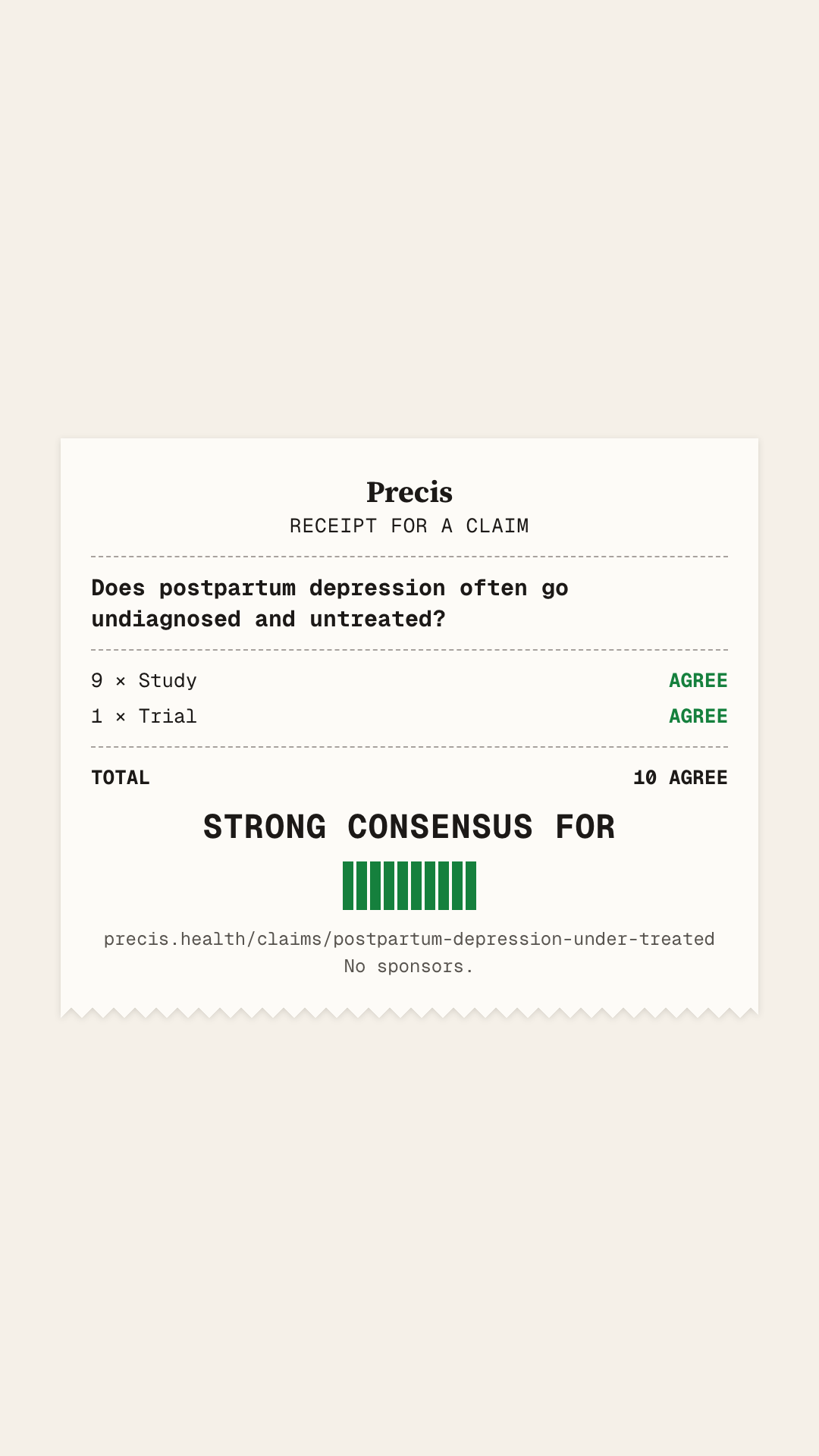
PrecisRECEIPT FOR A CLAIM


Does postpartum depression often go undiagnosed and untreated?


  • 9 × StudyAGREE
  • 1 × TrialAGREE

TOTAL10 AGREE

Strong consensus for

What do the studies say?

Strong consensus for

All 10 studies agree that postpartum depression often goes unrecognized. In a US survey, only one-quarter of people with postpartum depression symptoms said they got a diagnosis. In another study, fewer than half of women who scored as depressed 6 weeks after birth were picked up by their care team.

Computed from 10 studies that test this point, each judged by two readers, in full. 10 more studies are waiting for a full read and do not count yet.

What was said on the podcast?

“They may have hesitancy to ask for help. They may be told that their feelings aren't normal. So, it's definitely can be very serious and underrecognized and undertreated for all those reasons.”
Kathryn Gray, a guest on The Drive · 410 ‒ The biology of pregnancy: physiologic adaptation, childbirth, and long-term maternal health · 1:35:03 on YouTube
Episode check Missing the microbes of a vaginal birth is probably not the thing to stress about, the episode says. Of 10 studies, 6 disagree. 10 claims checked against 114 studies See every claim we checked →
Point 1 of 2 Strong consensus for

Postpartum depression often goes unrecognized or undiagnosed

Agree 10

other primary study · 2024 · landmark

“Of those with postpartum depressive symptoms, only one-quarter reported receipt of a PMAD diagnosis, and half reported receiving any mental health care in the year postpartum.”

Racial And Ethnic Inequities In Postpartum Depressive Symptoms, Diagnosis, And Care In 7 US Jurisdictions. Health Aff (Millwood)
Who: People with a live birth in 2020 in six US states and New York City (PRAMS respondents re-surveyed by PAHS at 12-14 months postpartum); diagnosis and care analysed among those with early postpartum depressive symptoms (weighted prevalence 11.8%)
PMID 38560804

controlled trial · 2012

“postpartum depression is common but often goes unrecognized or undertreated in clinical practice.”

TRIPPD: a practice-based network effectiveness study of postpartum depression screening and management. Ann Fam Med
Who: Women aged 18+ at 5-12 weeks postpartum in 28 US family medicine practices in 21 states, randomized by practice to a screening/management program or usual care
PMID 22778120

other primary study · 2009

“GPs and health visitors do not use the label "postnatal depression" if they feel they personally have nothing to offer the woman, or no services to refer women on to.”

Disclosure of symptoms of postnatal depression, the perspectives of health professionals and women: a qualitative study. BMC Fam Pract
Who: GPs, health visitors and women diagnosed with postnatal depression taking part in the RESPOND trial in Bristol, Manchester and London, UK
PMID 19159478

other primary study · 2016

“Finally, identification of new perinatal depression diagnoses significantly increased over the three phases from 8.2% (Pre-Implementation) to 9.5% (Roll-Out Phase) to 11.7% (Fully-Implemented) (test of trend, p<0.001).”

Improved Perinatal Depression Screening, Treatment, and Outcomes With a Universal Obstetric Program. Obstet Gynecol
Who: Pregnant women aged 18+ in Kaiser Permanente Northern California across three phases of a universal perinatal depression screening program (2007-2014)
PMID 27054938

Show 6 more Show fewer

other primary study · 2016

“Based on a self-reported screening scale with scores measuring distress at levels likely to indicate caseness our estimate of the overall proportion of missed cases of pre-birth common mental disorders was between 31.3% (95% CI 28.7–33.8) and 46.8% (95% CI 44.7–49.0).”

Evaluation of ethnic disparities in detection of depression and anxiety in primary care during the maternal period: combined analysis of routine and cohort data. Br J Psychiatry
Who: Women in the Born in Bradford birth cohort (ethnically diverse, mostly deprived, Bradford, UK; recruited 2007-2010) with linked GP records
PMID 26795424

other primary study · 2018

“Of the 218 clients who screened positive for perinatal depression, only three (1.4%) were identified by PHCWs as having the condition as indicated in their case records at first clinic contact.”

Quality of perinatal depression care in primary care setting in Nigeria. BMC Health Serv Res
Who: Antenatal women screening EPDS >=10 at 23 primary care maternal clinics in and around Ibadan, Nigeria, plus 20 facility managers
PMID 30466426

other primary study · 2024

“Of all women self-reporting EPDS scores ≥12 at 6 weeks postpartum, less than half were identified by the healthcare system as possibly depressed at 2 months postpartum.”

Feeling better? - Identification, interventions, and remission among women with early postpartum depressive symptoms in Sweden: a nested cohort study. Eur Psychiatry
Who: Women in the Swedish BASIC cohort (Uppsala, 2009-2019) with EPDS >=12 at 6 weeks postpartum and no ongoing psychiatric treatment; medical records reviewed
PMID 38254262

other primary study · 2025

“Our findings show that even though training appreciably improved the rate of detection of perinatal depression by non-physician primary healthcare workers, detection rates were still low.”

Screening and detection of perinatal depression by non-physician primary healthcare workers in Nigeria. BMC Prim Care
Who: Antenatal women at 27 primary maternal and child health clinics in and around Ibadan, Nigeria, meeting EPDS >=10 plus CIDI diagnostic criteria for depression
PMID 39939906

other primary study · 2025

“This discrepancy highlights a potential diagnostic gap, with numerous cases of PPD possibly remaining undiagnosed and untreated or diagnosed and treated too late.”

Diagnosis of postpartum depression and associated factors in South Africa: a cohort study of 47,697 women. Epidemiol Psychiatr Sci
Who: Women aged 10-55 who delivered in 2011-2020 while insured by a large South African private medical insurance scheme, excluding depression diagnosed in pregnancy (claims data)
PMID 40726088

other primary study · 2026

“Using an NLP-based approach, this study identified 29.6% more patients with PPD symptoms who did not have an ICD-based diagnosis recorded in the EHR, suggesting a sizeable number of patients remain underdiagnosed and undertreated.”

Identifying postpartum depression subtypes using natural language processing and clinical notes. BMJ Ment Health
Who: Adults aged 18 and older who delivered 2010-2023 at Weill Cornell Medicine, New York City (EHR clinical notes and ICD codes)
PMID 41871883
Partly agree 0· none of the studies we read

Disagree 0· none of the studies we read

Point 2 of 2 Strong consensus for

Postpartum depression often goes untreated

All 10 studies agree that many women with postpartum depression get no treatment. In the same US survey, only half of people with symptoms got any mental health care in the year after birth. Of women referred to a phone line for help, only 38.1% made it to a treatment visit.

Computed from 10 studies that test this point, each judged by two readers, in full. 10 more studies are waiting for a full read and do not count yet.

Agree 10

systematic review · 2019 · landmark

“In summary, we found that negative attitudes towards diagnosis and treatment of PMIs resulted in women avoiding help seeking and reinforced feelings of stigma and guilt.”

Barriers to accessing mental health services for women with perinatal mental illness: systematic review and meta-synthesis of qualitative studies in the UK. BMJ Open
Who: Qualitative UK studies of women with perinatal mental illness (mostly postnatal depression), their family members and healthcare professionals
PMID 30679296

other primary study · 2024 · landmark

“Using postpartum survey data from people who delivered in 2020 in six states and New York City, we found that only one-quarter of people with postpartum depressive symptoms reported receiving a PMAD diagnosis, and only half reported receiving postpartum mental health care.”

Racial And Ethnic Inequities In Postpartum Depressive Symptoms, Diagnosis, And Care In 7 US Jurisdictions. Health Aff (Millwood)
Who: People with a live birth in 2020 in six US states and New York City (PRAMS respondents re-surveyed by PAHS at 12-14 months postpartum); care analysed among those with early postpartum depressive symptoms (weighted prevalence 11.8%)
PMID 38560804

trial or observed group · 2011

“Although suboptimal detection and treatment rates are not uncommon for this condition or in this population, these results emphasize that postpartum depression remains an underrecognized and undertreated condition for all low-income women, especially for those from racial and ethnic minority groups.”

Racial and ethnic disparities in postpartum depression care among low-income women. Psychiatr Serv
Who: Low-income women on New Jersey Medicaid who delivered between July 2004 and October 2007 (13,001 white, 13,416 black, 3,184 Latina), excluding prenatal depression or anxiety
PMID 21632730

systematic review · 2015

“Screening without any intervention was associated with an average of 22% mental health care use amongst women who screened positive for depression.”

Enhancing Participation in Depression Care in Outpatient Perinatal Care Settings: A Systematic Review. Obstet Gynecol
Who: Studies of pregnant and postpartum women who screened positive for depression in outpatient perinatal care settings
PMID 26444130

Show 6 more Show fewer

other primary study · 2009

“Only 38.1% percent of pregnant and postpartum women who were referred to the MOMsline attended a mental health treatment visit at any point during the study and 6% received sustained treatment.”

Success of mental health referral among pregnant and postpartum women with psychiatric distress. Gen Hosp Psychiatry
Who: English- and Spanish-speaking pregnant and postpartum women with psychiatric distress at publicly funded obstetric clinics in New Haven, Connecticut (2001-2005), mostly African American and Hispanic
PMID 19269536

controlled trial · 2012

“postpartum depression is common but often goes unrecognized or undertreated in clinical practice.”

TRIPPD: a practice-based network effectiveness study of postpartum depression screening and management. Ann Fam Med
Who: Women aged 18+ at 5-12 weeks postpartum in 28 US family medicine practices in 21 states, randomized by practice to a screening/management program or usual care
PMID 22778120

other primary study · 2016

“In the absence of an accessible maternal mental health service, the treatment gap for PPD was very high.”

Treatment gap and help-seeking for postpartum depression in a rural African setting. BMC Psychiatry
Who: Women 1-12 months postpartum with PHQ-9 >=5 in rural Sodo district, Ethiopia, identified by house-to-house search
PMID 27287387

systematic review · 2022

“Although in some studies, a high proportion of women reported a need for treatment or were interested in professional health services during the perinatal period, the percentage of women who intended to seek help for PMHP was generally below 40%.”

Perinatal mental health literacy: knowledge, attitudes, and help-seeking among perinatal women and the public - a systematic review. BMC Pregnancy Childbirth
Who: Quantitative studies of perinatal women and the general public on perinatal mental health literacy (knowledge, attitudes, help-seeking), mostly cross-sectional and Western
PMID 35854232

other primary study · 2016

“In the Fully-Implemented Phase, 5% of all pregnant and postpartum women, nearly half of the women with a new depression diagnosis and 82% with severe depression received treatment at Kaiser Permanente.”

Improved Perinatal Depression Screening, Treatment, and Outcomes With a Universal Obstetric Program. Obstet Gynecol
Who: Pregnant women aged 18+ in Kaiser Permanente Northern California across three phases of a universal perinatal depression screening program (2007-2014)
PMID 27054938

other primary study · 2021

“Although perinatal depression screening has increased in recent years, many women who screen positive do not receive mental health treatment, with the lowest rates found for non-White women.”

Engagement in perinatal depression treatment: a qualitative study of barriers across and within racial/ethnic groups. BMC Pregnancy Childbirth
Who: Asian, Black, Latina and White pregnant and postpartum Kaiser Permanente Northern California patients with PHQ-9 >=10, plus clinicians experienced in perinatal depression
PMID 34271852

Partly agree 0· none of the studies we read

Disagree 0· none of the studies we read

More on mind and stress

The Precis Weekly

Get each new check by email.

One email a week with the claims and episodes we checked, what the studies found and the minute each claim was said.

Free. Unsubscribe anytime.