A claim you hear on longevity podcasts

Does a protein meal need 2.5 g of leucine to build muscle?

Leaning against. Of 10 studies that test it, 5 partly agree and 5 disagree.

Best for:
Anyone dosing protein around the leucine threshold
Price:
Free to read, with every receipt. Pro is $9 a month or $79 a year and adds AI Ask.

The claim checked: A protein meal needs about 2.5 g of leucine to switch on muscle building Hear it at 6:10

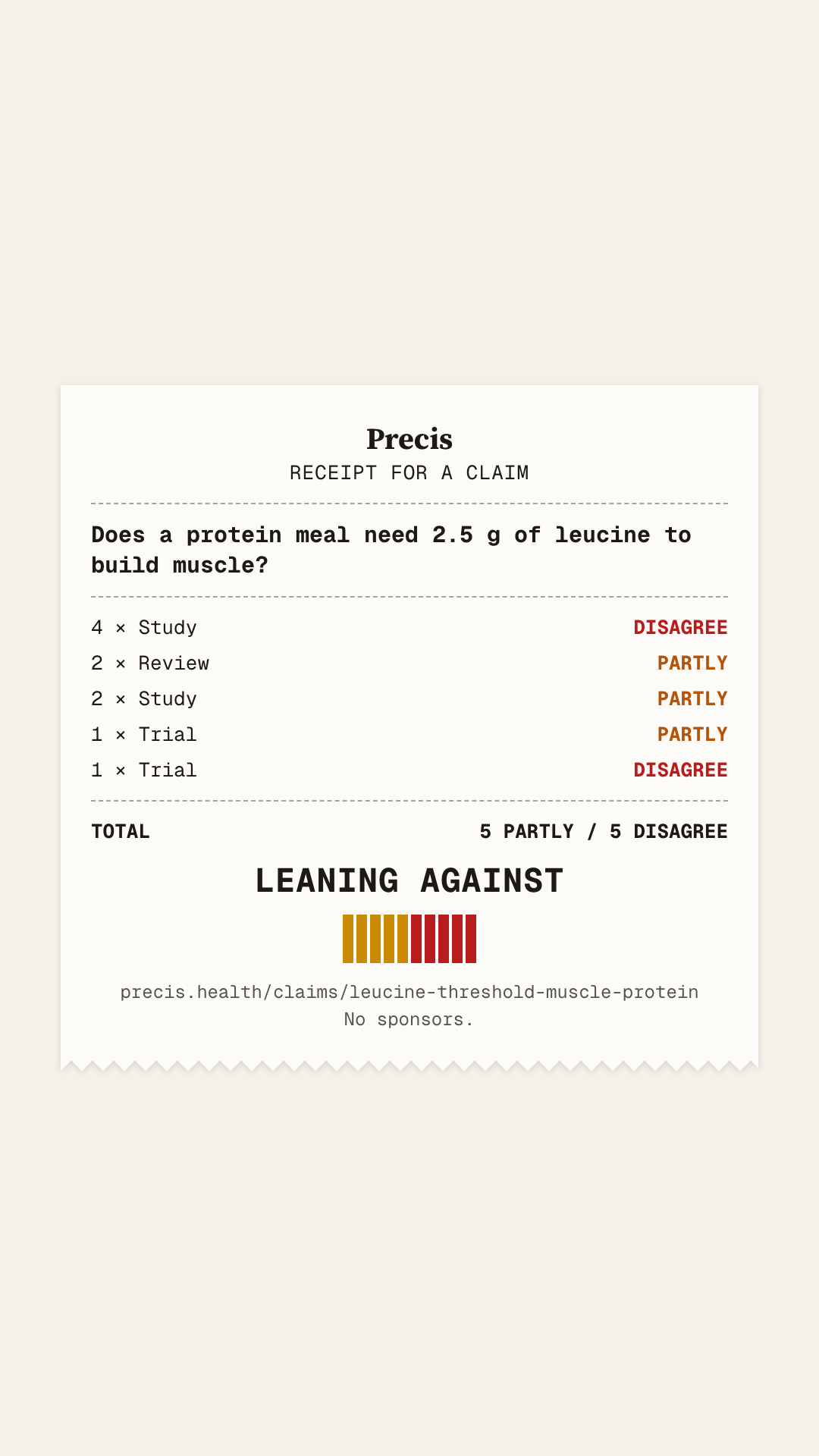
PrecisRECEIPT FOR A CLAIM


Does a protein meal need 2.5 g of leucine to build muscle?


  • 4 × StudyDISAGREE
  • 2 × ReviewPARTLY
  • 2 × StudyPARTLY
  • 1 × TrialPARTLY
  • 1 × TrialDISAGREE

TOTAL5 PARTLY / 5 DISAGREE

Leaning against

What do the studies say?

Leaning against

None of 10 studies agree. 5 disagree: in young adults and in older women, doses under 2 g of leucine, given with other amino acids, raised muscle building as much as larger doses. 5 partly agree: more leucine helped older adults in some studies, but no study found a clear cut-off at the dose on tape. A review counted 16 study arms that backed the idea of a leucine trigger and 15 that did not. Leucine is an amino acid in protein; muscle protein synthesis is the body building new muscle protein.

Computed from 10 studies that test this point, each judged by two readers, in full. 10 more studies are waiting for a full read and do not count yet.

What was said on the podcast?

“If you are eating less than two and a half grams of leucine in about 25 to 30 grams of protein, that protein is not necessarily turning into muscle.”
Mark Hyman, The Doctor's Farmacy · How Much Protein Do You Actually Need? (Most People Are Getting This Wrong) · 6:10 on YouTube
Episode check A protein meal needs a set dose of leucine to build muscle, the episode says. Of 10 studies, none agree and 5 disagree. 6 claims checked against 66 studies · 10 chapters not checked yet See the whole episode →
The point checked Leaning against

A protein dose needs about 2.5 g of leucine to switch on muscle protein synthesis; with less, the protein does not reliably build muscle

Agree 0· none of the studies we read

Partly agree 5

trial or observed group · 2006 · landmark

“We conclude that increasing the proportion of leucine in a mixture of EAA can reverse an attenuated response of muscle protein synthesis in elderly but does not result in further stimulation of muscle protein synthesis in young subjects.”

A high proportion of leucine is required for optimal stimulation of the rate of muscle protein synthesis by essential amino acids in the elderly. Am J Physiol Endocrinol Metab
Who: 36 healthy adults: 20 elderly (mean age 66.5-66.7 y) and 16 young (mean age 28.8-30.6 y), randomly assigned within each age group to one of two EAA mixtures
PMID 16507602

controlled trial · 2014

“We observed that the increase in MyoPS from 2 to 5 h after RE was unaffected by the quantity of Leu ingested, but greater Leu ingestion after RE did prolong the increase in MyoPS rate measured 24 h after exercise.”

Leucine-enriched amino acid ingestion after resistance exercise prolongs myofibrillar protein synthesis and amino acid transporter expression in older men. J Nutr
Who: 15 healthy, recreationally active older men (72 ± 2 y)
PMID 25332468

systematic review · 2021

“Overall, this systematic review revealed that 16 study arms support the leucine trigger hypothesis to explain the post-prandial regulation of MPS, whereas 15 study arms refute the hypothesis that a more rapid rate of appearance (magnitude and/or duration) of leucine into the circulation is stimulatory for increasing post-prandial rates of MPS.”

Evaluating the Leucine Trigger Hypothesis to Explain the Post-prandial Regulation of Muscle Protein Synthesis in Young and Older Adults: A Systematic Review. Front Nutr
Who: Healthy young (18-35 y), middle-aged and older (>60 y) adults in acute studies that compared protein sources and measured both plasma leucine and MPS
PMID 34307436

systematic review · 2023

“While there is a clear dose–response of ingested leucine with postexercise MPS rates in older individuals, our data do not identify a precise leucine threshold , as no evident plateau was identified, and a maximal MPS response appears to be achievable in young individuals with protein ingestion per se irrespective of leucine content.”

Association of postprandial postexercise muscle protein synthesis rates with dietary leucine: A systematic review. Physiol Rep
Who: Healthy young (19-29 y; 409 men, 40 women) and older (57-74 y; 142 men, 106 women) adults in RCTs giving a single protein bolus within 1 h of one resistance exercise bout
PMID 37537134

Show 1 more Show fewer

trial or observed group · 2006

“As shown in Fig. 6, leucine supplementation improved myofibrillar muscle protein fractional synthesis rate (FSR) measured at the end of the feeding period (0.083 ± 0.008 and 0.053 ± 0.009% h−1 in the leucine and control groups, respectively, P < 0.05).”

Leucine supplementation improves muscle protein synthesis in elderly men independently of hyperaminoacidaemia. J Physiol
Who: 20 healthy elderly men (69.6 ± 0.8 years) without chronic disease, on a controlled 0.8 g protein/kg/day diet for 4 days before the study
PMID 16777941

Disagree 5

trial or observed group · 2012

“These findings demonstrate that while leucine is potent in its ability to stimulate MPS, only a relatively small amount (0.75 g) is required to achieve a maximal stimulation of MPS when other EAAs are provided in larger quantities (∼8.5 g).”

Supplementation of a suboptimal protein dose with leucine or essential amino acids: effects on myofibrillar protein synthesis at rest and following resistance exercise in men. J Physiol
Who: 24 recreationally active young men (22 ± 0.6 y), 8 per group; rested leg (FED) and leg after unilateral resistance exercise (EX-FED)
PMID 22451437

trial or observed group · 2010

“Our results indicate that in 10 g of EAA, a leucine content typical of high-quality proteins (CTRL, 1.8 g) elicits a similar muscle protein anabolic response in young adults compared with higher leucine concentrations (LEU).”

Excess leucine intake enhances muscle anabolic signaling but not net protein anabolism in young men and women. J Nutr
Who: 14 healthy young adults (6 men, 8 women; mean age 29-32 y) not in regular exercise training, 7 per group
PMID 20844186

controlled trial · 2015

“We show here that increasing the quantity of EAA consumed does not necessarily augment MPS over and above the ingestion of ∼1.2 g LEU (plus a small 1.8-g mixed EAA) in older women.”

Intake of low-dose leucine-rich essential amino acids stimulates muscle anabolism equivalently to bolus whey protein in older women at rest and after exercise. Am J Physiol Endocrinol Metab
Who: 16 healthy older postmenopausal women (66 ± 3 y, BMI 29), 8 per group; rested leg (FED) and leg after unilateral knee-extension exercise (FED-EX)
PMID 25827594

trial or observed group · 2018

“In summary, our present data expands upon the findings from our previous work that a leucine enriched low dose amino acid supplement provides acute robust (perhaps maximal) stimulation of MPS in older women, with our present data showing as little as 1.5 g of LEAA stimulates MPS to levels equivalent to 40 g WP (a dose known to maximally stimulate MPS in adult males) both at rest and after exercise.”

Effects of leucine-enriched essential amino acid and whey protein bolus dosing upon skeletal muscle protein synthesis at rest and after exercise in older women. Clin Nutr
Who: 24 healthy older post-menopausal women (mean age 63-66 y), 8 per group; rested leg (FED) and leg after unilateral knee-extension exercise (FED-EX)
PMID 29031484

Show 1 more Show fewer

trial or observed group · 2025

“Overall, the plateau in MyoPS across the range of doses employed in our study implies less than 1 g of leucine is sufficient for optimally stimulating acute postexercise MyoPS in females, and that the recommended 20 g of whey protein immediately postexercise is in excess of what is required in this population.”

Postexercise myofibrillar protein synthesis rates do not differ following 1.5 g essential amino acids compared with 15 and 20 g of whey protein in young females. Am J Physiol Endocrinol Metab
Who: 28 healthy, recreationally active young women aged 18-40 (mean 28 ± 8 y), tested in the early follicular phase or on hormonal contraception
PMID 39880386

More on food and fasting

The Precis Weekly

Get each new check by email.

One email a week with the claims and episodes we checked, what the studies found and the minute each claim was said.

Free. Unsubscribe anytime.