A claim you hear on longevity podcasts

Does animal protein build more muscle than plant protein?

Leaning against. Of 10 studies that test it, 6 disagree, 3 partly agree and 1 agrees.

Best for:
Vegans and vegetarians who lift, and anyone choosing a protein powder
Price:
Free to read, with every receipt. Pro is $9 a month or $79 a year and adds AI Ask.

The claim checked: Study after study, animal protein beats vegan protein for building muscle, every time Hear it at 18:49

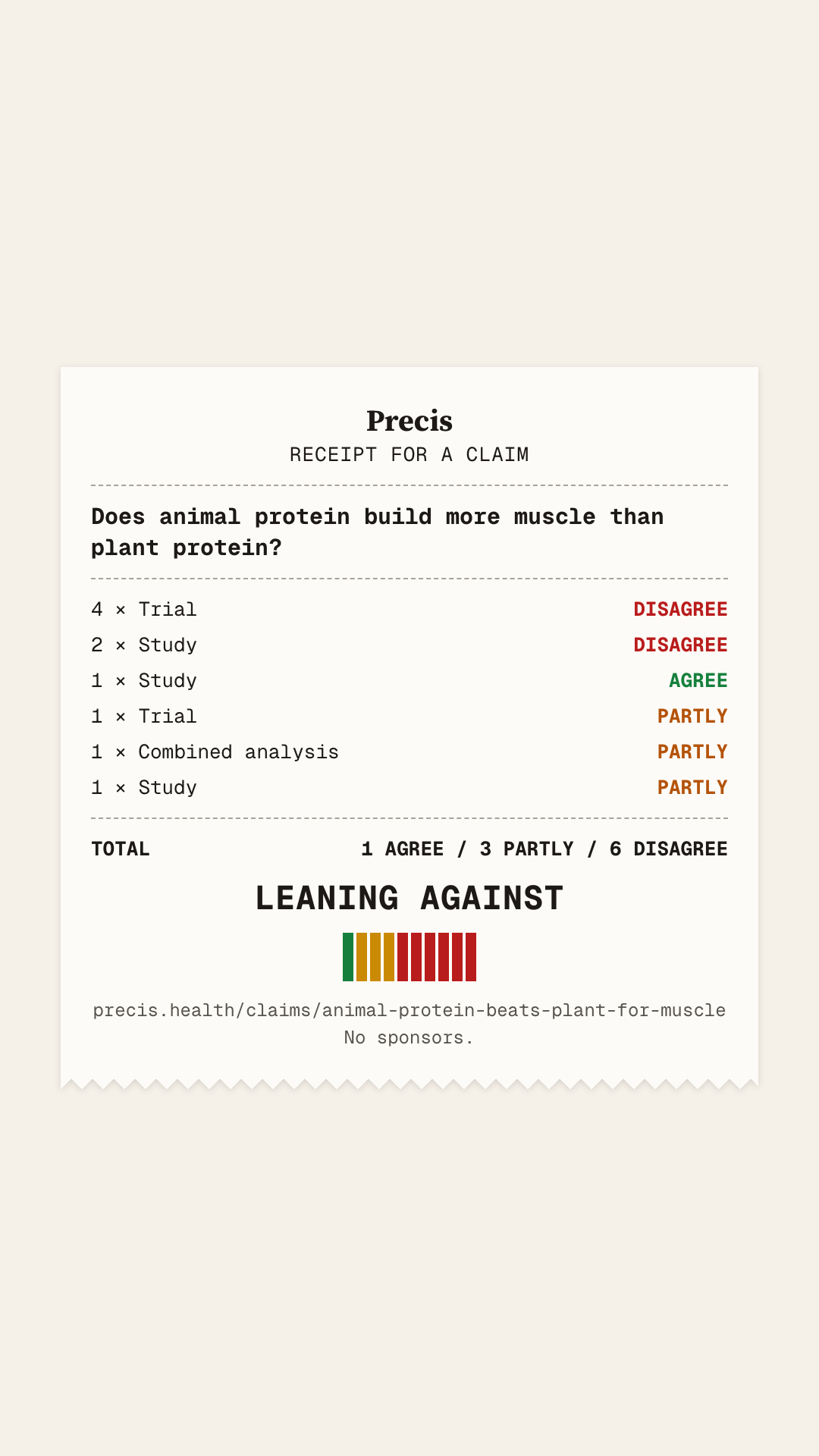
PrecisRECEIPT FOR A CLAIM


Does animal protein build more muscle than plant protein?


  • 4 × TrialDISAGREE
  • 2 × StudyDISAGREE
  • 1 × StudyAGREE
  • 1 × TrialPARTLY
  • 1 × Combined analysisPARTLY
  • 1 × StudyPARTLY

TOTAL1 AGREE / 3 PARTLY / 6 DISAGREE

Leaning against

What do the studies say?

Leaning against

Of 10 studies, 1 agrees, 6 disagree and 3 partly agree. In trials of 30 g doses, plant proteins and plant blends raised muscle building as much as milk protein. In training studies, rice and pea protein matched whey for muscle and strength. A pooled analysis found a small edge for animal protein on lean mass, but it was not statistically clear. The study that agrees found whey beat soy for muscle building in older men.

Computed from 10 studies that test this point, each judged by two readers, in full. 8 more studies are waiting for a full read and do not count yet.

What was said on the podcast?

“the data on this is very clear. I mean, over and over and study after study, when you compare animal to vegan proteins for per muscle building, the the animal protein wins out every time.”
Mark Hyman, The Doctor's Farmacy · How Much Protein Do You Actually Need? (Most People Are Getting This Wrong) · 18:49 on YouTube
Episode check A protein meal needs a set dose of leucine to build muscle, the episode says. Of 10 studies, none agree and 5 disagree. 6 claims checked against 66 studies · 10 chapters not checked yet See the whole episode →
The point checked Leaning against

Animal protein builds more muscle than the same amount of plant protein

Agree 1

other primary study · 2012

“As such, MPS was significantly greater following whey vs. soy protein with ingestion of both 20 g and 40 g protein (both P < 0.005).”

Myofibrillar protein synthesis following ingestion of soy protein isolate at rest and after resistance exercise in elderly men. Nutr Metab (Lond)
Who: Healthy, light-to-moderately active elderly men (age 71 ± 5 y, BMI 26 ± 3); soy and 0 g groups newly recruited, whey groups (W20, W40) reported previously and shown for comparison
PMID 22698458

Partly agree 3

pooled analysis · 2021 · landmark

“Meta-analysis revealed that although consuming animal protein provided a favorable effect on absolute lean mass compared to plant protein, the result was not statistically significant (WMD 0.22 kg; 95% CI −0.02 to 0.46) ( Figure 2 ).”

Animal Protein versus Plant Protein in Supporting Lean Mass and Muscle Strength: A Systematic Review and Meta-Analysis of Randomized Controlled Trials. Nutrients
Who: Adults with mean age >=19 years in 18 RCTs (healthy, trained/untrained, older, and some with kidney disease, hyperlipidemia, insulin resistance or metabolic syndrome); most animal protein from dairy, most plant protein from soy
PMID 33670701

controlled trial · 2017

“The main findings for our study included the following: (a) there was a training effect, but no effect of supplementation, for increases in TBMM, strength (i.e., IMTP, 3-RM squat, 3-RM bench press), vastus lateralis muscle thickness, and type I and II fiber CSA, type I and II fiber myonuclear number (b) WPC and WPH, but not LEU or PLA, significantly increased satellite cell counts, and increases in the SPC group approached significance, and (c) there was a time/training effect for decrements in SQ fat cell size ( p = 0.001).”

Effects of Whey, Soy or Leucine Supplementation with 12 Weeks of Resistance Training on Strength, Body Composition, and Skeletal Muscle and Adipose Tissue Histological Attributes in College-Aged Males. Nutrients
Who: Healthy, previously untrained college-aged men (19-23 y)
PMID 28869573

other primary study · 2019

“To summarize, our data suggest that whey and pea proteins promote similar strength, performance, body composition, and muscular adaptations following 8-weeks of HIFT.”

The Effects of Whey vs. Pea Protein on Physical Adaptations Following 8-Weeks of High-Intensity Functional Training (HIFT): A Pilot Study. Sports (Basel)
Who: HIFT (CrossFit)-trained men and women (about 39 y) training at least 3 times/week for at least 6 months; none vegan or vegetarian
PMID 30621129

Disagree 6

controlled trial · 2013

“Rice protein isolate consumption post resistance exercise decreases fat-mass and increases lean body mass, skeletal muscle hypertrophy, power and strength comparable to whey protein isolate.”

The effects of 8 weeks of whey or rice protein supplementation on body composition and exercise performance. Nutr J
Who: Healthy resistance-trained young men (21.3 ± 1.9 y, at least 1 year of resistance training experience)
PMID 23782948

other primary study · 2015

“This statistical superiority compared with the Placebo and the comparable results with those obtained for Whey intake make pea protein an alternative to Whey-based dietary products for athletes from different levels and sports.”

Pea proteins oral supplementation promotes muscle thickness gains during resistance training: a double-blind, randomized, Placebo-controlled clinical trial vs. Whey protein. J Int Soc Sports Nutr
Who: Healthy, moderately active young men (about 22 y) not engaged in strength training for the prior 6 months
PMID 25628520

other primary study · 2004

“The lean body mass data seen here contradicts the common, but unconfirmed notion that soy is inferior to whey for promoting lean body mass gain.”

Soy versus whey protein bars: effects on exercise training impact on lean body mass and antioxidant status. Nutr J
Who: Healthy, non-vegetarian male weightlifters aged 19-25 with at least 1 year of strength training experience
PMID 15588291

controlled trial · 2021

“Ingestion of a meal-like (30 g) dose of plant-derived protein can be as effective as ingesting the same amount of animal-derived protein to increase muscle protein synthesis rates in vivo in healthy, young males.”

No differences in muscle protein synthesis rates following ingestion of wheat protein, milk protein, and their protein blend in healthy, young males. Br J Nutr
Who: Healthy, recreationally active young men (23 ± 3 y) not in structured training
PMID 33597056

Show 2 more Show fewer

controlled trial · 2023

“Postprandial myofibrillar protein synthesis rates did not differ between MILK compared with PLANT-BLEND for the early (0–120 min; 2-sample t test: P = 0.58), late (120–300 min; 2-sample t test: P = 0.20), and entire (0–300 min; 2-sample t -test: P = 0.08) postprandial period.”

The Muscle Protein Synthetic Response to the Ingestion of a Plant-Derived Protein Blend Does Not Differ from an Equivalent Amount of Milk Protein in Healthy Young Males. J Nutr
Who: Healthy, recreationally active young men (24 ± 4 y) not in structured training
PMID 36170964

controlled trial · 2022

“The postprandial muscle protein synthetic response after the ingestion of 30 g potato protein does not differ from the response after the ingestion of an equivalent amount of milk protein.”

Potato Protein Ingestion Increases Muscle Protein Synthesis Rates at Rest and during Recovery from Exercise in Humans. Med Sci Sports Exerc
Who: Healthy, recreationally active young men (24 ± 4 y)
PMID 35438672

More on food and fasting

The Precis Weekly

Get each new check by email.

One email a week with the claims and episodes we checked, what the studies found and the minute each claim was said.

Free. Unsubscribe anytime.