Goal-Based Guide
Best Supplements for Menopause
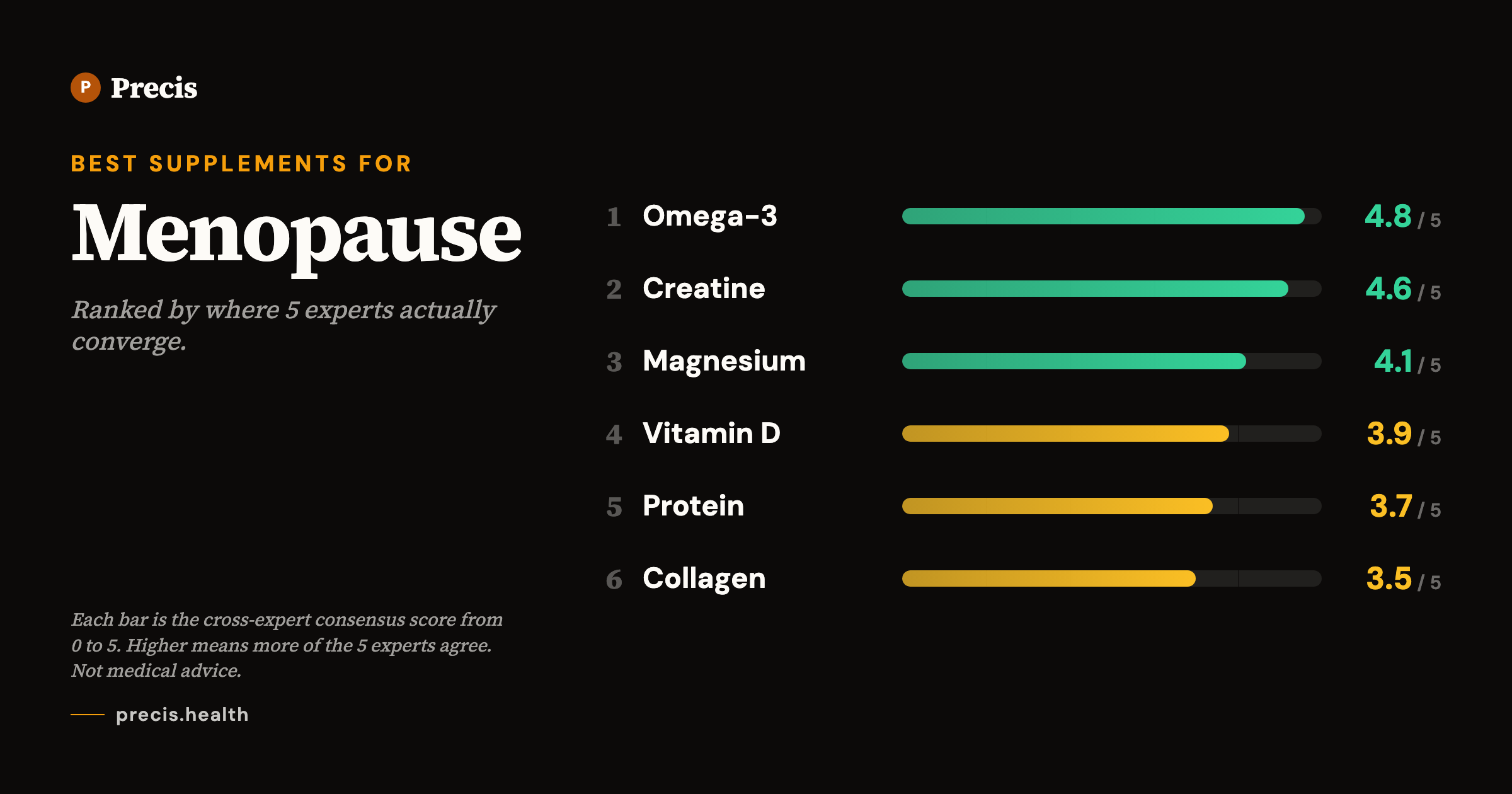
For menopause, the experts converge on foundations rather than anything menopause-specific: omega-3 (4.8/5 expert consensus), creatine (4.6/5), magnesium (4.1/5), vitamin D (3.9/5) and protein (3.7/5). Here's how each ranks.
Menopause itself — including whether to use hormone therapy — is a medical conversation for you and your doctor. But several supplements with strong expert consensus address the muscle, bone, mood, and sleep changes that come with this stage. These are ranked by how much our five experts actually agree, not by marketing.
Top Supplements for Menopause
Omega-3
All 5 experts actively recommend omega-3 supplementation, making this one of the strongest consensus topics. Patrick and Attia provide the deepest mechanistic coverage, Huberman recommends 1-3g EPA for mood and cognition, Hyman lists omega-3 as a foundational supplement everyone needs, and Johnson includes omega-3 sources in his Blueprint diet.
Creatine
All 5 experts actively recommend creatine — and the consensus has expanded well beyond muscle. Huberman, Attia, and Patrick each feature dedicated deep dives on creatine as brain fuel for cognition under stress, sleep deprivation, and aging — not just strength and hypertrophy. Johnson includes it in his Blueprint stack; Hyman names it one of six essential daily supplements for muscle mass, insulin sensitivity, and brain health as we age. The most common worry — elevated creatinine on bloodwork — is a harmless artifact of muscle metabolism, not kidney damage.
Magnesium
4 of 5 experts actively recommend magnesium supplementation. Patrick and Hyman are the strongest advocates, each discussing it across multiple videos. Attia recommends 300-500mg daily for bone health and personally supplements with three forms. Johnson's Blueprint stack does not explicitly include magnesium.
Vitamin D
4 of 5 experts recommend vitamin D supplementation for those with suboptimal levels, though Attia urges caution — arguing that the health benefits attributed to high vitamin D may actually come from the outdoor lifestyle needed to achieve them naturally. Patrick is the strongest advocate, citing a 40% reduction in dementia risk.
Protein
4 of 5 experts actively recommend more protein than the 0.8 g/kg RDA — converging on roughly 1.2-2 g/kg paired with resistance training (Johnson's coverage is thinner and plant-forward). The 'high protein shortens lifespan' fear traces mainly to guest Valter Longo's low-IGF-1 view; the core experts largely resolve it by noting that exercise redirects IGF-1 toward muscle and that sarcopenia — not mTOR — dominates aging risk after 50.
Collagen
4 of 5 experts support collagen for skin and connective tissue health, but Attia is notably skeptical — citing research showing collagen does not outperform whey protein for connective tissue synthesis. Johnson is the strongest advocate, taking collagen peptides daily in his Blueprint protocol. Huberman recommends it specifically for skin, not muscle. All experts agree collagen is inferior to whey for muscle building.
The Menopause Support Stack
Grounded in what the experts recommend for the muscle, bone, and mood changes of this stage:
- Creatine monohydrate — 5g daily; Hyman notes women produce less creatine and recommends it for muscle, cognition, and sleep support
- Omega-3 (EPA/DHA) — ~2g daily; Patrick links EPA/DHA to mood and Johnson specifically recommends omega-3 during menopause
- Vitamin D3 — 1,000-5,000 IU dosed to bloodwork; foundational for bone and immune health as estrogen declines (pair with K2 and magnesium per Hyman)
- Magnesium — 300-500mg glycinate or malate; supports sleep and relaxation (Patrick, Attia)
- Protein — 1.2-1.6 g/kg with resistance training to defend against accelerating muscle loss (Attia, Patrick)
Common Mistakes
Treating supplements as a substitute for the HRT conversation. Hormone therapy is a medical decision — these supplements address adjacent symptoms, not estrogen itself.
Skipping resistance training. Protein and creatine only protect muscle and bone when paired with strength work — every quantitative expert conditions the dose on training.
Counting magnesium threonate toward daily needs. Patrick warns its elemental magnesium is too low — use glycinate or malate for your daily magnesium.
Expecting collagen to build muscle. It helps skin (and possibly joints), but all 5 experts agree whey beats collagen for muscle.
Know what to take. Now learn exactly how.
This page shows you which supplements researchers agree on for menopause. Pro unlocks the specific protocols — exact dosages, timing, form recommendations, and interactions — so you can actually execute.
- Dosage protocols per expert with video sources
- Chat with 3,400+ expert videos — every answer cites real sources
- Interaction warnings so you don't cancel out benefits
Cancel anytime